

476
Climatic Geomorphology
meandering channel about 15 m wide which, after the floods of 1914, became a straight
bedload channel about 336 m wide. This dramatic change was interpreted as being due to
climatic fluctuations, agricultural activities, and the destruction of the natural vegetation.
Another no less surprising example is that of the Gila River that runs through Arizona
and New Mexico (Graf, 1988). Before 1890, the channel was narrow and meandering, but
in 1905 flooding modified it to become braided, and to have a width of 1 km in some
places. Later, the growth of vegetation and sedimentation narrowed the channel, and by
1980 - almost a century later - it had returned to its old meandering nature. These results
show that the change from braided to meandering channels occurs much more slowly than
in the opposite direction.
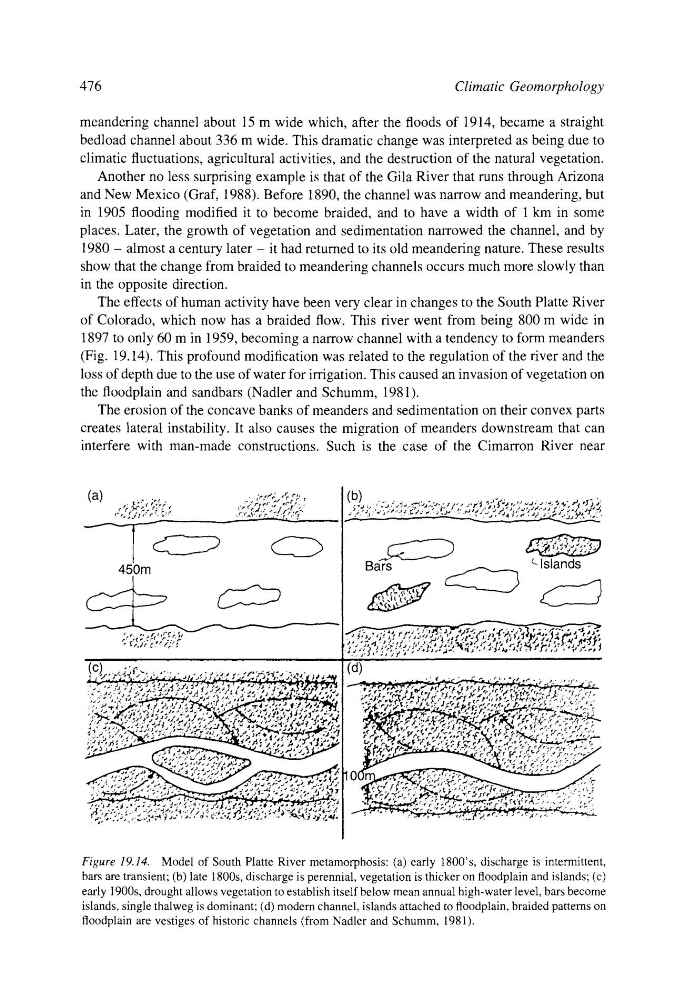
The effects of human activity have been very clear in changes to the South Platte River
of Colorado, which now has a braided flow. This fiver went from being 800 m wide in
1897 to only 60 m in 1959, becoming a narrow channel with a tendency to form meanders
(Fig. 19.14). This profound modification was related to the regulation of the river and the
loss of depth due to the use of water for irrigation. This caused an invasion of vegetation on
the floodplain and sandbars (Nadler and Schumm, 1981).
The erosion of the concave banks of meanders and sedimentation on their convex parts
creates lateral instability. It also causes the migration of meanders downstream that can
interfere with man-made constructions. Such is the case of the Cimarron River near
.
",',,"/ ,"r ""
(a)
,. .r"< ;,:'..i,
."-' :, ..... ,-'.<'
,-,.r.l,,.
, .. :.
. .~-~'.~ ." ":' i ",::~
450m
I (C l
"~'" 9, '" " ~'-'~"
,.'t~?
;:-'~ ,,-~'...'TZ~.~'f
1".~ ,.. ,. ;.,
.
/ ,., ,..s~'~ ~''
.a #
.
~~~.
9 ..,.7. ~. * -,"a,.4.'.~ ..,,y..,.~.,
(b)
......
,"
9
t '';.,
.,
" 9 --' s- ;,'
.,
. ....,~.~j
.~..
~.,.,
.$. .~ i~l),....t...a. ~A~
9
c. Islands
..' ~'J.,' ~: 5Y J, J-'.~tJS,'l '
~
"
?~t"7./J~:.,2"~
9 j ga
jl'r..~a~s,'i
ja,a.~
#,
.~j,ij(d)
_
..,
....
, .....
,,,.~
,: ..... ,
..
~,~,< 9 v,., ,,,,
,.~-,. r,,
9 r~;7,-: r.?~'l,.~'~%.:,;L-./
0
,..?.
9
,
"..:,.rl,~ "
Figure 19.14. Model of South Platte River metamorphosis: (a) early 1800's, discharge is intermittent,
bars are transient; (b) late 1800s, discharge is perennial, vegetation is thicker on floodplain and islands; (c)
early 1900s, drought allows vegetation to establish itself below mean annual high-water level, bars become
islands, single thalweg is dominant; (d) modern channel, islands attached to floodplain, braided patterns on
floodplain are vestiges of historic channels (from Nadler and Schumm, 1981).
Climatic Geomorphology
meandering channel about 15 m wide which, after the floods of 1914, became a straight
bedload channel about 336 m wide. This dramatic change was interpreted as being due to
climatic fluctuations, agricultural activities, and the destruction of the natural vegetation.
Another no less surprising example is that of the Gila River that runs through Arizona
and New Mexico (Graf, 1988). Before 1890, the channel was narrow and meandering, but
in 1905 flooding modified it to become braided, and to have a width of 1 km in some
places. Later, the growth of vegetation and sedimentation narrowed the channel, and by
1980 - almost a century later - it had returned to its old meandering nature. These results
show that the change from braided to meandering channels occurs much more slowly than
in the opposite direction.
The effects of human activity have been very clear in changes to the South Platte River
of Colorado, which now has a braided flow. This fiver went from being 800 m wide in
1897 to only 60 m in 1959, becoming a narrow channel with a tendency to form meanders
(Fig. 19.14). This profound modification was related to the regulation of the river and the
loss of depth due to the use of water for irrigation. This caused an invasion of vegetation on
the floodplain and sandbars (Nadler and Schumm, 1981).
The erosion of the concave banks of meanders and sedimentation on their convex parts
creates lateral instability. It also causes the migration of meanders downstream that can
interfere with man-made constructions. Such is the case of the Cimarron River near
.
",',,"/ ,"r ""
(a)
,. .r"< ;,:'..i,
."-' :, ..... ,-'.<'
,-,.r.l,,.
, .. :.
. .~-~'.~ ." ":' i ",::~
450m
I (C l
"~'" 9, '" " ~'-'~"
,.'t~?
;:-'~ ,,-~'...'TZ~.~'f
1".~ ,.. ,. ;.,
.
/ ,., ,..s~'~ ~''
.a #
.
~~~.
9 ..,.7. ~. * -,"a,.4.'.~ ..,,y..,.~.,
(b)
......
,"
9
t '';.,
.,
" 9 --' s- ;,'
.,
. ....,~.~j
.~..
~.,.,
.$. .~ i~l),....t...a. ~A~
9
c. Islands
..' ~'J.,' ~: 5Y J, J-'.~tJS,'l '
~
"
?~t"7./J~:.,2"~
9 j ga
jl'r..~a~s,'i
ja,a.~
#,
.~j,ij(d)
_
..,
....
, .....
,,,.~
,: ..... ,
..
~,~,< 9 v,., ,,,,
,.~-,. r,,
9 r~;7,-: r.?~'l,.~'~%.:,;L-./
0
,..?.
9
,
"..:,.rl,~ "
Figure 19.14. Model of South Platte River metamorphosis: (a) early 1800's, discharge is intermittent,
bars are transient; (b) late 1800s, discharge is perennial, vegetation is thicker on floodplain and islands; (c)
early 1900s, drought allows vegetation to establish itself below mean annual high-water level, bars become
islands, single thalweg is dominant; (d) modern channel, islands attached to floodplain, braided patterns on
floodplain are vestiges of historic channels (from Nadler and Schumm, 1981).