

Aeolian accumulations
457
with high dust content are followed by others with small or nonexistent quantities of dust,
indicating the alternation of periods with high and low aridity.
5.5. Loess
Loess, a term derived from the German lgss, is a clastic terrestrial sediment, composed
essentially of particles of a silt size and formed by the accumulation of aeolian dust (Pye,
1995). It presents a variety of colours; gray, white, yellow, brown, and red. It is possible to
differentiate between primary loess, with an aeolian origin, and secondary loess,
redeposited or originated by nonaeolian processes. In loess outcrops, a certain degree of
chemical and biological weathering occurs, and also edaphogenic processes.
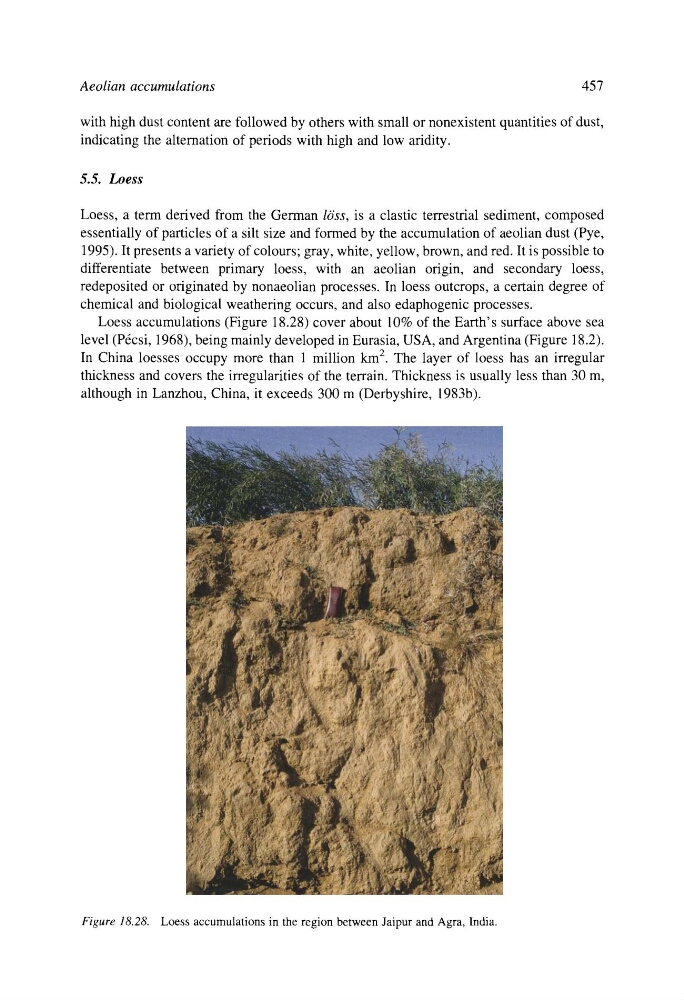
Loess accumulations (Figure 18.28) cover about 10% of the Earth's surface above sea
level (Prcsi, 1968), being mainly developed in Eurasia, USA, and Argentina (Figure 18.2).
In China loesses occupy more than 1 million km 2. The layer of loess has an irregular
thickness and covers the irregularities of the terrain. Thickness is usually less than 30 m,
although in Lanzhou, China, it exceeds 300 m (Derbyshire, 1983b).
Figure 18.28. Loess accumulations in the region between Jaipur and Agra, India.
457
with high dust content are followed by others with small or nonexistent quantities of dust,
indicating the alternation of periods with high and low aridity.
5.5. Loess
Loess, a term derived from the German lgss, is a clastic terrestrial sediment, composed
essentially of particles of a silt size and formed by the accumulation of aeolian dust (Pye,
1995). It presents a variety of colours; gray, white, yellow, brown, and red. It is possible to
differentiate between primary loess, with an aeolian origin, and secondary loess,
redeposited or originated by nonaeolian processes. In loess outcrops, a certain degree of
chemical and biological weathering occurs, and also edaphogenic processes.
Loess accumulations (Figure 18.28) cover about 10% of the Earth's surface above sea
level (Prcsi, 1968), being mainly developed in Eurasia, USA, and Argentina (Figure 18.2).
In China loesses occupy more than 1 million km 2. The layer of loess has an irregular
thickness and covers the irregularities of the terrain. Thickness is usually less than 30 m,
although in Lanzhou, China, it exceeds 300 m (Derbyshire, 1983b).
Figure 18.28. Loess accumulations in the region between Jaipur and Agra, India.