

Aeolian processes and erosive landforms
423
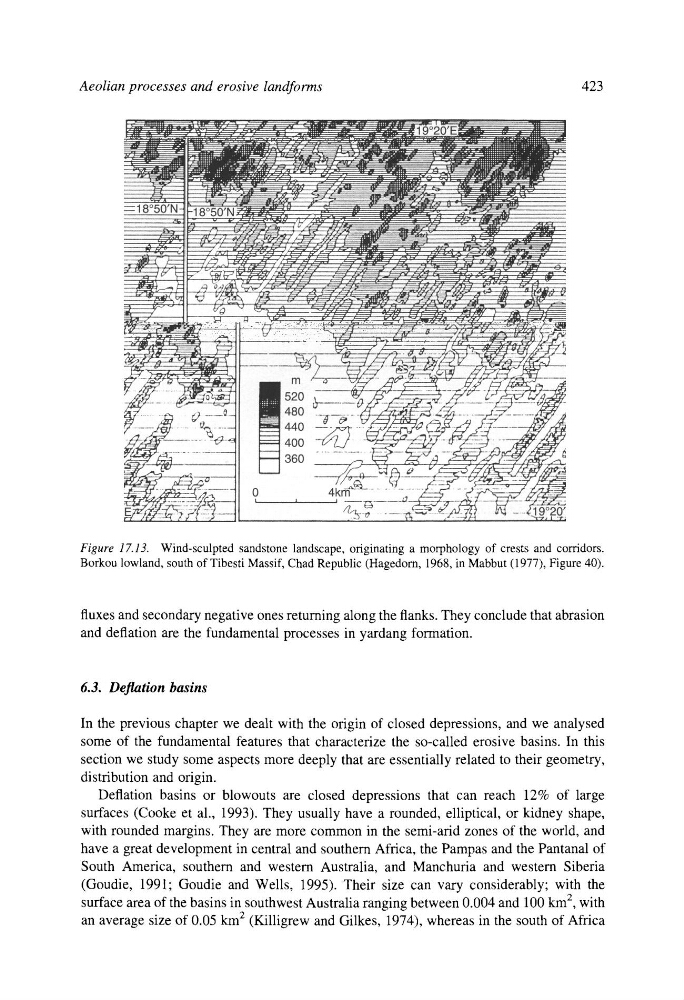
Figure 17.13. Wind-sculpted sandstone landscape, originating a morphology of crests and corridors.
Borkou lowland, south of Tibesti Massif, Chad Republic (Hagedorn, 1968, in Mabbut (1977), Figure 40).
fluxes and secondary negative ones returning along the flanks. They conclude that abrasion
and deflation are the fundamental processes in yardang formation.
6.3. Deflation basins
In the previous chapter we dealt with the origin of closed depressions, and we analysed
some of the fundamental features that characterize the so-called erosive basins. In this
section we study some aspects more deeply that are essentially related to their geometry,
distribution and origin.
Deflation basins or blowouts are closed depressions that can reach 12% of large
surfaces (Cooke et al., 1993). They usually have a rounded, elliptical, or kidney shape,
with rounded margins. They are more common in the semi-arid zones of the world, and
have a great development in central and southern Africa, the Pampas and the Pantanal of
South America, southern and western Australia, and Manchuria and western Siberia
(Goudie, 1991; Goudie and Wells, 1995). Their size can vary considerably; with the
surface area of the basins in southwest Australia ranging between 0.004 and 100 km 2, with
an average size of 0.05 km 2 (Killigrew and Gilkes, 1974), whereas in the south of Africa
423
Figure 17.13. Wind-sculpted sandstone landscape, originating a morphology of crests and corridors.
Borkou lowland, south of Tibesti Massif, Chad Republic (Hagedorn, 1968, in Mabbut (1977), Figure 40).
fluxes and secondary negative ones returning along the flanks. They conclude that abrasion
and deflation are the fundamental processes in yardang formation.
6.3. Deflation basins
In the previous chapter we dealt with the origin of closed depressions, and we analysed
some of the fundamental features that characterize the so-called erosive basins. In this
section we study some aspects more deeply that are essentially related to their geometry,
distribution and origin.
Deflation basins or blowouts are closed depressions that can reach 12% of large
surfaces (Cooke et al., 1993). They usually have a rounded, elliptical, or kidney shape,
with rounded margins. They are more common in the semi-arid zones of the world, and
have a great development in central and southern Africa, the Pampas and the Pantanal of
South America, southern and western Australia, and Manchuria and western Siberia
(Goudie, 1991; Goudie and Wells, 1995). Their size can vary considerably; with the
surface area of the basins in southwest Australia ranging between 0.004 and 100 km 2, with
an average size of 0.05 km 2 (Killigrew and Gilkes, 1974), whereas in the south of Africa