

The arid region piedmonts: glacis and alluvial fans
353
/
+
-t+
..
1 ......
a m 9
desiccated during dry season
s
+
+
+
-,3""
" Sr - 7- "
+
+
~."
+
+
+
(a)
/
+
f
+
+
+
+
+
+
+
+
./
+
~
+
(b)
/
+
+
+
+
+
j
+
+
+
+
+
(C) +
+
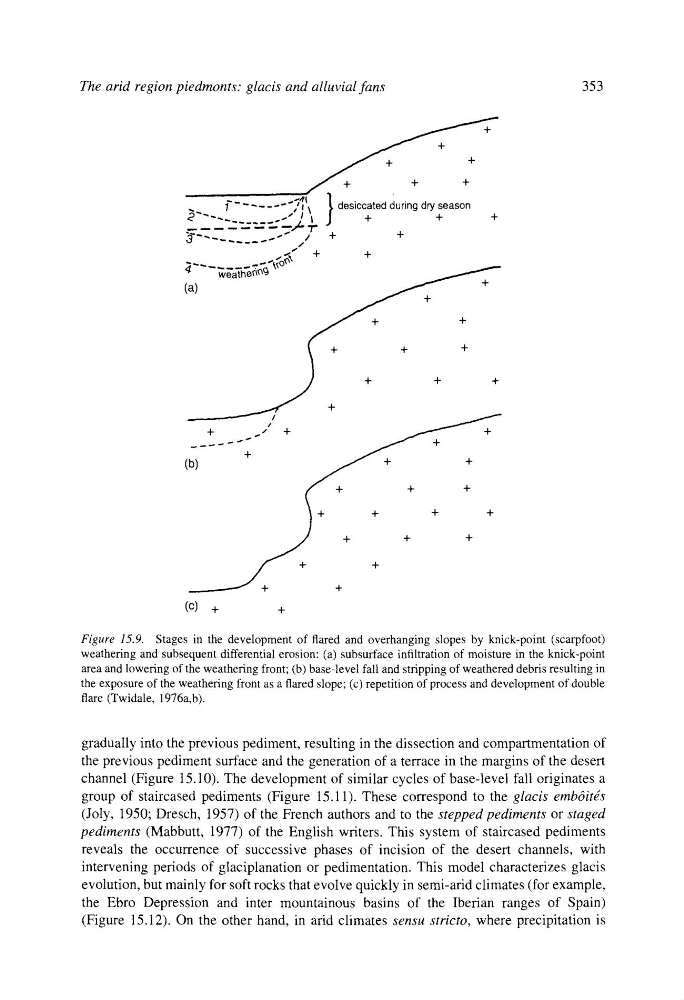
Figure 15.9. Stages in the development of flared and overhanging slopes by knick-point (scarpfoot)
weathering and subsequent differential erosion: (a) subsurface infiltration of moisture in the knick-point
area and lowering of the weathering front; (b) base-level fall and stripping of weathered debris resulting in
the exposure of the weathering front as a flared slope; (c) repetition of process and development of double
flare (Twidale, 1976a,b).
gradually into the previous pediment, resulting in the dissection and compartmentation of
the previous pediment surface and the generation of a terrace in the margins of the desert
channel (Figure 15.10). The development of similar cycles of base-level fall originates a
group of staircased pediments (Figure 15.11). These correspond to the glacis embfitds
(Joly, 1950; Dresch, 1957) of the French authors and to the stepped pediments or staged
pediments (Mabbutt, 1977) of the English writers. This system of staircased pediments
reveals the occurrence of successive phases of incision of the desert channels, with
intervening periods of glaciplanation or pedimentation. This model characterizes glacis
evolution, but mainly for soft rocks that evolve quickly in semi-arid climates (for example,
the Ebro Depression and inter mountainous basins of the Iberian ranges of Spain)
(Figure 15.12). On the other hand, in arid climates sensu stricto, where precipitation is
353
/
+
-t+
..
1 ......
a m 9
desiccated during dry season
s
+
+
+
-,3""
" Sr - 7- "
+
+
~."
+
+
+
(a)
/
+
f
+
+
+
+
+
+
+
+
./
+
~
+
(b)
/
+
+
+
+
+
j
+
+
+
+
+
(C) +
+
Figure 15.9. Stages in the development of flared and overhanging slopes by knick-point (scarpfoot)
weathering and subsequent differential erosion: (a) subsurface infiltration of moisture in the knick-point
area and lowering of the weathering front; (b) base-level fall and stripping of weathered debris resulting in
the exposure of the weathering front as a flared slope; (c) repetition of process and development of double
flare (Twidale, 1976a,b).
gradually into the previous pediment, resulting in the dissection and compartmentation of
the previous pediment surface and the generation of a terrace in the margins of the desert
channel (Figure 15.10). The development of similar cycles of base-level fall originates a
group of staircased pediments (Figure 15.11). These correspond to the glacis embfitds
(Joly, 1950; Dresch, 1957) of the French authors and to the stepped pediments or staged
pediments (Mabbutt, 1977) of the English writers. This system of staircased pediments
reveals the occurrence of successive phases of incision of the desert channels, with
intervening periods of glaciplanation or pedimentation. This model characterizes glacis
evolution, but mainly for soft rocks that evolve quickly in semi-arid climates (for example,
the Ebro Depression and inter mountainous basins of the Iberian ranges of Spain)
(Figure 15.12). On the other hand, in arid climates sensu stricto, where precipitation is