

The arid region piedmonts: glacis and alluvial fans
351
37Q
~0
-5
97~,q
,
17.~ g' 6.s
4.7
3.6
120
%,
\ \75
.....
~ ......
, 4~
!
4
i
30L. ~]
..~
O0
30 CENTIMETERS
901",~ 6.0
~
~ ..................
25
_
6
~
5
I
4
3
I
2.5
I
2
I
77,3~_~_
o
,
1 7
5.5
-5
4
90
5 ~
95 ~_
_ _
10
~,'~~ ,~"~7, ~-~-~ ~,
5
I
3.5
!
3
1
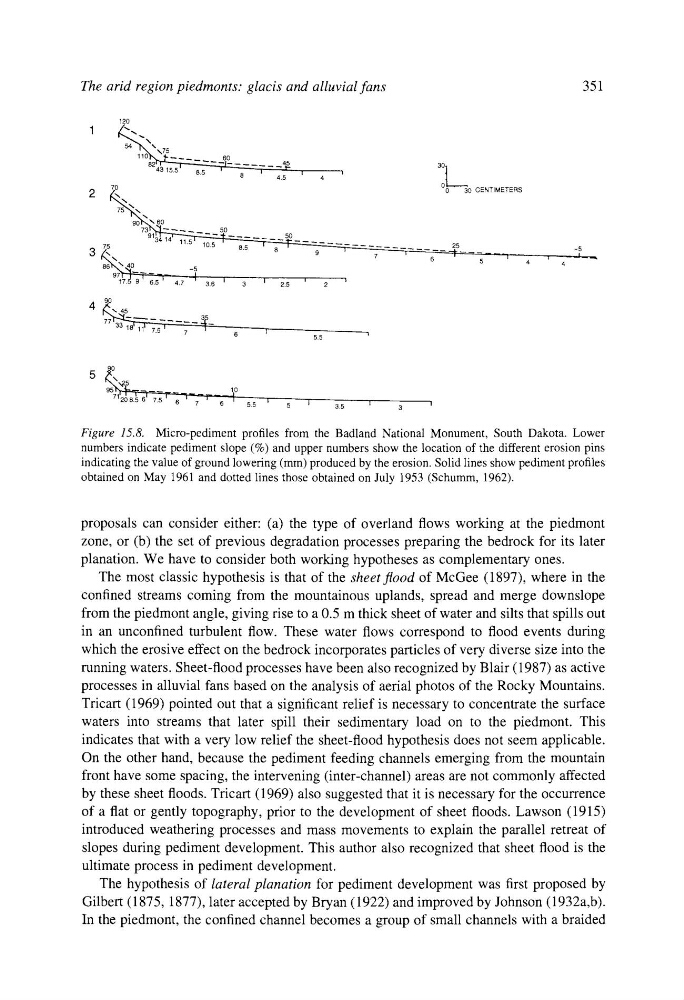
Figure 15.8. Micro-pediment profiles from the Badland National Monument, South Dakota. Lower
numbers indicate pediment slope (%) and upper numbers show the location of the different erosion pins
indicating the value of ground lowering (mm) produced by the erosion. Solid lines show pediment profiles
obtained on May 1961 and dotted lines those obtained on July 1953 (Schumm, 1962).
proposals can consider either: (a) the type of overland flows working at the piedmont
zone, or (b) the set of previous degradation processes preparing the bedrock for its later
planation. We have to consider both working hypotheses as complementary ones.
The most classic hypothesis is that of the sheet flood of McGee (1897), where in the
confined streams coming from the mountainous uplands, spread and merge downslope
from the piedmont angle, giving rise to a 0.5 m thick sheet of water and silts that spills out
in an unconfined turbulent flow. These water flows correspond to flood events during
which the erosive effect on the bedrock incorporates particles of very diverse size into the
running waters. Sheet-flood processes have been also recognized by Blair (1987) as active
processes in alluvial fans based on the analysis of aerial photos of the Rocky Mountains.
Tricart (1969) pointed out that a significant relief is necessary to concentrate the surface
waters into streams that later spill their sedimentary load on to the piedmont. This
indicates that with a very low relief the sheet-flood hypothesis does not seem applicable.
On the other hand, because the pediment feeding channels emerging from the mountain
front have some spacing, the intervening (inter-channel) areas are not commonly affected
by these sheet floods. Tricart (1969) also suggested that it is necessary for the occurrence
of a flat or gently topography, prior to the development of sheet floods. Lawson (1915)
introduced weathering processes and mass movements to explain the parallel retreat of
slopes during pediment development. This author also recognized that sheet flood is the
ultimate process in pediment development.
The hypothesis of lateral planation for pediment development was first proposed by
Gilbert (1875, 1877), later accepted by Bryan (1922) and improved by Johnson (1932a,b).
In the piedmont, the confined channel becomes a group of small channels with a braided
351
37Q
~0
-5
97~,q
,
17.~ g' 6.s
4.7
3.6
120
%,
\ \75
.....
~ ......
, 4~
!
4
i
30L. ~]
..~
O0
30 CENTIMETERS
901",~ 6.0
~
~ ..................
25
_
6
~
5
I
4
3
I
2.5
I
2
I
77,3~_~_
o
,
1 7
5.5
-5
4
90
5 ~
95 ~_
_ _
10
~,'~~ ,~"~7, ~-~-~ ~,
5
I
3.5
!
3
1
Figure 15.8. Micro-pediment profiles from the Badland National Monument, South Dakota. Lower
numbers indicate pediment slope (%) and upper numbers show the location of the different erosion pins
indicating the value of ground lowering (mm) produced by the erosion. Solid lines show pediment profiles
obtained on May 1961 and dotted lines those obtained on July 1953 (Schumm, 1962).
proposals can consider either: (a) the type of overland flows working at the piedmont
zone, or (b) the set of previous degradation processes preparing the bedrock for its later
planation. We have to consider both working hypotheses as complementary ones.
The most classic hypothesis is that of the sheet flood of McGee (1897), where in the
confined streams coming from the mountainous uplands, spread and merge downslope
from the piedmont angle, giving rise to a 0.5 m thick sheet of water and silts that spills out
in an unconfined turbulent flow. These water flows correspond to flood events during
which the erosive effect on the bedrock incorporates particles of very diverse size into the
running waters. Sheet-flood processes have been also recognized by Blair (1987) as active
processes in alluvial fans based on the analysis of aerial photos of the Rocky Mountains.
Tricart (1969) pointed out that a significant relief is necessary to concentrate the surface
waters into streams that later spill their sedimentary load on to the piedmont. This
indicates that with a very low relief the sheet-flood hypothesis does not seem applicable.
On the other hand, because the pediment feeding channels emerging from the mountain
front have some spacing, the intervening (inter-channel) areas are not commonly affected
by these sheet floods. Tricart (1969) also suggested that it is necessary for the occurrence
of a flat or gently topography, prior to the development of sheet floods. Lawson (1915)
introduced weathering processes and mass movements to explain the parallel retreat of
slopes during pediment development. This author also recognized that sheet flood is the
ultimate process in pediment development.
The hypothesis of lateral planation for pediment development was first proposed by
Gilbert (1875, 1877), later accepted by Bryan (1922) and improved by Johnson (1932a,b).
In the piedmont, the confined channel becomes a group of small channels with a braided