

330
Climatic Geomorphology
(a)
(b)
(c)
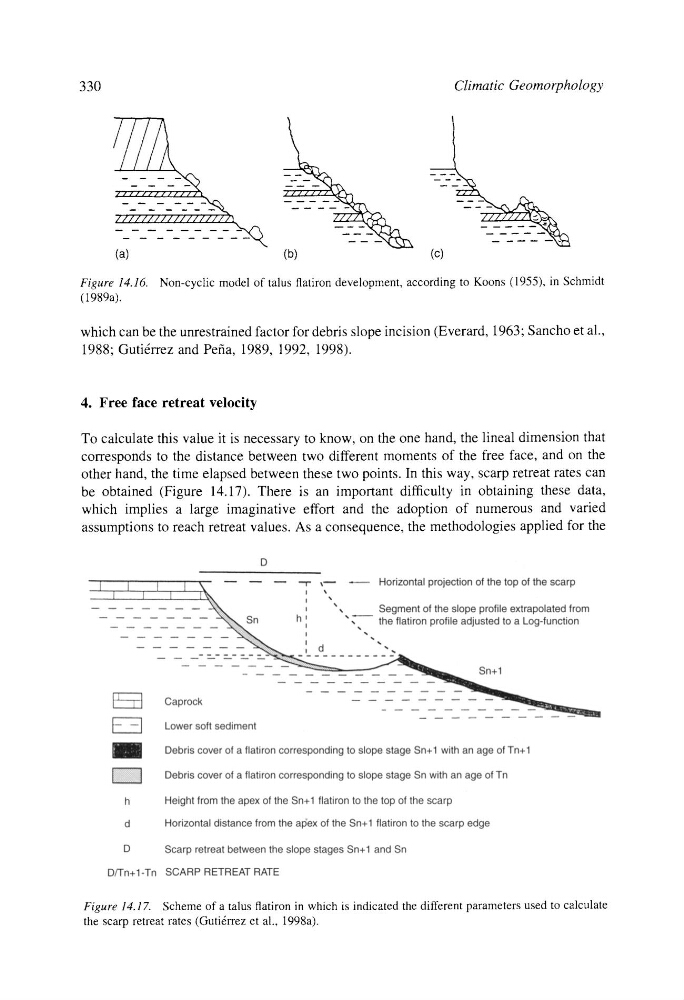
Figure 14.16. Non-cyclic model of talus flatiron development, according to Koons (1955), in Schmidt
(1989a).
which can be the unrestrained factor for debris slope incision (Everard, 1963; Sancho et al.,
1988; Guti6rrez and Pefia, 1989, 1992, 1998).
4. Free face retreat velocity
To calculate this value it is necessary to know, on the one hand, the lineal dimension that
corresponds to the distance between two different moments of the free face, and on the
other hand, the time elapsed between these two points. In this way, scarp retreat rates can
be obtained (Figure 14.17). There is an important difficulty in obtaining these data,
which implies a large imaginative effort and the adoption of numerous and varied
assumptions to reach retreat values. As a consequence, the methodologies applied for the
Figure 14.17. Scheme of a talus flatiron in which is indicated the different parameters used to calculate
the scarp retreat rates (Guti6rrez et al., 1998a).
Climatic Geomorphology
(a)
(b)
(c)
Figure 14.16. Non-cyclic model of talus flatiron development, according to Koons (1955), in Schmidt
(1989a).
which can be the unrestrained factor for debris slope incision (Everard, 1963; Sancho et al.,
1988; Guti6rrez and Pefia, 1989, 1992, 1998).
4. Free face retreat velocity
To calculate this value it is necessary to know, on the one hand, the lineal dimension that
corresponds to the distance between two different moments of the free face, and on the
other hand, the time elapsed between these two points. In this way, scarp retreat rates can
be obtained (Figure 14.17). There is an important difficulty in obtaining these data,
which implies a large imaginative effort and the adoption of numerous and varied
assumptions to reach retreat values. As a consequence, the methodologies applied for the
Figure 14.17. Scheme of a talus flatiron in which is indicated the different parameters used to calculate
the scarp retreat rates (Guti6rrez et al., 1998a).