

Slopes in arid zones
321
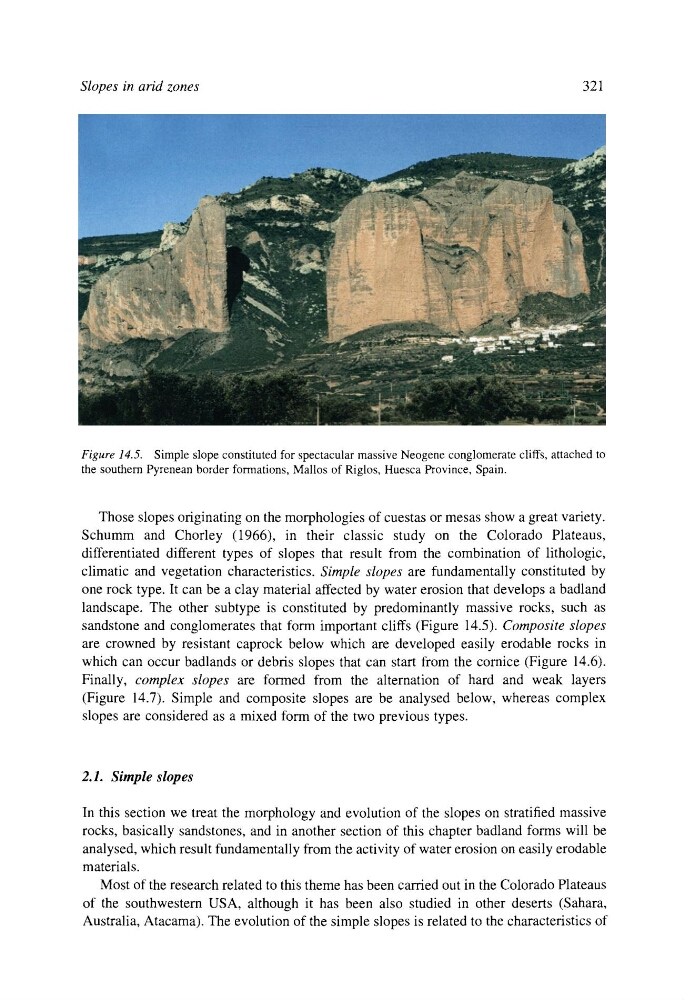
Figure 14.5. Simple slope constituted for spectacular massive Neogene conglomerate cliffs, attached to
the southern Pyrenean border formations, Mallos of Riglos, Huesca Province, Spain.
Those slopes originating on the morphologies of cuestas or mesas show a great variety.
Schumm and Chorley (1966), in their classic study on the Colorado Plateaus,
differentiated different types of slopes that result from the combination of lithologic,
climatic and vegetation characteristics. Simple slopes are fundamentally constituted by
one rock type. It can be a clay material affected by water erosion that develops a badland
landscape. The other subtype is constituted by predominantly massive rocks, such as
sandstone and conglomerates that form important cliffs (Figure 14.5). Composite slopes
are crowned by resistant caprock below which are developed easily erodable rocks in
which can occur badlands or debris slopes that can start from the cornice (Figure 14.6).
Finally, complex slopes are formed from the alternation of hard and weak layers
(Figure 14.7). Simple and composite slopes are be analysed below, whereas complex
slopes are considered as a mixed form of the two previous types.
2.1. Simple slopes
In this section we treat the morphology and evolution of the slopes on stratified massive
rocks, basically sandstones, and in another section of this chapter badland forms will be
analysed, which result fundamentally from the activity of water erosion on easily erodable
materials.
Most of the research related to this theme has been carried out in the Colorado Plateaus
of the southwestern USA, although it has been also studied in other deserts (Sahara,
Australia, Atacama). The evolution of the simple slopes is related to the characteristics of
321
Figure 14.5. Simple slope constituted for spectacular massive Neogene conglomerate cliffs, attached to
the southern Pyrenean border formations, Mallos of Riglos, Huesca Province, Spain.
Those slopes originating on the morphologies of cuestas or mesas show a great variety.
Schumm and Chorley (1966), in their classic study on the Colorado Plateaus,
differentiated different types of slopes that result from the combination of lithologic,
climatic and vegetation characteristics. Simple slopes are fundamentally constituted by
one rock type. It can be a clay material affected by water erosion that develops a badland
landscape. The other subtype is constituted by predominantly massive rocks, such as
sandstone and conglomerates that form important cliffs (Figure 14.5). Composite slopes
are crowned by resistant caprock below which are developed easily erodable rocks in
which can occur badlands or debris slopes that can start from the cornice (Figure 14.6).
Finally, complex slopes are formed from the alternation of hard and weak layers
(Figure 14.7). Simple and composite slopes are be analysed below, whereas complex
slopes are considered as a mixed form of the two previous types.
2.1. Simple slopes
In this section we treat the morphology and evolution of the slopes on stratified massive
rocks, basically sandstones, and in another section of this chapter badland forms will be
analysed, which result fundamentally from the activity of water erosion on easily erodable
materials.
Most of the research related to this theme has been carried out in the Colorado Plateaus
of the southwestern USA, although it has been also studied in other deserts (Sahara,
Australia, Atacama). The evolution of the simple slopes is related to the characteristics of