

The action of water in arid regions
313
l li
P%///
FLOOD
FLOOD
FLOOD
EVENT
EVENT
EVENT
1
2
3
9
9
9
'el
jjjj+:j
ill 0
,0
~176 W
j,,,lla
~/////////
////////~/~ Y/I/I/Ill/
'~l134,,, i~
'~II 391,
1,,, t l]
6
6
6
9 m 3 s -1
33 m 3 s -1
18 m 3 s -1
14
16
35
65
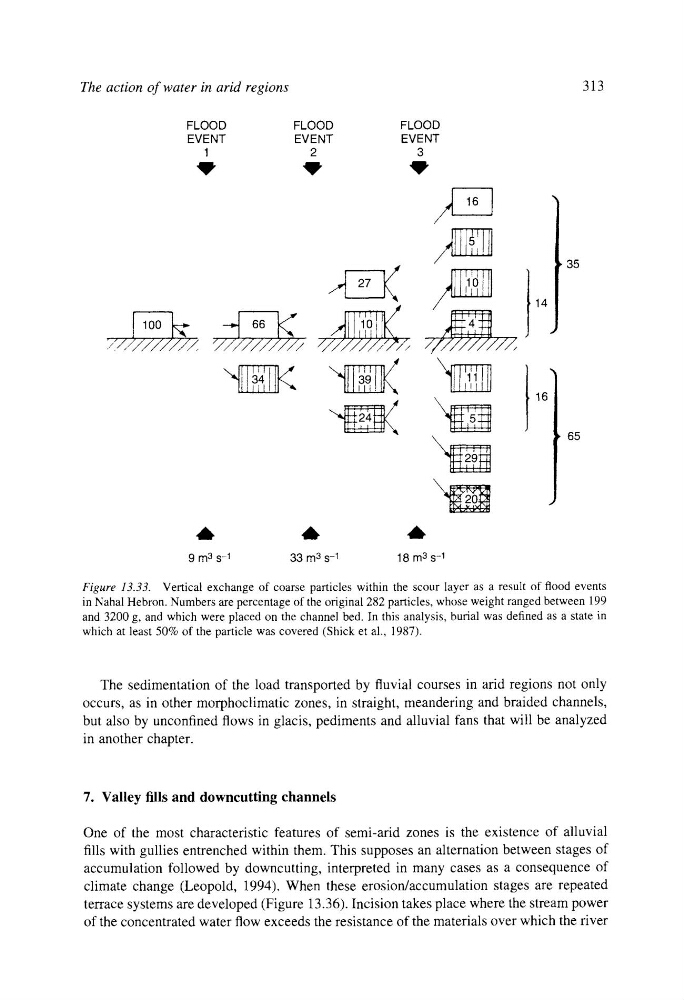
Figure 13.33. Vertical exchange of coarse particles within the scour layer as a result of flood events
in Nahal Hebron. Numbers are percentage of the original 282 particles, whose weight ranged between 199
and 3200 g, and which were placed on the channel bed. In this analysis, burial was defined as a state in
which at least 50% of the particle was covered (Shick et al., 1987).
The sedimentation of the load transported by fluvial courses in arid regions not only
occurs, as in other morphoclimatic zones, in straight, meandering and braided channels,
but also by unconfined flows in glacis, pediments and alluvial fans that will be analyzed
in another chapter.
7. Valley fills and downcutting channels
One of the most characteristic features of semi-arid zones is the existence of alluvial
fills with gullies entrenched within them. This supposes an alternation between stages of
accumulation followed by downcutting, interpreted in many cases as a consequence of
climate change (Leopold, 1994). When these erosion/accumulation stages are repeated
terrace systems are developed (Figure 13.36). Incision takes place where the stream power
of the concentrated water flow exceeds the resistance of the materials over which the fiver
313
l li
P%///
FLOOD
FLOOD
FLOOD
EVENT
EVENT
EVENT
1
2
3
9
9
9
'el
jjjj+:j
ill 0
,0
~176 W
j,,,lla
~/////////
////////~/~ Y/I/I/Ill/
'~l134,,, i~
'~II 391,
1,,, t l]
6
6
6
9 m 3 s -1
33 m 3 s -1
18 m 3 s -1
14
16
35
65
Figure 13.33. Vertical exchange of coarse particles within the scour layer as a result of flood events
in Nahal Hebron. Numbers are percentage of the original 282 particles, whose weight ranged between 199
and 3200 g, and which were placed on the channel bed. In this analysis, burial was defined as a state in
which at least 50% of the particle was covered (Shick et al., 1987).
The sedimentation of the load transported by fluvial courses in arid regions not only
occurs, as in other morphoclimatic zones, in straight, meandering and braided channels,
but also by unconfined flows in glacis, pediments and alluvial fans that will be analyzed
in another chapter.
7. Valley fills and downcutting channels
One of the most characteristic features of semi-arid zones is the existence of alluvial
fills with gullies entrenched within them. This supposes an alternation between stages of
accumulation followed by downcutting, interpreted in many cases as a consequence of
climate change (Leopold, 1994). When these erosion/accumulation stages are repeated
terrace systems are developed (Figure 13.36). Incision takes place where the stream power
of the concentrated water flow exceeds the resistance of the materials over which the fiver