

Desert surfaces: pavements, patterned ground, varnishes and crusts
273
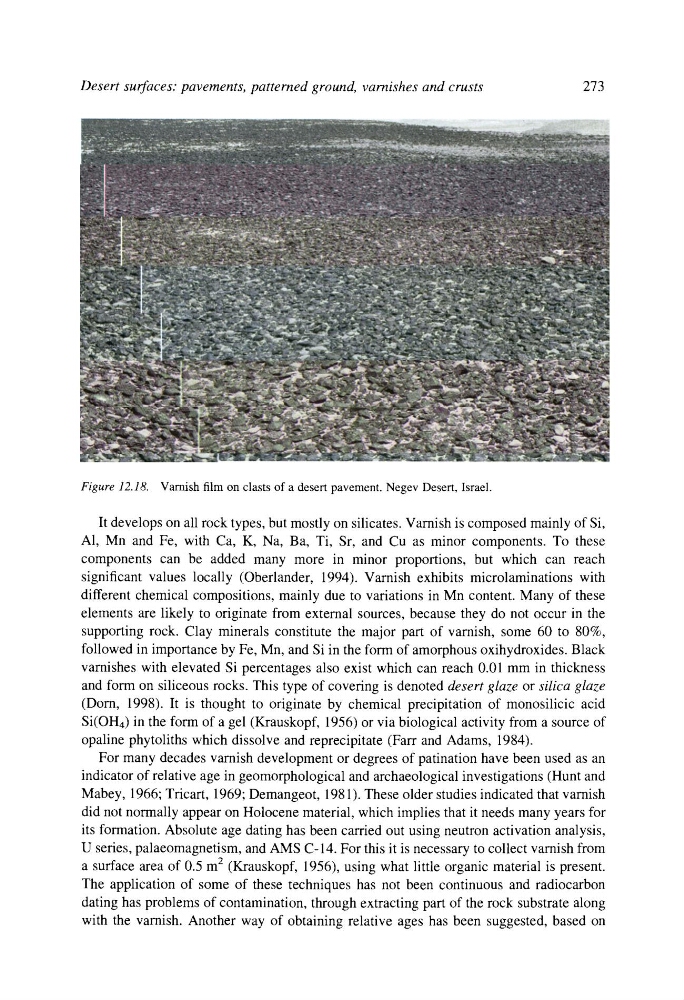
Figure 12.18. Varnish film on clasts of a desert pavement. Negev Desert, Israel.
It develops on all rock types, but mostly on silicates. Varnish is composed mainly of Si,
A1, Mn and Fe, with Ca, K, Na, Ba, Ti, Sr, and Cu as minor components. To these
components can be added many more in minor proportions, but which can reach
significant values locally (Oberlander, 1994). Varnish exhibits microlaminations with
different chemical compositions, mainly due to variations in Mn content. Many of these
elements are likely to originate from external sources, because they do not occur in the
supporting rock. Clay minerals constitute the major part of varnish, some 60 to 80%,
followed in importance by Fe, Mn, and Si in the form of amorphous oxihydroxides. Black
varnishes with elevated Si percentages also exist which can reach 0.01 mm in thickness
and form on siliceous rocks. This type of coveting is denoted desert glaze or silica glaze
(Dorn, 1998). It is thought to originate by chemical precipitation of monosilicic acid
Si(OH4) in the form of a gel (Krauskopf, 1956) or via biological activity from a source of
opaline phytoliths which dissolve and reprecipitate (Farr and Adams, 1984).
For many decades varnish development or degrees of patination have been used as an
indicator of relative age in geomorphological and archaeological investigations (Hunt and
Mabey, 1966; Tricart, 1969; Demangeot, 1981). These older studies indicated that varnish
did not normally appear on Holocene material, which implies that it needs many years for
its formation. Absolute age dating has been carried out using neutron activation analysis,
U series, palaeomagnetism, and AMS C- 14. For this it is necessary to collect varnish from
a surface area of 0.5 m 2 (Krauskopf, 1956), using what little organic material is present.
The application of some of these techniques has not been continuous and radiocarbon
dating has problems of contamination, through extracting part of the rock substrate along
with the varnish. Another way of obtaining relative ages has been suggested, based on
273
Figure 12.18. Varnish film on clasts of a desert pavement. Negev Desert, Israel.
It develops on all rock types, but mostly on silicates. Varnish is composed mainly of Si,
A1, Mn and Fe, with Ca, K, Na, Ba, Ti, Sr, and Cu as minor components. To these
components can be added many more in minor proportions, but which can reach
significant values locally (Oberlander, 1994). Varnish exhibits microlaminations with
different chemical compositions, mainly due to variations in Mn content. Many of these
elements are likely to originate from external sources, because they do not occur in the
supporting rock. Clay minerals constitute the major part of varnish, some 60 to 80%,
followed in importance by Fe, Mn, and Si in the form of amorphous oxihydroxides. Black
varnishes with elevated Si percentages also exist which can reach 0.01 mm in thickness
and form on siliceous rocks. This type of coveting is denoted desert glaze or silica glaze
(Dorn, 1998). It is thought to originate by chemical precipitation of monosilicic acid
Si(OH4) in the form of a gel (Krauskopf, 1956) or via biological activity from a source of
opaline phytoliths which dissolve and reprecipitate (Farr and Adams, 1984).
For many decades varnish development or degrees of patination have been used as an
indicator of relative age in geomorphological and archaeological investigations (Hunt and
Mabey, 1966; Tricart, 1969; Demangeot, 1981). These older studies indicated that varnish
did not normally appear on Holocene material, which implies that it needs many years for
its formation. Absolute age dating has been carried out using neutron activation analysis,
U series, palaeomagnetism, and AMS C- 14. For this it is necessary to collect varnish from
a surface area of 0.5 m 2 (Krauskopf, 1956), using what little organic material is present.
The application of some of these techniques has not been continuous and radiocarbon
dating has problems of contamination, through extracting part of the rock substrate along
with the varnish. Another way of obtaining relative ages has been suggested, based on