

Desert surfaces: pavements, patterned ground, varnishes and crusts
261
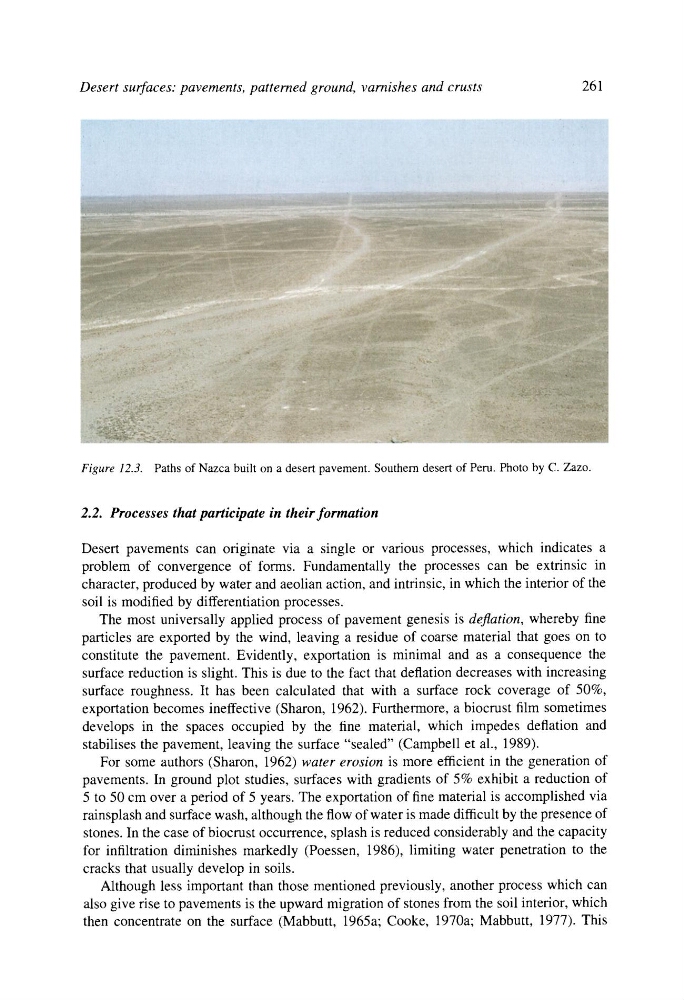
Figure 12.3. Paths of Nazca built on a desert pavement. Southern desert of Peru. Photo by C. Zazo.
2.2. Processes that participate in their formation
Desert pavements can originate via a single or various processes, which indicates a
problem of convergence of forms. Fundamentally the processes can be extrinsic in
character, produced by water and aeolian action, and intrinsic, in which the interior of the
soil is modified by differentiation processes.
The most universally applied process of pavement genesis is deflation, whereby fine
particles are exported by the wind, leaving a residue of coarse material that goes on to
constitute the pavement. Evidently, exportation is minimal and as a consequence the
surface reduction is slight. This is due to the fact that deflation decreases with increasing
surface roughness. It has been calculated that with a surface rock coverage of 50%,
exportation becomes ineffective (Sharon, 1962). Furthermore, a biocrust film sometimes
develops in the spaces occupied by the fine material, which impedes deflation and
stabilises the pavement, leaving the surface "sealed" (Campbell et al., 1989).
For some authors (Sharon, 1962) water erosion is more efficient in the generation of
pavements. In ground plot studies, surfaces with gradients of 5% exhibit a reduction of
5 to 50 cm over a period of 5 years. The exportation of fine material is accomplished via
rainsplash and surface wash, although the flow of water is made difficult by the presence of
stones. In the case of biocrust occurrence, splash is reduced considerably and the capacity
for infiltration diminishes markedly (Poessen, 1986), limiting water penetration to the
cracks that usually develop in soils.
Although less important than those mentioned previously, another process which can
also give rise to pavements is the upward migration of stones from the soil interior, which
then concentrate on the surface (Mabbutt, 1965a; Cooke, 1970a; Mabbutt, 1977). This
261
Figure 12.3. Paths of Nazca built on a desert pavement. Southern desert of Peru. Photo by C. Zazo.
2.2. Processes that participate in their formation
Desert pavements can originate via a single or various processes, which indicates a
problem of convergence of forms. Fundamentally the processes can be extrinsic in
character, produced by water and aeolian action, and intrinsic, in which the interior of the
soil is modified by differentiation processes.
The most universally applied process of pavement genesis is deflation, whereby fine
particles are exported by the wind, leaving a residue of coarse material that goes on to
constitute the pavement. Evidently, exportation is minimal and as a consequence the
surface reduction is slight. This is due to the fact that deflation decreases with increasing
surface roughness. It has been calculated that with a surface rock coverage of 50%,
exportation becomes ineffective (Sharon, 1962). Furthermore, a biocrust film sometimes
develops in the spaces occupied by the fine material, which impedes deflation and
stabilises the pavement, leaving the surface "sealed" (Campbell et al., 1989).
For some authors (Sharon, 1962) water erosion is more efficient in the generation of
pavements. In ground plot studies, surfaces with gradients of 5% exhibit a reduction of
5 to 50 cm over a period of 5 years. The exportation of fine material is accomplished via
rainsplash and surface wash, although the flow of water is made difficult by the presence of
stones. In the case of biocrust occurrence, splash is reduced considerably and the capacity
for infiltration diminishes markedly (Poessen, 1986), limiting water penetration to the
cracks that usually develop in soils.
Although less important than those mentioned previously, another process which can
also give rise to pavements is the upward migration of stones from the soil interior, which
then concentrate on the surface (Mabbutt, 1965a; Cooke, 1970a; Mabbutt, 1977). This