

258
Climatic Geomorphology
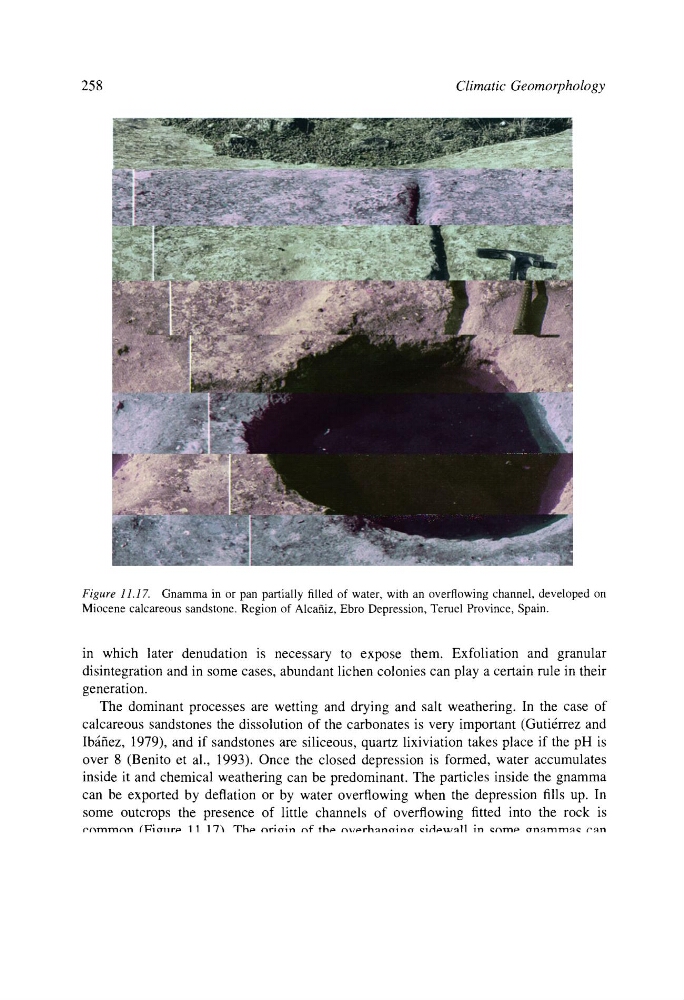
Figure 11.17. Gnamma in or pan partially filled of water, with an overflowing channel, developed on
Miocene calcareous sandstone. Region of Alcafiiz, Ebro Depression, Teruel Province, Spain.
in which later denudation is necessary to expose them. Exfoliation and granular
disintegration and in some cases, abundant lichen colonies can play a certain rule in their
generation.
The dominant processes are wetting and drying and salt weathering. In the case of
calcareous sandstones the dissolution of the carbonates is very important (Gutirrrez and
Ibfifiez, 1979), and if sandstones are siliceous, quartz lixiviation takes place if the pH is
over 8 (Benito et al., 1993). Once the closed depression is formed, water accumulates
inside it and chemical weathering can be predominant. The particles inside the gnamma
can be exported by deflation or by water overflowing when the depression fills up. In
some outcrops the presence of little channels of overflowing fitted into the rock is
common (Figure 11.17). The origin of the overhanging sidewall in some gnammas can
be due to a water prevalence in the bottom, for which weathering is major in this zone.
When gnammas and tafonis coexist in the same outcropping this can produce the
capture of one by the other, leaving the gnamma like an empty background buttonhole.
Also on occasion the headward erosion action of the fluvial network can reach in to
capture some gnammas.
Climatic Geomorphology
Figure 11.17. Gnamma in or pan partially filled of water, with an overflowing channel, developed on
Miocene calcareous sandstone. Region of Alcafiiz, Ebro Depression, Teruel Province, Spain.
in which later denudation is necessary to expose them. Exfoliation and granular
disintegration and in some cases, abundant lichen colonies can play a certain rule in their
generation.
The dominant processes are wetting and drying and salt weathering. In the case of
calcareous sandstones the dissolution of the carbonates is very important (Gutirrrez and
Ibfifiez, 1979), and if sandstones are siliceous, quartz lixiviation takes place if the pH is
over 8 (Benito et al., 1993). Once the closed depression is formed, water accumulates
inside it and chemical weathering can be predominant. The particles inside the gnamma
can be exported by deflation or by water overflowing when the depression fills up. In
some outcrops the presence of little channels of overflowing fitted into the rock is
common (Figure 11.17). The origin of the overhanging sidewall in some gnammas can
be due to a water prevalence in the bottom, for which weathering is major in this zone.
When gnammas and tafonis coexist in the same outcropping this can produce the
capture of one by the other, leaving the gnamma like an empty background buttonhole.
Also on occasion the headward erosion action of the fluvial network can reach in to
capture some gnammas.