

256
Climatic Geomorphology
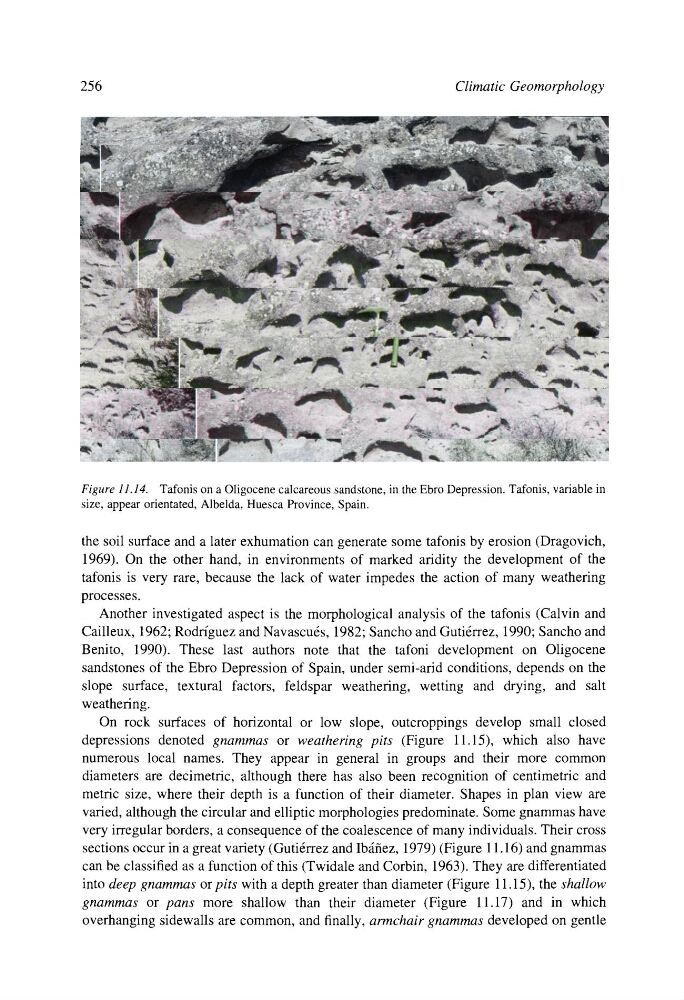
Figure 11.14. Tafonis on a Oligocene calcareous sandstone, in the Ebro Depression. Tafonis, variable in
size, appear orientated, Albelda, Huesca Province, Spain.
the soil surface and a later exhumation can generate some tafonis by erosion (Dragovich,
1969). On the other hand, in environments of marked aridity the development of the
tafonis is very rare, because the lack of water impedes the action of many weathering
processes.
Another investigated aspect is the morphological analysis of the tafonis (Calvin and
Cailleux, 1962; Rodrfguez and Navascurs, 1982; Sancho and Gutirrrez, 1990; Sancho and
Benito, 1990). These last authors note that the tafoni development on Oligocene
sandstones of the Ebro Depression of Spain, under semi-arid conditions, depends on the
slope surface, textural factors, feldspar weathering, wetting and drying, and salt
weathering.
On rock surfaces of horizontal or low slope, outcroppings develop small closed
depressions denoted gnammas or weathering pits (Figure 11.15), which also have
numerous local names. They appear in general in groups and their more common
diameters are decimetric, although there has also been recognition of centimetric and
metric size, where their depth is a function of their diameter. Shapes in plan view are
varied, although the circular and elliptic morphologies predominate. Some gnammas have
very irregular borders, a consequence of the coalescence of many individuals. Their cross
sections occur in a great variety (Guti~rrez and Ibfifiez, 1979) (Figure 11.16) and gnammas
can be classified as a function of this (Twidale and Corbin, 1963). They are differentiated
into deep gnammas or pits with a depth greater than diameter (Figure 11.15), the shallow
gnammas or pans more shallow than their diameter (Figure 11.17) and in which
overhanging sidewalls are common, and finally, armchair gnammas developed on gentle
Climatic Geomorphology
Figure 11.14. Tafonis on a Oligocene calcareous sandstone, in the Ebro Depression. Tafonis, variable in
size, appear orientated, Albelda, Huesca Province, Spain.
the soil surface and a later exhumation can generate some tafonis by erosion (Dragovich,
1969). On the other hand, in environments of marked aridity the development of the
tafonis is very rare, because the lack of water impedes the action of many weathering
processes.
Another investigated aspect is the morphological analysis of the tafonis (Calvin and
Cailleux, 1962; Rodrfguez and Navascurs, 1982; Sancho and Gutirrrez, 1990; Sancho and
Benito, 1990). These last authors note that the tafoni development on Oligocene
sandstones of the Ebro Depression of Spain, under semi-arid conditions, depends on the
slope surface, textural factors, feldspar weathering, wetting and drying, and salt
weathering.
On rock surfaces of horizontal or low slope, outcroppings develop small closed
depressions denoted gnammas or weathering pits (Figure 11.15), which also have
numerous local names. They appear in general in groups and their more common
diameters are decimetric, although there has also been recognition of centimetric and
metric size, where their depth is a function of their diameter. Shapes in plan view are
varied, although the circular and elliptic morphologies predominate. Some gnammas have
very irregular borders, a consequence of the coalescence of many individuals. Their cross
sections occur in a great variety (Guti~rrez and Ibfifiez, 1979) (Figure 11.16) and gnammas
can be classified as a function of this (Twidale and Corbin, 1963). They are differentiated
into deep gnammas or pits with a depth greater than diameter (Figure 11.15), the shallow
gnammas or pans more shallow than their diameter (Figure 11.17) and in which
overhanging sidewalls are common, and finally, armchair gnammas developed on gentle