

220
Climatic Geomorphology
layer of the foundation is provided with ventilation pipes to assist in the cooling of the
permafrost. Finally, some buildings are constructed on a gravel bed (Figure 9.5) that
favours drainage and prevents swamping and thermal erosion.
4.2. Lineal infrastructures
During the end of the 19th century the colossal work of the Trans-Siberian Railway was
developed for the wood transport towards the west. Subsequent to the Second World War
numerous roads, railways, and airfields were built in Canada, Alaska, Siberia, and
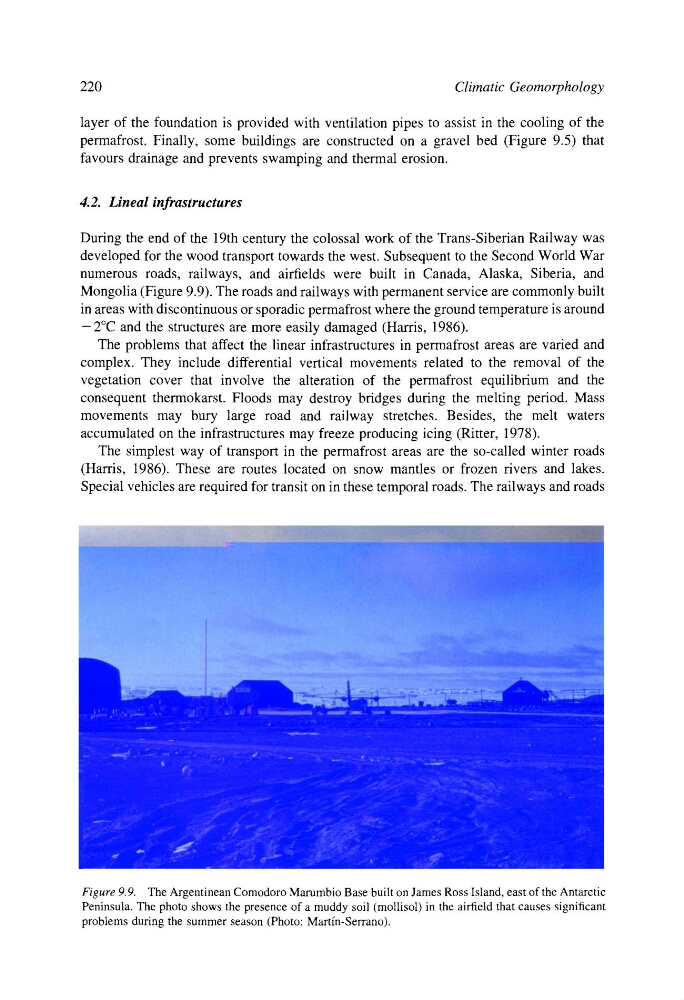
Mongolia (Figure 9.9). The roads and railways with permanent service are commonly built
in areas with discontinuous or sporadic permafrost where the ground temperature is around
-2~ and the structures are more easily damaged (Harris, 1986).
The problems that affect the linear infrastructures in permafrost areas are varied and
complex. They include differential vertical movements related to the removal of the
vegetation cover that involve the alteration of the permafrost equilibrium and the
consequent thermokarst. Hoods may destroy bridges during the melting period. Mass
movements may bury large road and railway stretches. Besides, the melt waters
accumulated on the infrastructures may freeze producing icing (Ritter, 1978).
The simplest way of transport in the permafrost areas are the so-called winter roads
(Harris, 1986). These are routes located on snow mantles or frozen rivers and lakes.
Special vehicles are required for transit on in these temporal roads. The railways and roads
Figure 9.9. The Argentinean Comodoro Marumbio Base built on James Ross Island, east of the Antarctic
Peninsula. The photo shows the presence of a muddy soil (mollisol) in the airfield that causes significant
problems during the summer season (Photo: Martfn-Serrano).
Climatic Geomorphology
layer of the foundation is provided with ventilation pipes to assist in the cooling of the
permafrost. Finally, some buildings are constructed on a gravel bed (Figure 9.5) that
favours drainage and prevents swamping and thermal erosion.
4.2. Lineal infrastructures
During the end of the 19th century the colossal work of the Trans-Siberian Railway was
developed for the wood transport towards the west. Subsequent to the Second World War
numerous roads, railways, and airfields were built in Canada, Alaska, Siberia, and
Mongolia (Figure 9.9). The roads and railways with permanent service are commonly built
in areas with discontinuous or sporadic permafrost where the ground temperature is around
-2~ and the structures are more easily damaged (Harris, 1986).
The problems that affect the linear infrastructures in permafrost areas are varied and
complex. They include differential vertical movements related to the removal of the
vegetation cover that involve the alteration of the permafrost equilibrium and the
consequent thermokarst. Hoods may destroy bridges during the melting period. Mass
movements may bury large road and railway stretches. Besides, the melt waters
accumulated on the infrastructures may freeze producing icing (Ritter, 1978).
The simplest way of transport in the permafrost areas are the so-called winter roads
(Harris, 1986). These are routes located on snow mantles or frozen rivers and lakes.
Special vehicles are required for transit on in these temporal roads. The railways and roads
Figure 9.9. The Argentinean Comodoro Marumbio Base built on James Ross Island, east of the Antarctic
Peninsula. The photo shows the presence of a muddy soil (mollisol) in the airfield that causes significant
problems during the summer season (Photo: Martfn-Serrano).