

12
Climatic Geomorphology
Davis had started his theory with a planated land surface undergoing abrupt uplift followed
by a long period of tectonic stability. The model of Penck began with the gradual uplift
of a primary surface (Primiirrumpf) promoting the progressive development of a set of
benched erosional surfaces around the margins of the primary one. This process was
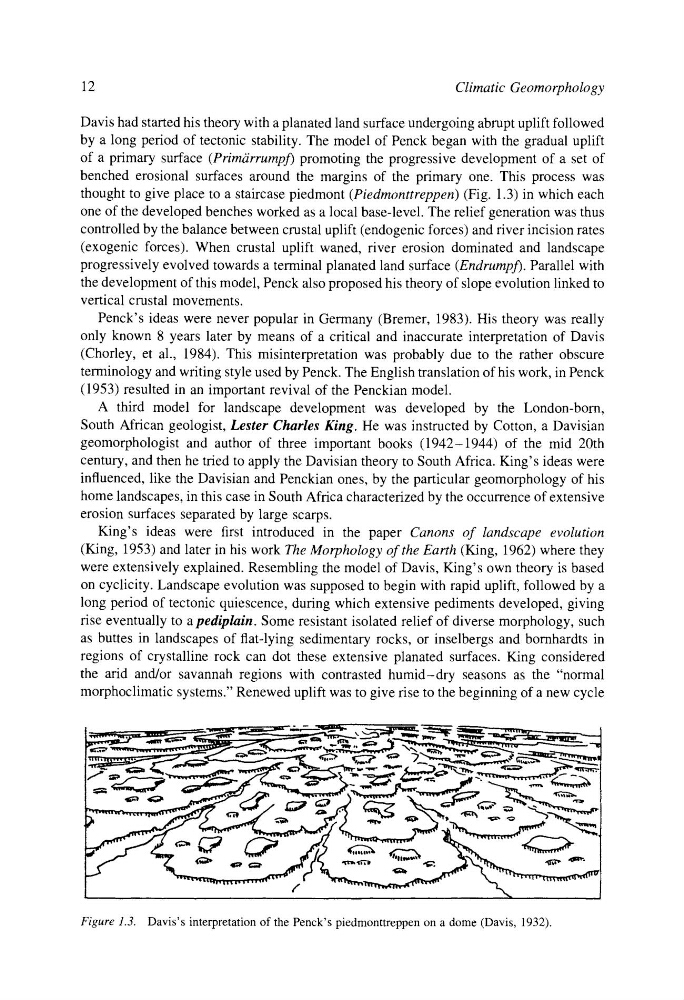
thought to give place to a staircase piedmont (Piedmonttreppen) (Fig. 1.3) in which each
one of the developed benches worked as a local base-level. The relief generation was thus
controlled by the balance between crustal uplift (endogenic forces) and river incision rates
(exogenic forces). When crustal uplift waned, fiver erosion dominated and landscape
progressively evolved towards a terminal planated land surface (Endrumpf). Parallel with
the development of this model, Penck also proposed his theory of slope evolution linked to
vertical crustal movements.
Penck's ideas were never popular in Germany (Bremer, 1983). His theory was really
only known 8 years later by means of a critical and inaccurate interpretation of Davis
(Chorley, et al., 1984). This misinterpretation was probably due to the rather obscure
terminology and writing style used by Penck. The English translation of his work, in Penck
(1953) resulted in an important revival of the Penckian model.
A third model for landscape development was developed by the London-born,
South African geologist, Lester Charles King. He was instructed by Cotton, a Davisian
geomorphologist and author of three important books (1942-1944) of the mid 20th
century, and then he tried to apply the Davisian theory to South Africa. King's ideas were
influenced, like the Davisian and Penckian ones, by the particular geomorphology of his
home landscapes, in this case in South Africa characterized by the occurrence of extensive
erosion surfaces separated by large scarps.
King's ideas were first introduced in the paper Canons of landscape evolution
(King, 1953) and later in his work The Morphology of the Earth (King, 1962) where they
were extensively explained. Resembling the model of Davis, King's own theory is based
on cyclicity. Landscape evolution was supposed to begin with rapid uplift, followed by a
long period of tectonic quiescence, during which extensive pediments developed, giving
rise eventually to a pediplain. Some resistant isolated relief of diverse morphology, such
as buttes in landscapes of flat-lying sedimentary rocks, or inselbergs and bornhardts in
regions of crystalline rock can dot these extensive planated surfaces. King considered
the arid and/or savannah regions with contrasted humid-dry seasons as the "normal
morphoclimatic systems." Renewed uplift was to give rise to the beginning of a new cycle
Figure 1.3. Davis's interpretation of the Penck's piedmonttreppen on a dome (Davis, 1932).
Climatic Geomorphology
Davis had started his theory with a planated land surface undergoing abrupt uplift followed
by a long period of tectonic stability. The model of Penck began with the gradual uplift
of a primary surface (Primiirrumpf) promoting the progressive development of a set of
benched erosional surfaces around the margins of the primary one. This process was
thought to give place to a staircase piedmont (Piedmonttreppen) (Fig. 1.3) in which each
one of the developed benches worked as a local base-level. The relief generation was thus
controlled by the balance between crustal uplift (endogenic forces) and river incision rates
(exogenic forces). When crustal uplift waned, fiver erosion dominated and landscape
progressively evolved towards a terminal planated land surface (Endrumpf). Parallel with
the development of this model, Penck also proposed his theory of slope evolution linked to
vertical crustal movements.
Penck's ideas were never popular in Germany (Bremer, 1983). His theory was really
only known 8 years later by means of a critical and inaccurate interpretation of Davis
(Chorley, et al., 1984). This misinterpretation was probably due to the rather obscure
terminology and writing style used by Penck. The English translation of his work, in Penck
(1953) resulted in an important revival of the Penckian model.
A third model for landscape development was developed by the London-born,
South African geologist, Lester Charles King. He was instructed by Cotton, a Davisian
geomorphologist and author of three important books (1942-1944) of the mid 20th
century, and then he tried to apply the Davisian theory to South Africa. King's ideas were
influenced, like the Davisian and Penckian ones, by the particular geomorphology of his
home landscapes, in this case in South Africa characterized by the occurrence of extensive
erosion surfaces separated by large scarps.
King's ideas were first introduced in the paper Canons of landscape evolution
(King, 1953) and later in his work The Morphology of the Earth (King, 1962) where they
were extensively explained. Resembling the model of Davis, King's own theory is based
on cyclicity. Landscape evolution was supposed to begin with rapid uplift, followed by a
long period of tectonic quiescence, during which extensive pediments developed, giving
rise eventually to a pediplain. Some resistant isolated relief of diverse morphology, such
as buttes in landscapes of flat-lying sedimentary rocks, or inselbergs and bornhardts in
regions of crystalline rock can dot these extensive planated surfaces. King considered
the arid and/or savannah regions with contrasted humid-dry seasons as the "normal
morphoclimatic systems." Renewed uplift was to give rise to the beginning of a new cycle
Figure 1.3. Davis's interpretation of the Penck's piedmonttreppen on a dome (Davis, 1932).