

Periglacial landforms
183
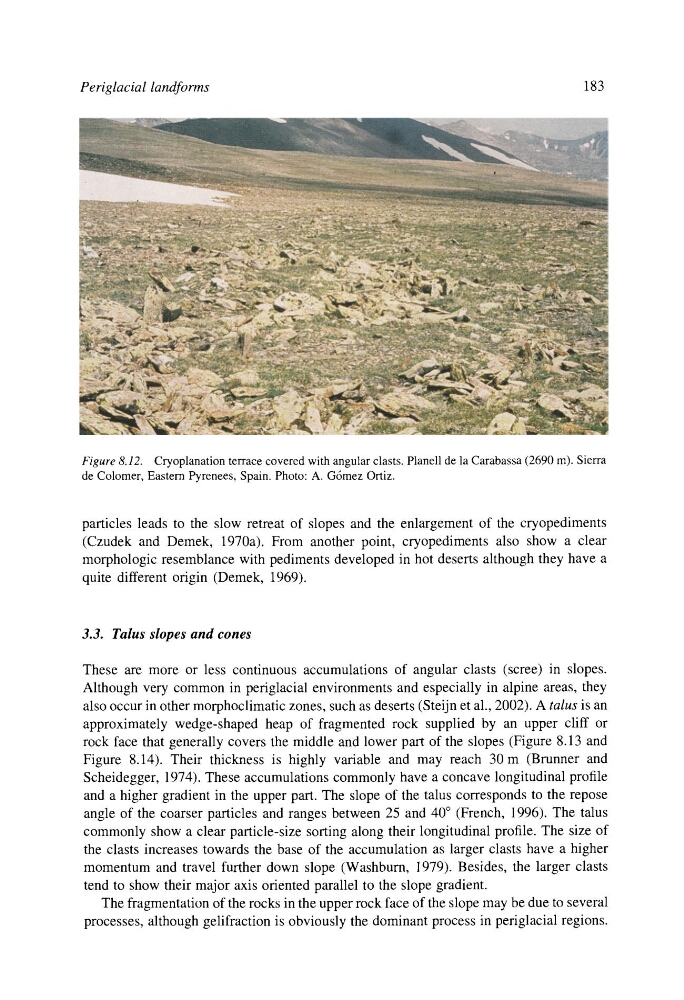
Figure 8.12. Cryoplanation terrace covered with angular clasts. Planell de la Carabassa (2690 m). Sierra
de Colomer, Eastern Pyrenees, Spain. Photo: A. Grmez Ortiz.
particles leads to the slow retreat of slopes and the enlargement of the cryopediments
(Czudek and Demek, 1970a). From another point, cryopediments also show a clear
morphologic resemblance with pediments developed in hot deserts although they have a
quite different origin (Demek, 1969).
3.3. Talus slopes and cones
These are more or less continuous accumulations of angular clasts (scree) in slopes.
Although very common in periglacial environments and especially in alpine areas, they
also occur in other morphoclimatic zones, such as deserts (Steijn et al., 2002). A talus is an
approximately wedge-shaped heap of fragmented rock supplied by an upper cliff or
rock face that generally covers the middle and lower part of the slopes (Figure 8.13 and
Figure 8.14). Their thickness is highly variable and may reach 30 m (Brunner and
Scheidegger, 1974). These accumulations commonly have a concave longitudinal profile
and a higher gradient in the upper part. The slope of the talus corresponds to the repose
angle of the coarser particles and ranges between 25 and 40 ~ (French, 1996). The talus
commonly show a clear particle-size sorting along their longitudinal profile. The size of
the clasts increases towards the base of the accumulation as larger clasts have a higher
momentum and travel further down slope (Washburn, 1979). Besides, the larger clasts
tend to show their major axis oriented parallel to the slope gradient.
The fragmentation of the rocks in the upper rock face of the slope may be due to several
processes, although gelifraction is obviously the dominant process in periglacial regions.
183
Figure 8.12. Cryoplanation terrace covered with angular clasts. Planell de la Carabassa (2690 m). Sierra
de Colomer, Eastern Pyrenees, Spain. Photo: A. Grmez Ortiz.
particles leads to the slow retreat of slopes and the enlargement of the cryopediments
(Czudek and Demek, 1970a). From another point, cryopediments also show a clear
morphologic resemblance with pediments developed in hot deserts although they have a
quite different origin (Demek, 1969).
3.3. Talus slopes and cones
These are more or less continuous accumulations of angular clasts (scree) in slopes.
Although very common in periglacial environments and especially in alpine areas, they
also occur in other morphoclimatic zones, such as deserts (Steijn et al., 2002). A talus is an
approximately wedge-shaped heap of fragmented rock supplied by an upper cliff or
rock face that generally covers the middle and lower part of the slopes (Figure 8.13 and
Figure 8.14). Their thickness is highly variable and may reach 30 m (Brunner and
Scheidegger, 1974). These accumulations commonly have a concave longitudinal profile
and a higher gradient in the upper part. The slope of the talus corresponds to the repose
angle of the coarser particles and ranges between 25 and 40 ~ (French, 1996). The talus
commonly show a clear particle-size sorting along their longitudinal profile. The size of
the clasts increases towards the base of the accumulation as larger clasts have a higher
momentum and travel further down slope (Washburn, 1979). Besides, the larger clasts
tend to show their major axis oriented parallel to the slope gradient.
The fragmentation of the rocks in the upper rock face of the slope may be due to several
processes, although gelifraction is obviously the dominant process in periglacial regions.