

10
Climatic Geomorphology
(a)
(d)
(b)
(e)
(c)
(f)
(g)
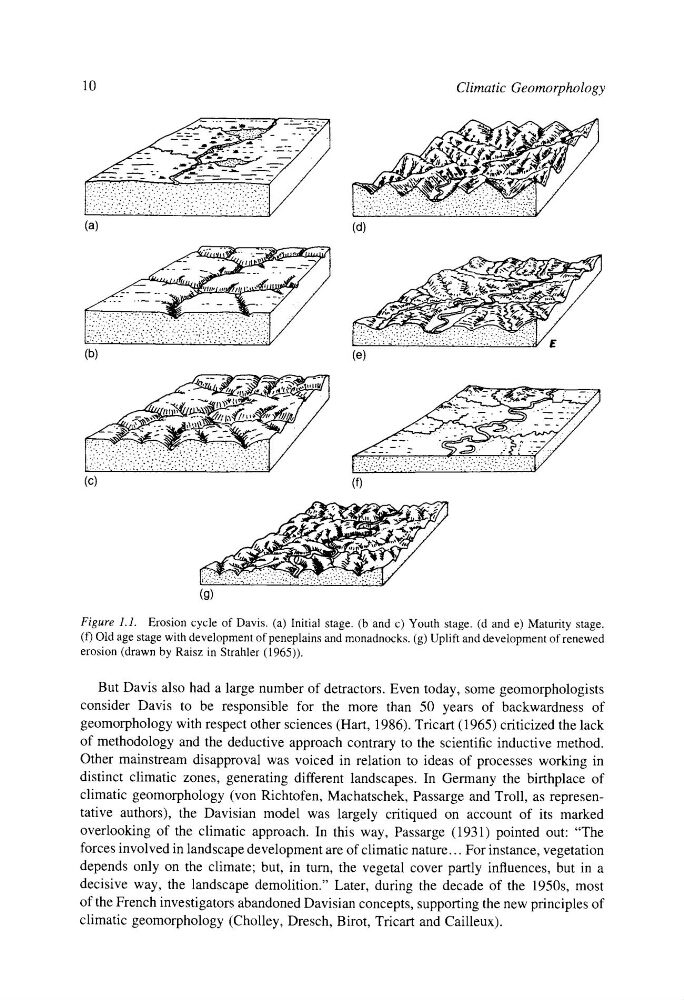
Figure 1.1. Erosion cycle of Davis. (a) Initial stage. (b and c) Youth stage. (d and e) Maturity stage.
(f) Old age stage with development of peneplains and monadnocks. (g) Uplift and development of renewed
erosion (drawn by Raisz in Strahler (1965)).
But Davis also had a large number of detractors. Even today, some geomorphologists
consider Davis to be responsible for the more than 50 years of backwardness of
geomorphology with respect other sciences (Hart, 1986). Tricart (1965) criticized the lack
of methodology and the deductive approach contrary to the scientific inductive method.
Other mainstream disapproval was voiced in relation to ideas of processes working in
distinct climatic zones, generating different landscapes. In Germany the birthplace of
climatic geomorphology (von Richtofen, Machatschek, Passarge and Troll, as representative authors), the Davisian model was largely critiqued on account of its marked
overlooking of the climatic approach. In this way, Passarge (1931) pointed out: "The
forces involved in landscape development are of climatic nature... For instance, vegetation
depends only on the climate; but, in turn, the vegetal cover partly influences, but in a
decisive way, the landscape demolition." Later, during the decade of the 1950s, most
of the French investigators abandoned Davisian concepts, supporting the new principles of
climatic geomorphology (Cholley, Dresch, Birot, Tricart and Cailleux).
Climatic Geomorphology
(a)
(d)
(b)
(e)
(c)
(f)
(g)
Figure 1.1. Erosion cycle of Davis. (a) Initial stage. (b and c) Youth stage. (d and e) Maturity stage.
(f) Old age stage with development of peneplains and monadnocks. (g) Uplift and development of renewed
erosion (drawn by Raisz in Strahler (1965)).
But Davis also had a large number of detractors. Even today, some geomorphologists
consider Davis to be responsible for the more than 50 years of backwardness of
geomorphology with respect other sciences (Hart, 1986). Tricart (1965) criticized the lack
of methodology and the deductive approach contrary to the scientific inductive method.
Other mainstream disapproval was voiced in relation to ideas of processes working in
distinct climatic zones, generating different landscapes. In Germany the birthplace of
climatic geomorphology (von Richtofen, Machatschek, Passarge and Troll, as representative authors), the Davisian model was largely critiqued on account of its marked
overlooking of the climatic approach. In this way, Passarge (1931) pointed out: "The
forces involved in landscape development are of climatic nature... For instance, vegetation
depends only on the climate; but, in turn, the vegetal cover partly influences, but in a
decisive way, the landscape demolition." Later, during the decade of the 1950s, most
of the French investigators abandoned Davisian concepts, supporting the new principles of
climatic geomorphology (Cholley, Dresch, Birot, Tricart and Cailleux).