

180
Climatic Geomorphology
cover. Several processes may be involved in their genesis, such as gelifraction (frostshattering), mass movements, runoff or nivation. All of them may operate independently
or in a combined way with a highly variable intensity. On the other hand, many of the
resulting landforms are not specific to periglacial regions as they also generate in other
morphoclimatic zones. Besides, some of the periglacial slope morphologies were formed
in the past (relict) and may be out of balance with the currently existing conditions.
3.1. Gelifluction slopes
The differential movements related to the downslope displacement of colluvial deposits
and rocks caused by frost-creep and gelifluction processes give place to several landforms
whose differentiation is based on geometric criteria (Washburn, 1979). Gelifluction sheets
have a large lateral extent and a festooned lower edge. They develop on slopes with
gradients higher than 1 to 3 ~ Gelifluction benches are characterised by a terraced form and
the major dimension is commonly parallel to the contour lines. Gelifluction lobes with a
tongue-like shape develop, like the benches, on slopes with gradients up to 20 to 25 ~ . The
lobate geometry is due to the higher displacement rate along the central axis of the lobe.
The gelifluction features with a pronounced linear geometry oriented parallel to the slope
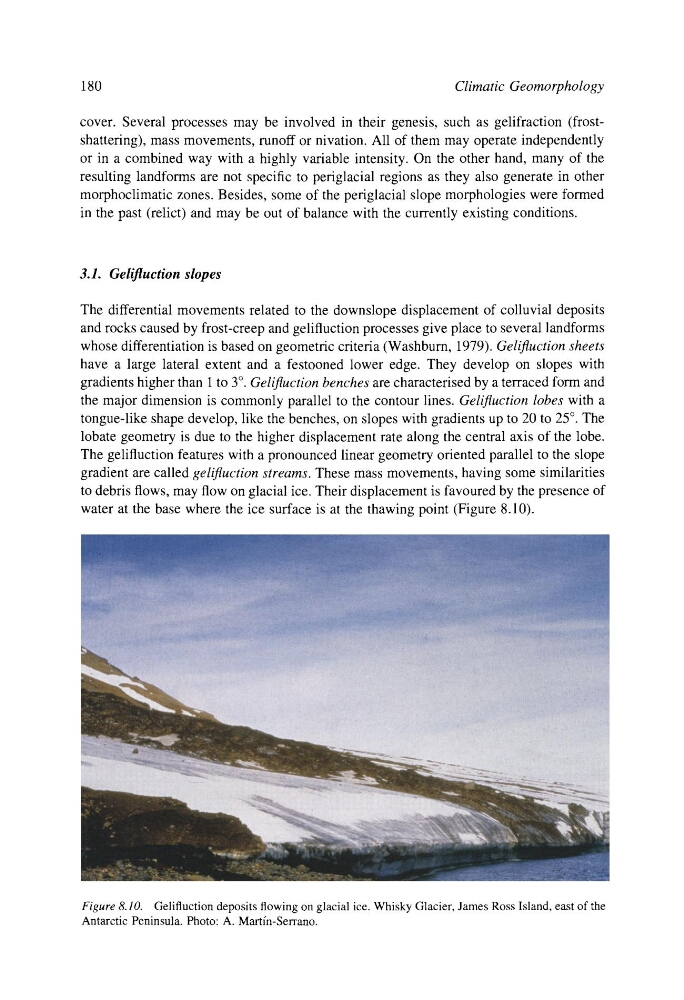
gradient are called gelifluction streams. These mass movements, having some similarities
to debris flows, may flow on glacial ice. Their displacement is favoured by the presence of
water at the base where the ice surface is at the thawing point (Figure 8.10).
Figure 8.10. Gelifluction deposits fowing on glacial ice. Whisky Glacier, James Ross Island, east of the
Antarctic Peninsula. Photo: A. Martfn-Serrano.
Climatic Geomorphology
cover. Several processes may be involved in their genesis, such as gelifraction (frostshattering), mass movements, runoff or nivation. All of them may operate independently
or in a combined way with a highly variable intensity. On the other hand, many of the
resulting landforms are not specific to periglacial regions as they also generate in other
morphoclimatic zones. Besides, some of the periglacial slope morphologies were formed
in the past (relict) and may be out of balance with the currently existing conditions.
3.1. Gelifluction slopes
The differential movements related to the downslope displacement of colluvial deposits
and rocks caused by frost-creep and gelifluction processes give place to several landforms
whose differentiation is based on geometric criteria (Washburn, 1979). Gelifluction sheets
have a large lateral extent and a festooned lower edge. They develop on slopes with
gradients higher than 1 to 3 ~ Gelifluction benches are characterised by a terraced form and
the major dimension is commonly parallel to the contour lines. Gelifluction lobes with a
tongue-like shape develop, like the benches, on slopes with gradients up to 20 to 25 ~ . The
lobate geometry is due to the higher displacement rate along the central axis of the lobe.
The gelifluction features with a pronounced linear geometry oriented parallel to the slope
gradient are called gelifluction streams. These mass movements, having some similarities
to debris flows, may flow on glacial ice. Their displacement is favoured by the presence of
water at the base where the ice surface is at the thawing point (Figure 8.10).
Figure 8.10. Gelifluction deposits fowing on glacial ice. Whisky Glacier, James Ross Island, east of the
Antarctic Peninsula. Photo: A. Martfn-Serrano.