

Periglacial landforms
173
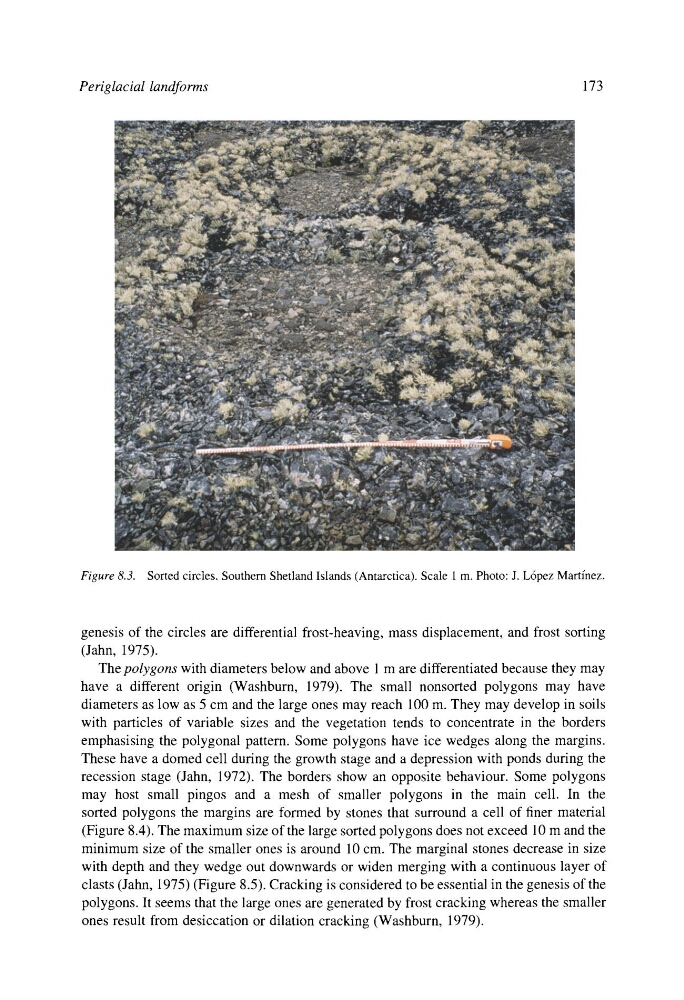
Figure 8.3. Sorted circles. Southern Shetland Islands (Antarctica). Scale 1 m. Photo: J. L6pez Martfnez.
genesis of the circles are differential frost-heaving, mass displacement, and frost sorting
(Jahn, 1975).
The polygons with diameters below and above 1 m are differentiated because they may
have a different origin (Washburn, 1979). The small nonsorted polygons may have
diameters as low as 5 cm and the large ones may reach 100 m. They may develop in soils
with particles of variable sizes and the vegetation tends to concentrate in the borders
emphasising the polygonal pattern. Some polygons have ice wedges along the margins.
These have a domed cell during the growth stage and a depression with ponds during the
recession stage (Jahn, 1972). The borders show an opposite behaviour. Some polygons
may host small pingos and a mesh of smaller polygons in the main cell. In the
sorted polygons the margins are formed by stones that surround a cell of finer material
(Figure 8.4). The maximum size of the large sorted polygons does not exceed 10 m and the
minimum size of the smaller ones is around 10 cm. The marginal stones decrease in size
with depth and they wedge out downwards or widen merging with a continuous layer of
clasts (Jahn, 1975) (Figure 8.5). Cracking is considered to be essential in the genesis of the
polygons. It seems that the large ones are generated by frost cracking whereas the smaller
ones result from desiccation or dilation cracking (Washburn, 1979).
173
Figure 8.3. Sorted circles. Southern Shetland Islands (Antarctica). Scale 1 m. Photo: J. L6pez Martfnez.
genesis of the circles are differential frost-heaving, mass displacement, and frost sorting
(Jahn, 1975).
The polygons with diameters below and above 1 m are differentiated because they may
have a different origin (Washburn, 1979). The small nonsorted polygons may have
diameters as low as 5 cm and the large ones may reach 100 m. They may develop in soils
with particles of variable sizes and the vegetation tends to concentrate in the borders
emphasising the polygonal pattern. Some polygons have ice wedges along the margins.
These have a domed cell during the growth stage and a depression with ponds during the
recession stage (Jahn, 1972). The borders show an opposite behaviour. Some polygons
may host small pingos and a mesh of smaller polygons in the main cell. In the
sorted polygons the margins are formed by stones that surround a cell of finer material
(Figure 8.4). The maximum size of the large sorted polygons does not exceed 10 m and the
minimum size of the smaller ones is around 10 cm. The marginal stones decrease in size
with depth and they wedge out downwards or widen merging with a continuous layer of
clasts (Jahn, 1975) (Figure 8.5). Cracking is considered to be essential in the genesis of the
polygons. It seems that the large ones are generated by frost cracking whereas the smaller
ones result from desiccation or dilation cracking (Washburn, 1979).