

The periglacial environment
165
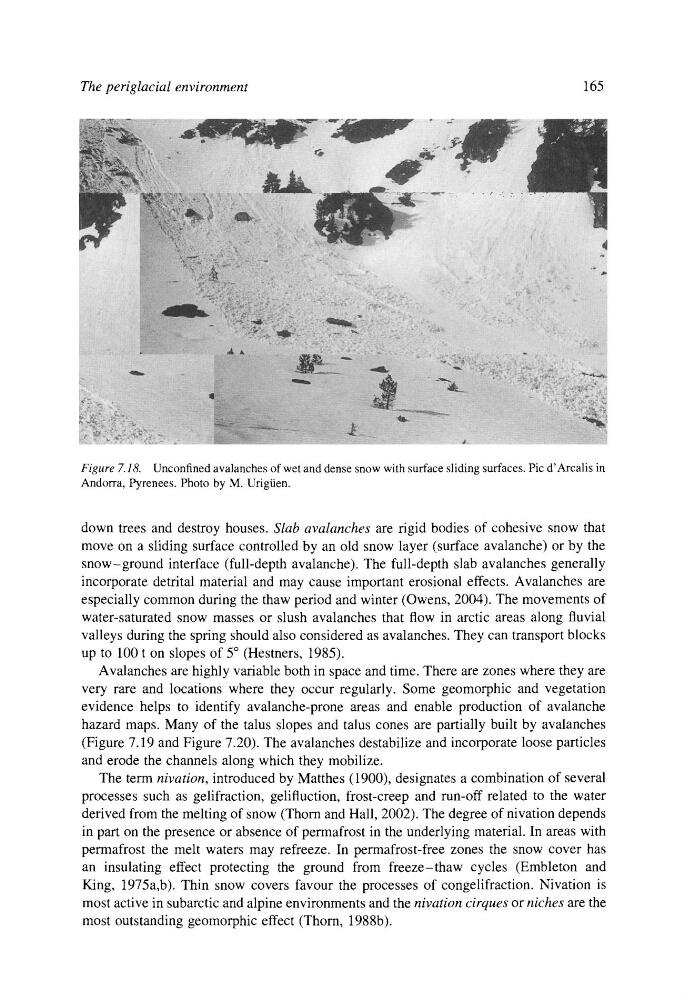
Figure 7.18. Unconfined avalanches of wet and dense snow with surface sliding surfaces. Pic d'Arcalis in
Andorra, Pyrenees. Photo by M. Urigtien.
down trees and destroy houses. Slab avalanches are rigid bodies of cohesive snow that
move on a sliding surface controlled by an old snow layer (surface avalanche) or by the
snow-ground interface (full-depth avalanche). The full-depth slab avalanches generally
incorporate detrital material and may cause important erosional effects. Avalanches are
especially common during the thaw period and winter (Owens, 2004). The movements of
water-saturated snow masses or slush avalanches that flow in arctic areas along fluvial
valleys during the spring should also considered as avalanches. They can transport blocks
up to 100 t on slopes of 5 ~ (Hestners, 1985).
Avalanches are highly variable both in space and time. There are zones where they are
very rare and locations where they occur regularly. Some geomorphic and vegetation
evidence helps to identify avalanche-prone areas and enable production of avalanche
hazard maps. Many of the talus slopes and talus cones are partially built by avalanches
(Figure 7.19 and Figure 7.20). The avalanches destabilize and incorporate loose particles
and erode the channels along which they mobilize.
The term nivation, introduced by Matthes (1900), designates a combination of several
processes such as gelifraction, gelifluction, frost-creep and run-off related to the water
derived from the melting of snow (Thorn and Hall, 2002). The degree of nivation depends
in part on the presence or absence of permafrost in the underlying material. In areas with
permafrost the melt waters may refreeze. In permafrost-free zones the snow cover has
an insulating effect protecting the ground from freeze-thaw cycles (Embleton and
King, 1975a,b). Thin snow covers favour the processes of congelifraction. Nivation is
most active in subarctic and alpine environments and the nivation cirques or niches are the
most outstanding geomorphic effect (Thorn, 1988b).
165
Figure 7.18. Unconfined avalanches of wet and dense snow with surface sliding surfaces. Pic d'Arcalis in
Andorra, Pyrenees. Photo by M. Urigtien.
down trees and destroy houses. Slab avalanches are rigid bodies of cohesive snow that
move on a sliding surface controlled by an old snow layer (surface avalanche) or by the
snow-ground interface (full-depth avalanche). The full-depth slab avalanches generally
incorporate detrital material and may cause important erosional effects. Avalanches are
especially common during the thaw period and winter (Owens, 2004). The movements of
water-saturated snow masses or slush avalanches that flow in arctic areas along fluvial
valleys during the spring should also considered as avalanches. They can transport blocks
up to 100 t on slopes of 5 ~ (Hestners, 1985).
Avalanches are highly variable both in space and time. There are zones where they are
very rare and locations where they occur regularly. Some geomorphic and vegetation
evidence helps to identify avalanche-prone areas and enable production of avalanche
hazard maps. Many of the talus slopes and talus cones are partially built by avalanches
(Figure 7.19 and Figure 7.20). The avalanches destabilize and incorporate loose particles
and erode the channels along which they mobilize.
The term nivation, introduced by Matthes (1900), designates a combination of several
processes such as gelifraction, gelifluction, frost-creep and run-off related to the water
derived from the melting of snow (Thorn and Hall, 2002). The degree of nivation depends
in part on the presence or absence of permafrost in the underlying material. In areas with
permafrost the melt waters may refreeze. In permafrost-free zones the snow cover has
an insulating effect protecting the ground from freeze-thaw cycles (Embleton and
King, 1975a,b). Thin snow covers favour the processes of congelifraction. Nivation is
most active in subarctic and alpine environments and the nivation cirques or niches are the
most outstanding geomorphic effect (Thorn, 1988b).