

138
Climatic Geomorphology
4. Some considerations about engineering geology in areas
previously occupied by ice
The most outstanding feature of glacial-origin sequences is their high variability in
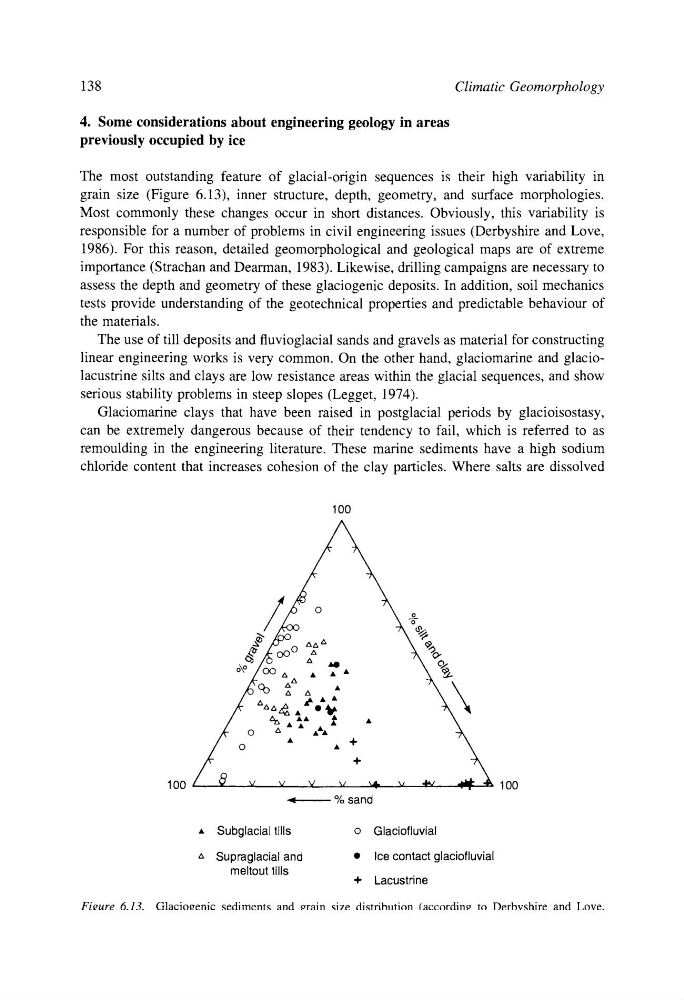
grain size (Figure 6.13), inner structure, depth, geometry, and surface morphologies.
Most commonly these changes occur in short distances. Obviously, this variability is
responsible for a number of problems in civil engineering issues (Derbyshire and Love,
1986). For this reason, detailed geomorphological and geological maps are of extreme
importance (Strachan and Dearman, 1983). Likewise, drilling campaigns are necessary to
assess the depth and geometry of these glaciogenic deposits. In addition, soil mechanics
tests provide understanding of the geotechnical properties and predictable behaviour of
the materials.
The use of till deposits and fluvioglacial sands and gravels as material for constructing
linear engineering works is very common. On the other hand, glaciomarine and glaciolacustrine silts and clays are low resistance areas within the glacial sequences, and show
serious stability problems in steep slopes (Legget, 1974).
Glaciomarine clays that have been raised in postglacial periods by glacioisostasy,
can be extremely dangerous because of their tendency to fail, which is referred to as
remoulding in the engineering literature. These marine sediments have a high sodium
chloride content that increases cohesion of the clay particles. Where salts are dissolved
100
$
100
% sand
100
Figure 6.13.
1986).
9 Subglacial tills
o Glaciofluvial
Supraglacial and
9 Ice contact glaciofluvial
meltout tills
§ Lacustrine
Glaciogenic sediments and grain size distribution (according to Derbyshire and Love,
Climatic Geomorphology
4. Some considerations about engineering geology in areas
previously occupied by ice
The most outstanding feature of glacial-origin sequences is their high variability in
grain size (Figure 6.13), inner structure, depth, geometry, and surface morphologies.
Most commonly these changes occur in short distances. Obviously, this variability is
responsible for a number of problems in civil engineering issues (Derbyshire and Love,
1986). For this reason, detailed geomorphological and geological maps are of extreme
importance (Strachan and Dearman, 1983). Likewise, drilling campaigns are necessary to
assess the depth and geometry of these glaciogenic deposits. In addition, soil mechanics
tests provide understanding of the geotechnical properties and predictable behaviour of
the materials.
The use of till deposits and fluvioglacial sands and gravels as material for constructing
linear engineering works is very common. On the other hand, glaciomarine and glaciolacustrine silts and clays are low resistance areas within the glacial sequences, and show
serious stability problems in steep slopes (Legget, 1974).
Glaciomarine clays that have been raised in postglacial periods by glacioisostasy,
can be extremely dangerous because of their tendency to fail, which is referred to as
remoulding in the engineering literature. These marine sediments have a high sodium
chloride content that increases cohesion of the clay particles. Where salts are dissolved
100
$
100
% sand
100
Figure 6.13.
1986).
9 Subglacial tills
o Glaciofluvial
Supraglacial and
9 Ice contact glaciofluvial
meltout tills
§ Lacustrine
Glaciogenic sediments and grain size distribution (according to Derbyshire and Love,