

Fluvioglacial erosion and sedimentation
123
number of braided channels increases. They are shallow (1 to 2 m in depth), change
frequently in position and commonly are flooded during high discharges. Finally, the distal
area has proglacial lakes. During the stages of glacial retreat, the proximal areas of the
sandar are eroded and new sandar develop from the previous ones.
The presence of lakes is very common in fluvioglacial environments, particularly in
marginal and proglacial positions. The discharge of materials in the lakes results in
glaciolacustrine beaches and deltas. If the lake is drained afterwards, then the bottom
deposits make up plains ofglaciolacustrine origin. Some of these deposits have a rhythmic
character and show seasonal variations. They are called varves and have been used in
absolute dating with diverse results. Each varve is composed of two layers, one of coarser
sand deposited in summer and the other of finer clay and silt that is deposited during the
rest of the year. The value of the method of counting varves for chronology construction
has been subject to criticism, because in some years more than a pair of layers can deposit,
whereas other years may not have a sedimentation record due to discharge variations or
deviations of the channels that flow into the lake (Smith et al., 1982).
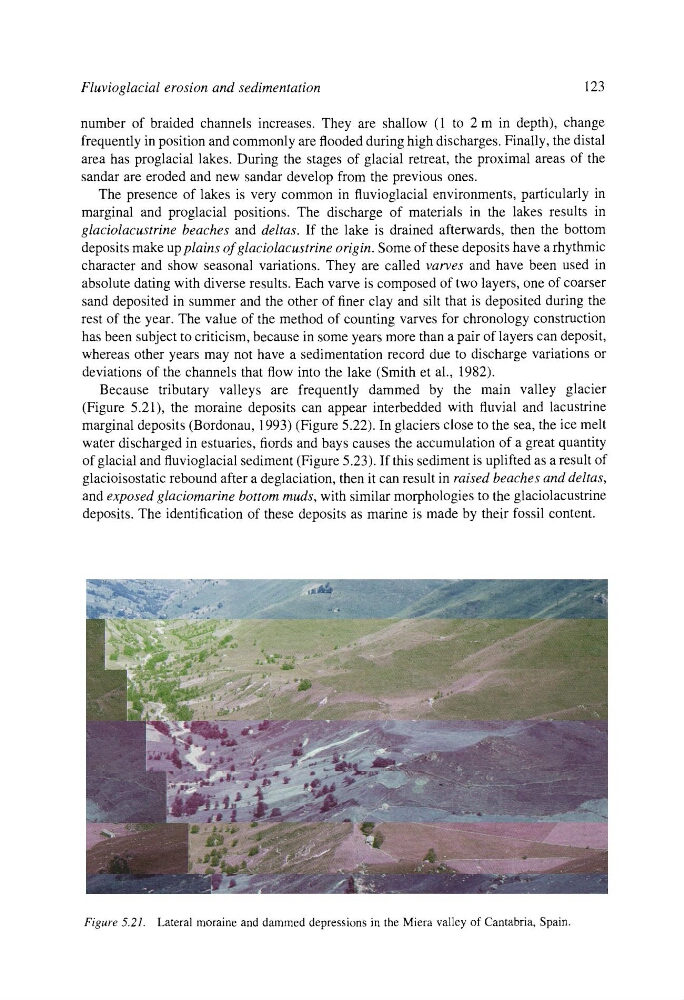
Because tributary valleys are frequently dammed by the main valley glacier
(Figure 5.21), the moraine deposits can appear interbedded with fluvial and lacustrine
marginal deposits (Bordonau, 1993) (Figure 5.22). In glaciers close to the sea, the ice melt
water discharged in estuaries, fiords and bays causes the accumulation of a great quantity
of glacial and fluvioglacial sediment (Figure 5.23). If this sediment is uplifted as a result of
glacioisostatic rebound after a deglaciation, then it can result in raised beaches and deltas,
and exposed glaciomarine bottom muds, with similar morphologies to the glaciolacustrine
deposits. The identification of these deposits as marine is made by their fossil content.
Figure 5.21. Lateral moraine and dammed depressions in the Miera valley of Cantabria, Spain.
123
number of braided channels increases. They are shallow (1 to 2 m in depth), change
frequently in position and commonly are flooded during high discharges. Finally, the distal
area has proglacial lakes. During the stages of glacial retreat, the proximal areas of the
sandar are eroded and new sandar develop from the previous ones.
The presence of lakes is very common in fluvioglacial environments, particularly in
marginal and proglacial positions. The discharge of materials in the lakes results in
glaciolacustrine beaches and deltas. If the lake is drained afterwards, then the bottom
deposits make up plains ofglaciolacustrine origin. Some of these deposits have a rhythmic
character and show seasonal variations. They are called varves and have been used in
absolute dating with diverse results. Each varve is composed of two layers, one of coarser
sand deposited in summer and the other of finer clay and silt that is deposited during the
rest of the year. The value of the method of counting varves for chronology construction
has been subject to criticism, because in some years more than a pair of layers can deposit,
whereas other years may not have a sedimentation record due to discharge variations or
deviations of the channels that flow into the lake (Smith et al., 1982).
Because tributary valleys are frequently dammed by the main valley glacier
(Figure 5.21), the moraine deposits can appear interbedded with fluvial and lacustrine
marginal deposits (Bordonau, 1993) (Figure 5.22). In glaciers close to the sea, the ice melt
water discharged in estuaries, fiords and bays causes the accumulation of a great quantity
of glacial and fluvioglacial sediment (Figure 5.23). If this sediment is uplifted as a result of
glacioisostatic rebound after a deglaciation, then it can result in raised beaches and deltas,
and exposed glaciomarine bottom muds, with similar morphologies to the glaciolacustrine
deposits. The identification of these deposits as marine is made by their fossil content.
Figure 5.21. Lateral moraine and dammed depressions in the Miera valley of Cantabria, Spain.