

116
Climatic Geomorphology
Transport and sedimentation mechanisms are similar to those occurring in other fluvial,
lacustrine, and marine environments. In the fluvioglacial channels, ripples, dunes, and
cross stratification are common in sandy deposits. These alternate with gravels where the
flow energy is greater. The sorting of the deposits is a consequence of the seasonal, annual,
and even daily fluctuations of the discharge. The particles of silt and clay size are carried
longer distances, and they are deposited in glaciolacustrine or glaciomarine environments
(Price, 1973).
Lacustrine sedimentation occurs in subglacial, marginal, and proglacial lakes. The
deepest layers of sedimentation represent the distal sedimentation of fine particles, whereas
the frontal and upward layers represent the supply of coarser proximal material.
The deposits of fluvioglacial channels are composed of rounder clasts than the till clasts,
although this differentiation is not a conclusive criterion, because some fluvioglacial
deposits have undergone a short transport. On the other hand, the grain size distribution is
very different from the till deposits. It is not bimodal, because the silt and clay particles
have been carried away, unlike the tills.
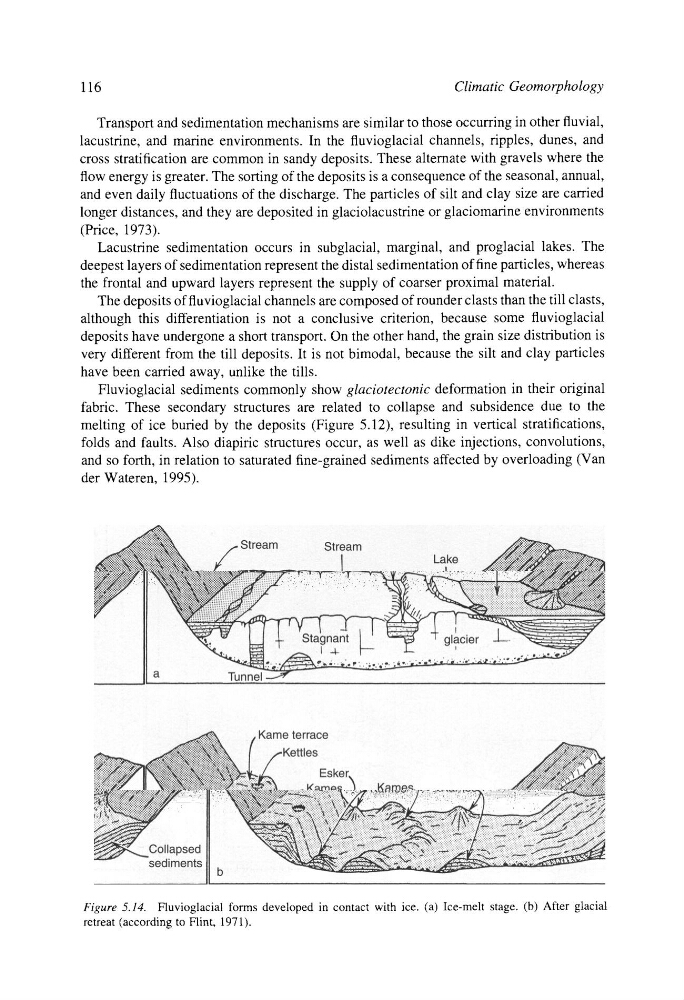
Fluvioglacial sediments commonly show glaciotectonic deformation in their original
fabric. These secondary structures are related to collapse and subsidence due to the
melting of ice buried by the deposits (Figure 5.12), resulting in vertical stratifications,
folds and faults. Also diapiric structures occur, as well as dike injections, convolutions,
and so forth, in relation to saturated fine-grained sediments affected by overloading (Van
der Wateren, 1995).
Figure 5.14. Fluvioglacial forms developed in contact with ice. (a) Ice-melt stage. (b) After glacial
retreat (according to Flint, 1971).
Climatic Geomorphology
Transport and sedimentation mechanisms are similar to those occurring in other fluvial,
lacustrine, and marine environments. In the fluvioglacial channels, ripples, dunes, and
cross stratification are common in sandy deposits. These alternate with gravels where the
flow energy is greater. The sorting of the deposits is a consequence of the seasonal, annual,
and even daily fluctuations of the discharge. The particles of silt and clay size are carried
longer distances, and they are deposited in glaciolacustrine or glaciomarine environments
(Price, 1973).
Lacustrine sedimentation occurs in subglacial, marginal, and proglacial lakes. The
deepest layers of sedimentation represent the distal sedimentation of fine particles, whereas
the frontal and upward layers represent the supply of coarser proximal material.
The deposits of fluvioglacial channels are composed of rounder clasts than the till clasts,
although this differentiation is not a conclusive criterion, because some fluvioglacial
deposits have undergone a short transport. On the other hand, the grain size distribution is
very different from the till deposits. It is not bimodal, because the silt and clay particles
have been carried away, unlike the tills.
Fluvioglacial sediments commonly show glaciotectonic deformation in their original
fabric. These secondary structures are related to collapse and subsidence due to the
melting of ice buried by the deposits (Figure 5.12), resulting in vertical stratifications,
folds and faults. Also diapiric structures occur, as well as dike injections, convolutions,
and so forth, in relation to saturated fine-grained sediments affected by overloading (Van
der Wateren, 1995).
Figure 5.14. Fluvioglacial forms developed in contact with ice. (a) Ice-melt stage. (b) After glacial
retreat (according to Flint, 1971).