

106
Climatic Geomorphology
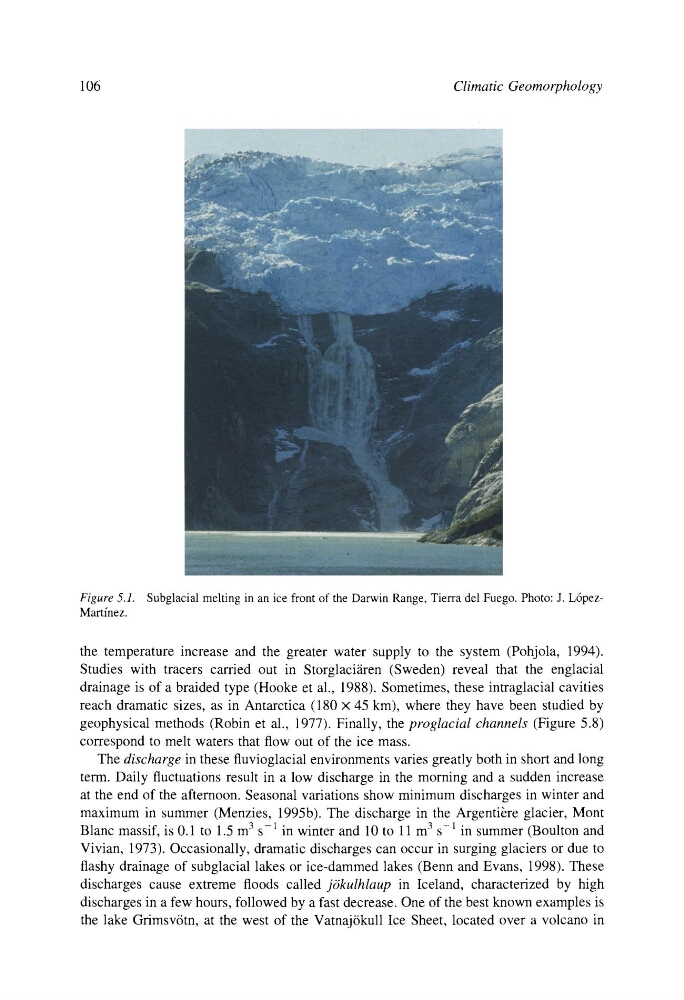
Figure 5.1. Subglacial melting in an ice front of the Darwin Range, Tierra del Fuego. Photo: J. L6pezMartfnez.
the temperature increase and the greater water supply to the system (Pohjola, 1994).
Studies with tracers carried out in Storglaci~iren (Sweden) reveal that the englacial
drainage is of a braided type (Hooke et al., 1988). Sometimes, these intraglacial cavities
reach dramatic sizes, as in Antarctica (180 x 45 km), where they have been studied by
geophysical methods (Robin et al., 1977). Finally, the proglacial channels (Figure 5.8)
correspond to melt waters that flow out of the ice mass.
The discharge in these fluvioglacial environments varies greatly both in short and long
term. Daily fluctuations result in a low discharge in the morning and a sudden increase
at the end of the afternoon. Seasonal variations show minimum discharges in winter and
maximum in summer (Menzies, 1995b). The discharge in the Argenti~re glacier, Mont
Blanc massif, is 0.1 to 1.5 m 3 s -1 in winter and 10 to 11 m 3 s -1 in summer (Boulton and
Vivian, 1973). Occasionally, dramatic discharges can occur in surging glaciers or due to
flashy drainage of subglacial lakes or ice-dammed lakes (Benn and Evans, 1998). These
discharges cause extreme floods called j6kulhlaup in Iceland, characterized by high
discharges in a few hours, followed by a fast decrease. One of the best known examples is
the lake Grimsv6tn, at the west of the Vatnaj6kull Ice Sheet, located over a volcano in
Climatic Geomorphology
Figure 5.1. Subglacial melting in an ice front of the Darwin Range, Tierra del Fuego. Photo: J. L6pezMartfnez.
the temperature increase and the greater water supply to the system (Pohjola, 1994).
Studies with tracers carried out in Storglaci~iren (Sweden) reveal that the englacial
drainage is of a braided type (Hooke et al., 1988). Sometimes, these intraglacial cavities
reach dramatic sizes, as in Antarctica (180 x 45 km), where they have been studied by
geophysical methods (Robin et al., 1977). Finally, the proglacial channels (Figure 5.8)
correspond to melt waters that flow out of the ice mass.
The discharge in these fluvioglacial environments varies greatly both in short and long
term. Daily fluctuations result in a low discharge in the morning and a sudden increase
at the end of the afternoon. Seasonal variations show minimum discharges in winter and
maximum in summer (Menzies, 1995b). The discharge in the Argenti~re glacier, Mont
Blanc massif, is 0.1 to 1.5 m 3 s -1 in winter and 10 to 11 m 3 s -1 in summer (Boulton and
Vivian, 1973). Occasionally, dramatic discharges can occur in surging glaciers or due to
flashy drainage of subglacial lakes or ice-dammed lakes (Benn and Evans, 1998). These
discharges cause extreme floods called j6kulhlaup in Iceland, characterized by high
discharges in a few hours, followed by a fast decrease. One of the best known examples is
the lake Grimsv6tn, at the west of the Vatnaj6kull Ice Sheet, located over a volcano in