

Biochemical Systematics and Ecology 96 (2021) 104262
2
used as chemotaxonomic markers of the genus Echinaster. Recently,
cyclic saponins were isolated from tropical starfish Leiaster sp. This
finding indicates that cyclic are more widely distributed in starfish than
the two species of the genus Echinaster (Malyarenko et al., 2016). To
date, nine representatives of cyclic saponins have been discovered from
the starfish E. sepositus (De Simone et al., 1981; Riccio et al., 1981) and
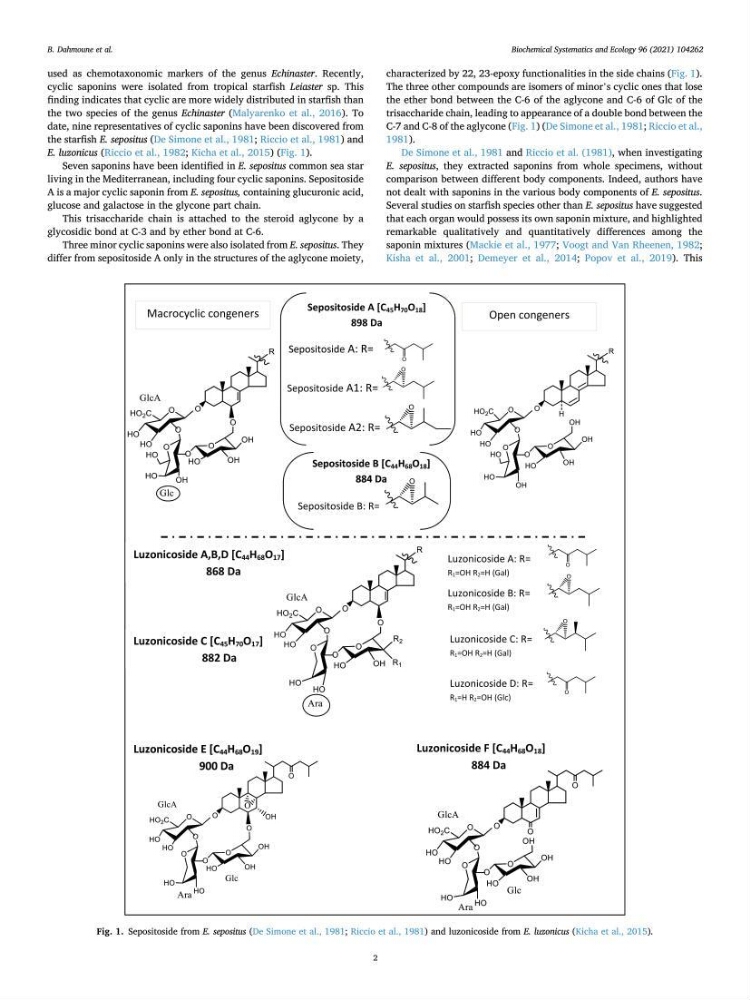
E. luzonicus (Riccio et al., 1982; Kicha et al., 2015) (Fig. 1).
Seven saponins have been identified in E. sepositus common sea star
living in the Mediterranean, including four cyclic saponins. Sepositoside
A is a major cyclic saponin from E. sepositus, containing glucuronic acid,
glucose and galactose in the glycone part chain.
This trisaccharide chain is attached to the steroid aglycone by a
glycosidic bond at C-3 and by ether bond at C-6.
Three minor cyclic saponins were also isolated from E. sepositus. They
differ from sepositoside A only in the structures of the aglycone moiety,
characterized by 22, 23-epoxy functionalities in the side chains (Fig. 1).
The three other compounds are isomers of minor’s cyclic ones that lose
the ether bond between the C-6 of the aglycone and C-6 of Glc of the
trisaccharide chain, leading to appearance of a double bond between the
C-7 and C-8 of the aglycone (Fig. 1) (De Simone et al., 1981; Riccio et al.,
1981).
De Simone et al., 1981 and Riccio et al. (1981), when investigating
E. sepositus, they extracted saponins from whole specimens, without
comparison between different body components. Indeed, authors have
not dealt with saponins in the various body components of E. sepositus.
Several studies on starfish species other than E. sepositus have suggested
that each organ would possess its own saponin mixture, and highlighted
remarkable qualitatively and quantitatively differences among the
saponin mixtures (Mackie et al., 1977; Voogt and Van Rheenen, 1982;
Kisha et al., 2001; Demeyer et al., 2014; Popov et al., 2019). This
Fig. 1. Sepositoside from E. sepositus (De Simone et al., 1981; Riccio et al., 1981) and luzonicoside from E. luzonicus (Kicha et al., 2015).
B. Dahmoune et al.
2
used as chemotaxonomic markers of the genus Echinaster. Recently,
cyclic saponins were isolated from tropical starfish Leiaster sp. This
finding indicates that cyclic are more widely distributed in starfish than
the two species of the genus Echinaster (Malyarenko et al., 2016). To
date, nine representatives of cyclic saponins have been discovered from
the starfish E. sepositus (De Simone et al., 1981; Riccio et al., 1981) and
E. luzonicus (Riccio et al., 1982; Kicha et al., 2015) (Fig. 1).
Seven saponins have been identified in E. sepositus common sea star
living in the Mediterranean, including four cyclic saponins. Sepositoside
A is a major cyclic saponin from E. sepositus, containing glucuronic acid,
glucose and galactose in the glycone part chain.
This trisaccharide chain is attached to the steroid aglycone by a
glycosidic bond at C-3 and by ether bond at C-6.
Three minor cyclic saponins were also isolated from E. sepositus. They
differ from sepositoside A only in the structures of the aglycone moiety,
characterized by 22, 23-epoxy functionalities in the side chains (Fig. 1).
The three other compounds are isomers of minor’s cyclic ones that lose
the ether bond between the C-6 of the aglycone and C-6 of Glc of the
trisaccharide chain, leading to appearance of a double bond between the
C-7 and C-8 of the aglycone (Fig. 1) (De Simone et al., 1981; Riccio et al.,
1981).
De Simone et al., 1981 and Riccio et al. (1981), when investigating
E. sepositus, they extracted saponins from whole specimens, without
comparison between different body components. Indeed, authors have
not dealt with saponins in the various body components of E. sepositus.
Several studies on starfish species other than E. sepositus have suggested
that each organ would possess its own saponin mixture, and highlighted
remarkable qualitatively and quantitatively differences among the
saponin mixtures (Mackie et al., 1977; Voogt and Van Rheenen, 1982;
Kisha et al., 2001; Demeyer et al., 2014; Popov et al., 2019). This
Fig. 1. Sepositoside from E. sepositus (De Simone et al., 1981; Riccio et al., 1981) and luzonicoside from E. luzonicus (Kicha et al., 2015).
B. Dahmoune et al.