

Chemical Engineering and Processing - Process Intensification 163 (2021) 108359
3
magnetic agitation on the microstructure of the samples powder (before
and after the different extraction processes) were observed by scanning
electron microscopy (SEM).
2.3. Extraction procedures
2.3.1. Microwave-assisted extraction (MAE)
Microwave-assisted extraction (MAE) was carried out using a
multimode microwave oven (NN-S674MF, Samsung, Malaysia) equipped with a digital control system for irradiation time and microwave
power. The apparatus is characterized by a frequency of 2450 kHz; a
maximum output power of 1000 W with an increment of 100, and a
heating cavity dimensions is 22.5 cm × 37.5 cm × 38.6 cm. In order to
condensate the vapors generated during extraction, the heating cavity
was modified.
Briefly, 1 g of starfish powder was placed in a flask and an adequate
volume of extraction solvent is added. The suspension was irradiated at
regular intervals of power and time according to the operation in
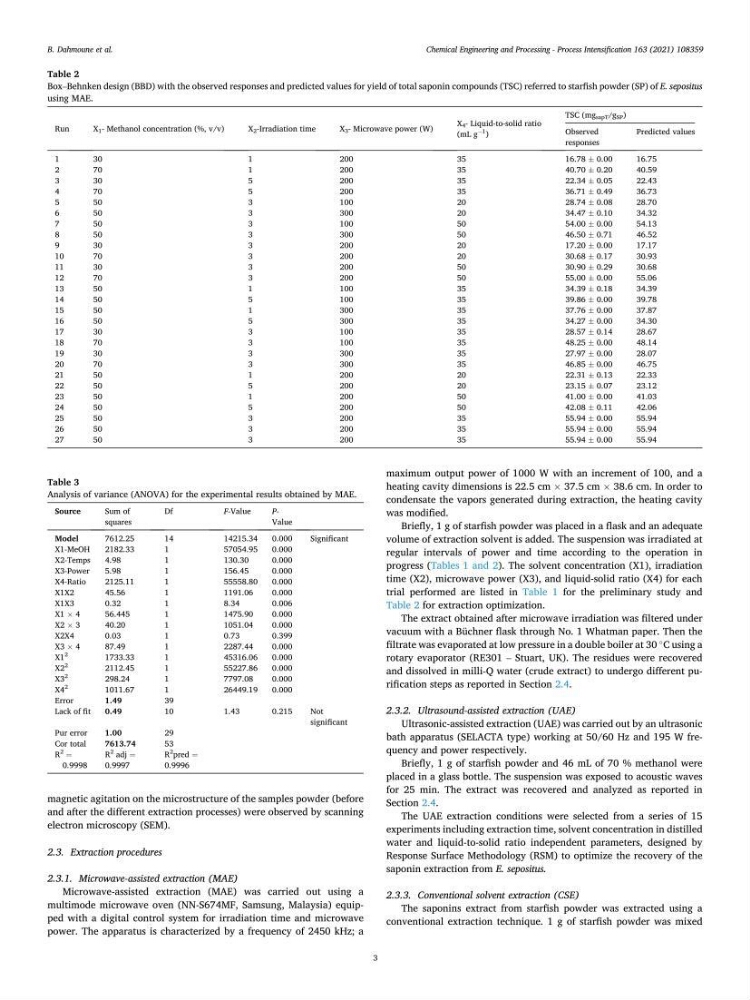
progress (Tables 1 and 2). The solvent concentration (X1), irradiation
time (X2), microwave power (X3), and liquid-solid ratio (X4) for each
trial performed are listed in Table 1 for the preliminary study and
Table 2 for extraction optimization.
The extract obtained after microwave irradiation was filtered under
vacuum with a Büchner flask through No. 1 Whatman paper. Then the
filtrate was evaporated at low pressure in a double boiler at 30
◦
C using a
rotary evaporator (RE301 – Stuart, UK). The residues were recovered
and dissolved in milli-Q water (crude extract) to undergo different purification steps as reported in Section 2.4.
2.3.2. Ultrasound-assisted extraction (UAE)
Ultrasonic-assisted extraction (UAE) was carried out by an ultrasonic
bath apparatus (SELACTA type) working at 50/60 Hz and 195 W frequency and power respectively.
Briefly, 1 g of starfish powder and 46 mL of 70 % methanol were
placed in a glass bottle. The suspension was exposed to acoustic waves
for 25 min. The extract was recovered and analyzed as reported in
Section 2.4.
The UAE extraction conditions were selected from a series of 15
experiments including extraction time, solvent concentration in distilled
water and liquid-to-solid ratio independent parameters, designed by
Response Surface Methodology (RSM) to optimize the recovery of the
saponin extraction from E. sepositus.
2.3.3. Conventional solvent extraction (CSE)
The saponins extract from starfish powder was extracted using a
conventional extraction technique. 1 g of starfish powder was mixed
Table 2
Box–Behnken design (BBD) with the observed responses and predicted values for yield of total saponin compounds (TSC) referred to starfish powder (SP) of E. sepositus
using MAE.
Run
X 1 - Methanol concentration (%, v/v)
X 2 -Irradiation time
X 3 - Microwave power (W)
X 4 - Liquid-to-solid ratio
(mL g
− 1
)
TSC (mg sapT /g SP )
Observed
responses
Predicted values
1
30
1
200
35
16.78 ± 0.00
16.75
2
70
1
200
35
40.70 ± 0.20
40.59
3
30
5
200
35
22.34 ± 0.05
22.43
4
70
5
200
35
36.71 ± 0.49
36.73
5
50
3
100
20
28.74 ± 0.08
28.70
6
50
3
300
20
34.47 ± 0.10
34.32
7
50
3
100
50
54.00 ± 0.00
54.13
8
50
3
300
50
46.50 ± 0.71
46.52
9
30
3
200
20
17.20 ± 0.00
17.17
10
70
3
200
20
30.68 ± 0.17
30.93
11
30
3
200
50
30.90 ± 0.29
30.68
12
70
3
200
50
55.00 ± 0.00
55.06
13
50
1
100
35
34.39 ± 0.18
34.39
14
50
5
100
35
39.86 ± 0.00
39.78
15
50
1
300
35
37.76 ± 0.00
37.87
16
50
5
300
35
34.27 ± 0.00
34.30
17
30
3
100
35
28.57 ± 0.14
28.67
18
70
3
100
35
48.25 ± 0.00
48.14
19
30
3
300
35
27.97 ± 0.00
28.07
20
70
3
300
35
46.85 ± 0.00
46.75
21
50
1
200
20
22.31 ± 0.13
22.33
22
50
5
200
20
23.15 ± 0.07
23.12
23
50
1
200
50
41.00 ± 0.00
41.03
24
50
5
200
50
42.08 ± 0.11
42.06
25
50
3
200
35
55.94 ± 0.00
55.94
26
50
3
200
35
55.94 ± 0.00
55.94
27
50
3
200
35
55.94 ± 0.00
55.94
Table 3
Analysis of variance (ANOVA) for the experimental results obtained by MAE.
Source
Sum of
squares
Df
F-Value
PValue
Model
7612.25
14
14215.34
0.000
Significant
X1-MeOH
2182.33
1
57054.95
0.000
X2-Temps
4.98
1
130.30
0.000
X3-Power
5.98
1
156.45
0.000
X4-Ratio
2125.11
1
55558.80
0.000
X1X2
45.56
1
1191.06
0.000
X1X3
0.32
1
8.34
0.006
X1 × 4
56.445
1
1475.90
0.000
X2 × 3
40.20
1
1051.04
0.000
X2X4
0.03
1
0.73
0.399
X3 × 4
87.49
1
2287.44
0.000
X1
2
1733.33
1
45316.06
0.000
X2
2
2112.45
1
55227.86
0.000
X3
2
298.24
1
7797.08
0.000
X4
2
1011.67
1
26449.19
0.000
Error
1.49
39
Lack of fit
0.49
10
1.43
0.215
Not
significant
Pur error
1.00
29
Cor total
7613.74
53
R
2 =
0.9998
R
2 adj =
0.9997
R
2
pred =
0.9996
B. Dahmoune et al.
3
magnetic agitation on the microstructure of the samples powder (before
and after the different extraction processes) were observed by scanning
electron microscopy (SEM).
2.3. Extraction procedures
2.3.1. Microwave-assisted extraction (MAE)
Microwave-assisted extraction (MAE) was carried out using a
multimode microwave oven (NN-S674MF, Samsung, Malaysia) equipped with a digital control system for irradiation time and microwave
power. The apparatus is characterized by a frequency of 2450 kHz; a
maximum output power of 1000 W with an increment of 100, and a
heating cavity dimensions is 22.5 cm × 37.5 cm × 38.6 cm. In order to
condensate the vapors generated during extraction, the heating cavity
was modified.
Briefly, 1 g of starfish powder was placed in a flask and an adequate
volume of extraction solvent is added. The suspension was irradiated at
regular intervals of power and time according to the operation in
progress (Tables 1 and 2). The solvent concentration (X1), irradiation
time (X2), microwave power (X3), and liquid-solid ratio (X4) for each
trial performed are listed in Table 1 for the preliminary study and
Table 2 for extraction optimization.
The extract obtained after microwave irradiation was filtered under
vacuum with a Büchner flask through No. 1 Whatman paper. Then the
filtrate was evaporated at low pressure in a double boiler at 30
◦
C using a
rotary evaporator (RE301 – Stuart, UK). The residues were recovered
and dissolved in milli-Q water (crude extract) to undergo different purification steps as reported in Section 2.4.
2.3.2. Ultrasound-assisted extraction (UAE)
Ultrasonic-assisted extraction (UAE) was carried out by an ultrasonic
bath apparatus (SELACTA type) working at 50/60 Hz and 195 W frequency and power respectively.
Briefly, 1 g of starfish powder and 46 mL of 70 % methanol were
placed in a glass bottle. The suspension was exposed to acoustic waves
for 25 min. The extract was recovered and analyzed as reported in
Section 2.4.
The UAE extraction conditions were selected from a series of 15
experiments including extraction time, solvent concentration in distilled
water and liquid-to-solid ratio independent parameters, designed by
Response Surface Methodology (RSM) to optimize the recovery of the
saponin extraction from E. sepositus.
2.3.3. Conventional solvent extraction (CSE)
The saponins extract from starfish powder was extracted using a
conventional extraction technique. 1 g of starfish powder was mixed
Table 2
Box–Behnken design (BBD) with the observed responses and predicted values for yield of total saponin compounds (TSC) referred to starfish powder (SP) of E. sepositus
using MAE.
Run
X 1 - Methanol concentration (%, v/v)
X 2 -Irradiation time
X 3 - Microwave power (W)
X 4 - Liquid-to-solid ratio
(mL g
− 1
)
TSC (mg sapT /g SP )
Observed
responses
Predicted values
1
30
1
200
35
16.78 ± 0.00
16.75
2
70
1
200
35
40.70 ± 0.20
40.59
3
30
5
200
35
22.34 ± 0.05
22.43
4
70
5
200
35
36.71 ± 0.49
36.73
5
50
3
100
20
28.74 ± 0.08
28.70
6
50
3
300
20
34.47 ± 0.10
34.32
7
50
3
100
50
54.00 ± 0.00
54.13
8
50
3
300
50
46.50 ± 0.71
46.52
9
30
3
200
20
17.20 ± 0.00
17.17
10
70
3
200
20
30.68 ± 0.17
30.93
11
30
3
200
50
30.90 ± 0.29
30.68
12
70
3
200
50
55.00 ± 0.00
55.06
13
50
1
100
35
34.39 ± 0.18
34.39
14
50
5
100
35
39.86 ± 0.00
39.78
15
50
1
300
35
37.76 ± 0.00
37.87
16
50
5
300
35
34.27 ± 0.00
34.30
17
30
3
100
35
28.57 ± 0.14
28.67
18
70
3
100
35
48.25 ± 0.00
48.14
19
30
3
300
35
27.97 ± 0.00
28.07
20
70
3
300
35
46.85 ± 0.00
46.75
21
50
1
200
20
22.31 ± 0.13
22.33
22
50
5
200
20
23.15 ± 0.07
23.12
23
50
1
200
50
41.00 ± 0.00
41.03
24
50
5
200
50
42.08 ± 0.11
42.06
25
50
3
200
35
55.94 ± 0.00
55.94
26
50
3
200
35
55.94 ± 0.00
55.94
27
50
3
200
35
55.94 ± 0.00
55.94
Table 3
Analysis of variance (ANOVA) for the experimental results obtained by MAE.
Source
Sum of
squares
Df
F-Value
PValue
Model
7612.25
14
14215.34
0.000
Significant
X1-MeOH
2182.33
1
57054.95
0.000
X2-Temps
4.98
1
130.30
0.000
X3-Power
5.98
1
156.45
0.000
X4-Ratio
2125.11
1
55558.80
0.000
X1X2
45.56
1
1191.06
0.000
X1X3
0.32
1
8.34
0.006
X1 × 4
56.445
1
1475.90
0.000
X2 × 3
40.20
1
1051.04
0.000
X2X4
0.03
1
0.73
0.399
X3 × 4
87.49
1
2287.44
0.000
X1
2
1733.33
1
45316.06
0.000
X2
2
2112.45
1
55227.86
0.000
X3
2
298.24
1
7797.08
0.000
X4
2
1011.67
1
26449.19
0.000
Error
1.49
39
Lack of fit
0.49
10
1.43
0.215
Not
significant
Pur error
1.00
29
Cor total
7613.74
53
R
2 =
0.9998
R
2 adj =
0.9997
R
2
pred =
0.9996
B. Dahmoune et al.