

The Principles of Fluorescence
31
effect of this interference is that the fluorescence signal no longer varies simply with the
concentration of the fluorophore(s), but is also strongly dependent on changes in the optical
attenuation coefficients of the sample, at the excitation and fluorescing wavelengths. This
problem can be largely overcome by monitoring the water Raman signal and fluorescence
emission. The relatively intense scattered signal from the O–H vibrational stretching mode
of liquid water gives a good indication of the probed sample volume. By taking the ratio of
the intensities for the fluorescence signal to that of the Raman signal, fluorescence emission data can be obtained that are independent of changes in the optical attenuation at the
excitation wavelength and the water Raman signal wavelengths. For example, when a water
sample is excited at 350 nm, water Raman signals occurs at 397 nm. The water Raman signal at 397 nm will be superimposed on a broad band of fluorescence due to the presence of
dissolved organic matter (DOM). In samples with high levels of DOM the broad band fluorescence may be high and therefore it is necessary to separate the water Raman signal from
the fluorescence spectra. This can be achieved by taking measurements on either side of the
Raman band and calculating the Raman component by linear interpolation. The correction
of fluorescence emission intensities using water Raman signals accounts for the attenuation
of the incident light at the excitation wavelength and also for the attenuation at wavelengths
corresponding to the water Raman line. There is still a problem of signal attenuation at
other wavelengths and if this attenuation is significant then separate corrections have to be
developed and applied to compensate for this differential absorption.
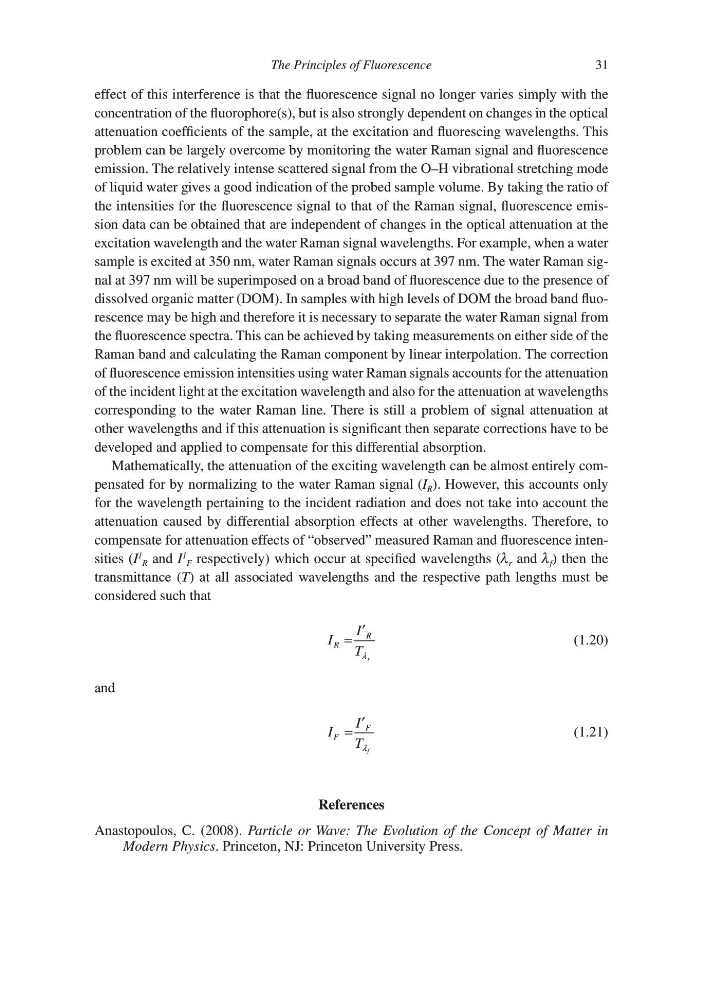
Mathematically, the attenuation of the exciting wavelength can be almost entirely compensated for by normalizing to the water Raman signal (I R ). However, this accounts only
for the wavelength pertaining to the incident radiation and does not take into account the
attenuation caused by differential absorption effects at other wavelengths. Therefore, to
compensate for attenuation effects of “observed” measured Raman and fluorescence intensities (I
1 R and I
1 F respectively) which occur at specified wavelengths (λ r and λ f ) then the
transmittance (T) at all associated wavelengths and the respective path lengths must be
considered such that
I
I
T
R
R
r
=
′
λ
(1.20)
and
I
I
T
F
F
f
=
′
λ
(1.21)
References
Anastopoulos, C. (2008). Particle or Wave: The Evolution of the Concept of Matter in
Modern Physics. Princeton, NJ: Princeton University Press.
31
effect of this interference is that the fluorescence signal no longer varies simply with the
concentration of the fluorophore(s), but is also strongly dependent on changes in the optical
attenuation coefficients of the sample, at the excitation and fluorescing wavelengths. This
problem can be largely overcome by monitoring the water Raman signal and fluorescence
emission. The relatively intense scattered signal from the O–H vibrational stretching mode
of liquid water gives a good indication of the probed sample volume. By taking the ratio of
the intensities for the fluorescence signal to that of the Raman signal, fluorescence emission data can be obtained that are independent of changes in the optical attenuation at the
excitation wavelength and the water Raman signal wavelengths. For example, when a water
sample is excited at 350 nm, water Raman signals occurs at 397 nm. The water Raman signal at 397 nm will be superimposed on a broad band of fluorescence due to the presence of
dissolved organic matter (DOM). In samples with high levels of DOM the broad band fluorescence may be high and therefore it is necessary to separate the water Raman signal from
the fluorescence spectra. This can be achieved by taking measurements on either side of the
Raman band and calculating the Raman component by linear interpolation. The correction
of fluorescence emission intensities using water Raman signals accounts for the attenuation
of the incident light at the excitation wavelength and also for the attenuation at wavelengths
corresponding to the water Raman line. There is still a problem of signal attenuation at
other wavelengths and if this attenuation is significant then separate corrections have to be
developed and applied to compensate for this differential absorption.
Mathematically, the attenuation of the exciting wavelength can be almost entirely compensated for by normalizing to the water Raman signal (I R ). However, this accounts only
for the wavelength pertaining to the incident radiation and does not take into account the
attenuation caused by differential absorption effects at other wavelengths. Therefore, to
compensate for attenuation effects of “observed” measured Raman and fluorescence intensities (I
1 R and I
1 F respectively) which occur at specified wavelengths (λ r and λ f ) then the
transmittance (T) at all associated wavelengths and the respective path lengths must be
considered such that
I
I
T
R
R
r
=
′
λ
(1.20)
and
I
I
T
F
F
f
=
′
λ
(1.21)
References
Anastopoulos, C. (2008). Particle or Wave: The Evolution of the Concept of Matter in
Modern Physics. Princeton, NJ: Princeton University Press.