

Reynolds
24
Substituting for [M*] from Eq. (1.8) gives
I t k M
k t
F
R
F
( ) =
−
[ ]
(
)
* 0 exp
(1.10)
Substituting for [M*] 0 from I F (0) = k R [M*] 0 , where I F (0) is the intensity at the time of the
initial excitation, into Eq. (1.10) gives
I t I
kt
F
F
F
( ) =
−
( ) (
)
0 exp
(1.11)
Therefore the intensity decays exponentially after the initial excitation pulse. The fluorescence lifetime of the excited state, τ F , can be represented as τ F = (1/k F ). The fluorescence
lifetime of a molecule is defined as the time taken for the excited state population to fall to
1/e of that initially excited. Equation (1.11) can then be rewritten as
I t I
e
F
F
t F
( ) = ( )
−
0
/ τ
Equation (1.11) relates the measured parameter of intensity to the fluorescence lifetime,
enabling its calculation experimentally. Possible methods for the determination of the
300
Wavelength (nm)
Stokes shift
Fluorescence Excitation
350
400
450
500
550
600
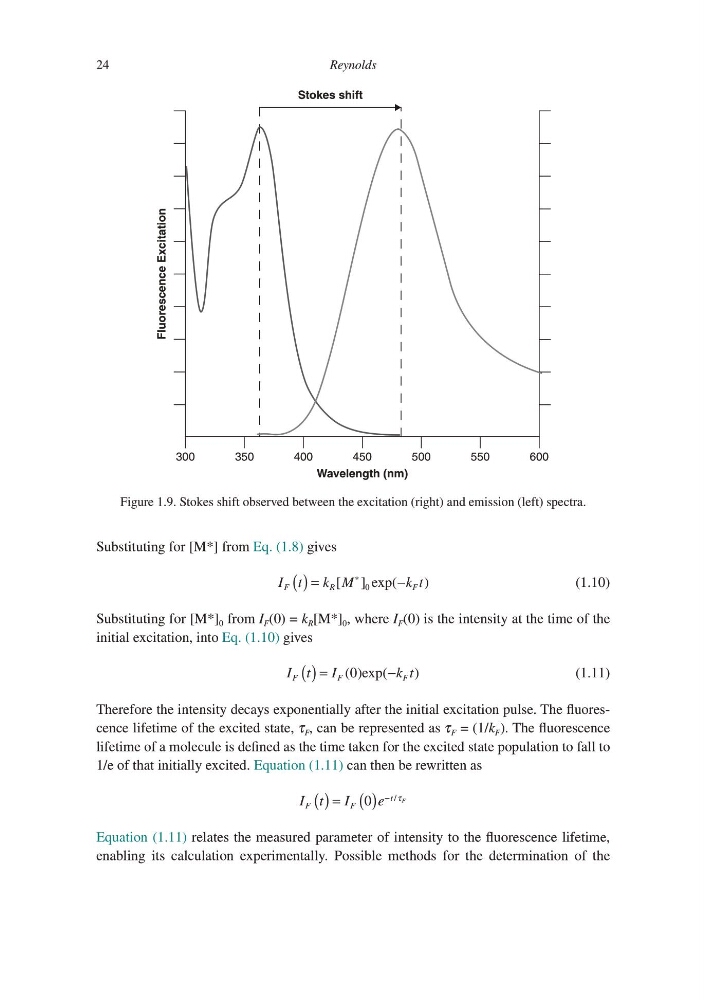
Figure 1.9. Stokes shift observed between the excitation (right) and emission (left) spectra.
24
Substituting for [M*] from Eq. (1.8) gives
I t k M
k t
F
R
F
( ) =
−
[ ]
(
)
* 0 exp
(1.10)
Substituting for [M*] 0 from I F (0) = k R [M*] 0 , where I F (0) is the intensity at the time of the
initial excitation, into Eq. (1.10) gives
I t I
kt
F
F
F
( ) =
−
( ) (
)
0 exp
(1.11)
Therefore the intensity decays exponentially after the initial excitation pulse. The fluorescence lifetime of the excited state, τ F , can be represented as τ F = (1/k F ). The fluorescence
lifetime of a molecule is defined as the time taken for the excited state population to fall to
1/e of that initially excited. Equation (1.11) can then be rewritten as
I t I
e
F
F
t F
( ) = ( )
−
0
/ τ
Equation (1.11) relates the measured parameter of intensity to the fluorescence lifetime,
enabling its calculation experimentally. Possible methods for the determination of the
300
Wavelength (nm)
Stokes shift
Fluorescence Excitation
350
400
450
500
550
600
Figure 1.9. Stokes shift observed between the excitation (right) and emission (left) spectra.