

Reynolds
22
a photon of light (see solid vertical lines in Figure 1.1). If the excitation energy were to be
removed then the lifetime of the fluorescence would be short, typically ranging from picoseconds to nanoseconds. In contrast, phosphorescence lifetimes are much longer in nature
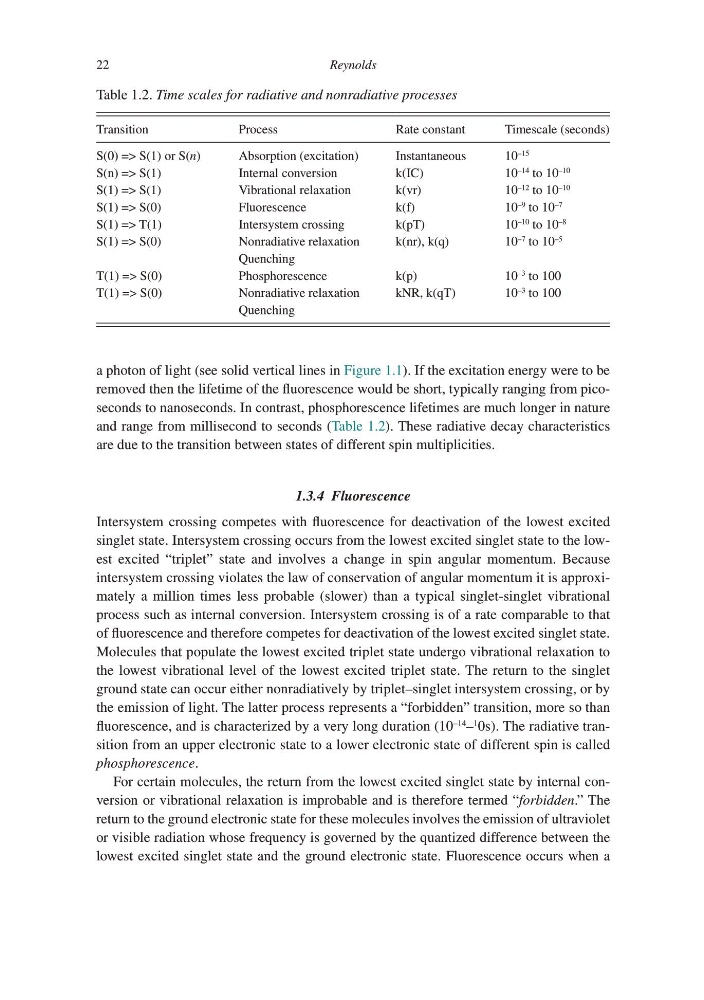
and range from millisecond to seconds (Table 1.2). These radiative decay characteristics
are due to the transition between states of different spin multiplicities.
1.3.4 Fluorescence
Intersystem crossing competes with fluorescence for deactivation of the lowest excited
singlet state. Intersystem crossing occurs from the lowest excited singlet state to the lowest excited “triplet” state and involves a change in spin angular momentum. Because
intersystem crossing violates the law of conservation of angular momentum it is approximately a million times less probable (slower) than a typical singlet-singlet vibrational
process such as internal conversion. Intersystem crossing is of a rate comparable to that
of fluorescence and therefore competes for deactivation of the lowest excited singlet state.
Molecules that populate the lowest excited triplet state undergo vibrational relaxation to
the lowest vibrational level of the lowest excited triplet state. The return to the singlet
ground state can occur either nonradiatively by triplet–singlet intersystem crossing, or by
the emission of light. The latter process represents a “forbidden” transition, more so than
fluorescence, and is characterized by a very long duration (10
–14
–
1
0s). The radiative transition from an upper electronic state to a lower electronic state of different spin is called
phosphorescence.
For certain molecules, the return from the lowest excited singlet state by internal conversion or vibrational relaxation is improbable and is therefore termed “forbidden.” The
return to the ground electronic state for these molecules involves the emission of ultraviolet
or visible radiation whose frequency is governed by the quantized difference between the
lowest excited singlet state and the ground electronic state. Fluorescence occurs when a
Table 1.2. Time scales for radiative and nonradiative processes
Transition
Process
Rate constant
Timescale (seconds)
S(0) => S(1) or S(n)
Absorption (excitation)
Instantaneous
10
–15
S(n) => S(1)
Internal conversion
k(IC)
10
–14
to 10
–10
S(1) => S(1)
Vibrational relaxation
k(vr)
10
–12
to 10
–10
S(1) => S(0)
Fluorescence
k(f)
10
–9
to 10
–7
S(1) => T(1)
Intersystem crossing
k(pT)
10
–10
to 10
–8
S(1) => S(0)
Nonradiative relaxation
Quenching
k(nr), k(q)
10
–7
to 10
–5
T(1) => S(0)
Phosphorescence
k(p)
10
–3
to 100
T(1) => S(0)
Nonradiative relaxation
Quenching
kNR, k(qT)
10
–3
to 100
22
a photon of light (see solid vertical lines in Figure 1.1). If the excitation energy were to be
removed then the lifetime of the fluorescence would be short, typically ranging from picoseconds to nanoseconds. In contrast, phosphorescence lifetimes are much longer in nature
and range from millisecond to seconds (Table 1.2). These radiative decay characteristics
are due to the transition between states of different spin multiplicities.
1.3.4 Fluorescence
Intersystem crossing competes with fluorescence for deactivation of the lowest excited
singlet state. Intersystem crossing occurs from the lowest excited singlet state to the lowest excited “triplet” state and involves a change in spin angular momentum. Because
intersystem crossing violates the law of conservation of angular momentum it is approximately a million times less probable (slower) than a typical singlet-singlet vibrational
process such as internal conversion. Intersystem crossing is of a rate comparable to that
of fluorescence and therefore competes for deactivation of the lowest excited singlet state.
Molecules that populate the lowest excited triplet state undergo vibrational relaxation to
the lowest vibrational level of the lowest excited triplet state. The return to the singlet
ground state can occur either nonradiatively by triplet–singlet intersystem crossing, or by
the emission of light. The latter process represents a “forbidden” transition, more so than
fluorescence, and is characterized by a very long duration (10
–14
–
1
0s). The radiative transition from an upper electronic state to a lower electronic state of different spin is called
phosphorescence.
For certain molecules, the return from the lowest excited singlet state by internal conversion or vibrational relaxation is improbable and is therefore termed “forbidden.” The
return to the ground electronic state for these molecules involves the emission of ultraviolet
or visible radiation whose frequency is governed by the quantized difference between the
lowest excited singlet state and the ground electronic state. Fluorescence occurs when a
Table 1.2. Time scales for radiative and nonradiative processes
Transition
Process
Rate constant
Timescale (seconds)
S(0) => S(1) or S(n)
Absorption (excitation)
Instantaneous
10
–15
S(n) => S(1)
Internal conversion
k(IC)
10
–14
to 10
–10
S(1) => S(1)
Vibrational relaxation
k(vr)
10
–12
to 10
–10
S(1) => S(0)
Fluorescence
k(f)
10
–9
to 10
–7
S(1) => T(1)
Intersystem crossing
k(pT)
10
–10
to 10
–8
S(1) => S(0)
Nonradiative relaxation
Quenching
k(nr), k(q)
10
–7
to 10
–5
T(1) => S(0)
Phosphorescence
k(p)
10
–3
to 100
T(1) => S(0)
Nonradiative relaxation
Quenching
kNR, k(qT)
10
–3
to 100