

Reynolds
20
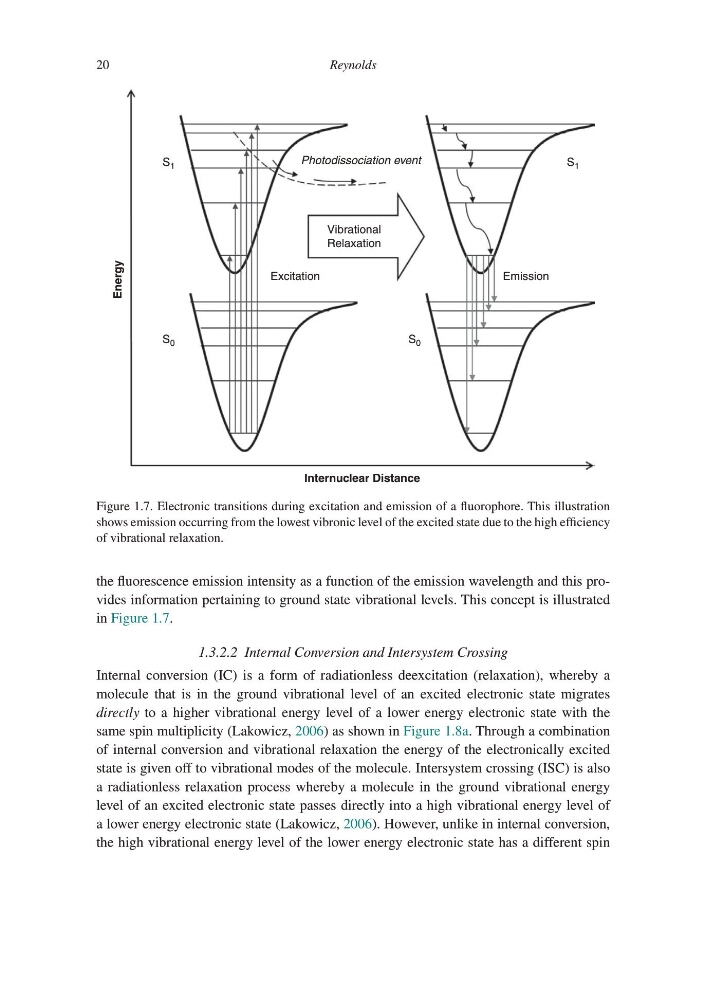
the fluorescence emission intensity as a function of the emission wavelength and this provides information pertaining to ground state vibrational levels. This concept is illustrated
in Figure 1.7.
1.3.2.2 Internal Conversion and Intersystem Crossing
Internal conversion (IC) is a form of radiationless deexcitation (relaxation), whereby a
molecule that is in the ground vibrational level of an excited electronic state migrates
directly to a higher vibrational energy level of a lower energy electronic state with the
same spin multiplicity (Lakowicz, 2006) as shown in Figure 1.8a. Through a combination
of internal conversion and vibrational relaxation the energy of the electronically excited
state is given off to vibrational modes of the molecule. Intersystem crossing (ISC) is also
a radiationless relaxation process whereby a molecule in the ground vibrational energy
level of an excited electronic state passes directly into a high vibrational energy level of
a lower energy electronic state (Lakowicz, 2006). However, unlike in internal conversion,
the high vibrational energy level of the lower energy electronic state has a different spin
Excitation
S 0
S 1
S 0
S 1
Emission
Vibrational
Relaxation
Photodissociation event
Internuclear Distance
Energy
Figure 1.7. Electronic transitions during excitation and emission of a fluorophore. This illustration
shows emission occurring from the lowest vibronic level of the excited state due to the high efficiency
of vibrational relaxation.
20
the fluorescence emission intensity as a function of the emission wavelength and this provides information pertaining to ground state vibrational levels. This concept is illustrated
in Figure 1.7.
1.3.2.2 Internal Conversion and Intersystem Crossing
Internal conversion (IC) is a form of radiationless deexcitation (relaxation), whereby a
molecule that is in the ground vibrational level of an excited electronic state migrates
directly to a higher vibrational energy level of a lower energy electronic state with the
same spin multiplicity (Lakowicz, 2006) as shown in Figure 1.8a. Through a combination
of internal conversion and vibrational relaxation the energy of the electronically excited
state is given off to vibrational modes of the molecule. Intersystem crossing (ISC) is also
a radiationless relaxation process whereby a molecule in the ground vibrational energy
level of an excited electronic state passes directly into a high vibrational energy level of
a lower energy electronic state (Lakowicz, 2006). However, unlike in internal conversion,
the high vibrational energy level of the lower energy electronic state has a different spin
Excitation
S 0
S 1
S 0
S 1
Emission
Vibrational
Relaxation
Photodissociation event
Internuclear Distance
Energy
Figure 1.7. Electronic transitions during excitation and emission of a fluorophore. This illustration
shows emission occurring from the lowest vibronic level of the excited state due to the high efficiency
of vibrational relaxation.