

Fluorescence Indices and Their Interpretation
321
polycondensation than soil extracts from extensively used or unused land. Zsolnay et al.
(1999) proposed the HIX EM to measure the effects of soil drying on DOM quality, demonstrating that drying released a greater degree of non-humified material, and Agaki et al.
(2007) utilized HIX EM to assess the effects of two different soil sample treatments.
Several studies have used and compared both humification indices (i.e., both HIX SYN
and HIX EM ). Kalbitz et al. (2003) investigated the impact of biodegradation on the properties of dissolved organic matter extracted from 13 different soil samples. With increasing biodegradation both HIX EM and HIX SYN decreased, indicative of a smaller degree of
humification. This decrease in humification was also associated with a decrease in aromatic
Reduced
humics
?
eFe-and
humicsreducing
bacteria
Oxidized
humics
0.3
1.4
1.5
1.6
Fluorescence index (FI)
1.7
Microbial
(labile DOM)
Site B pond
Other SW
Terrestrial
(sedimentary humics)
0.4
11m GW
14m GW
8m GW
40m GW
52m GW
0.5
y = –1.1x + 2.0
R
2 = 0.74
Redox index
Oxidized
Reduced
Sedimentary
humics
Fe(II)
Free
As
Fe mineral + As
CO 2
Labile
DOM
(b)
(a)
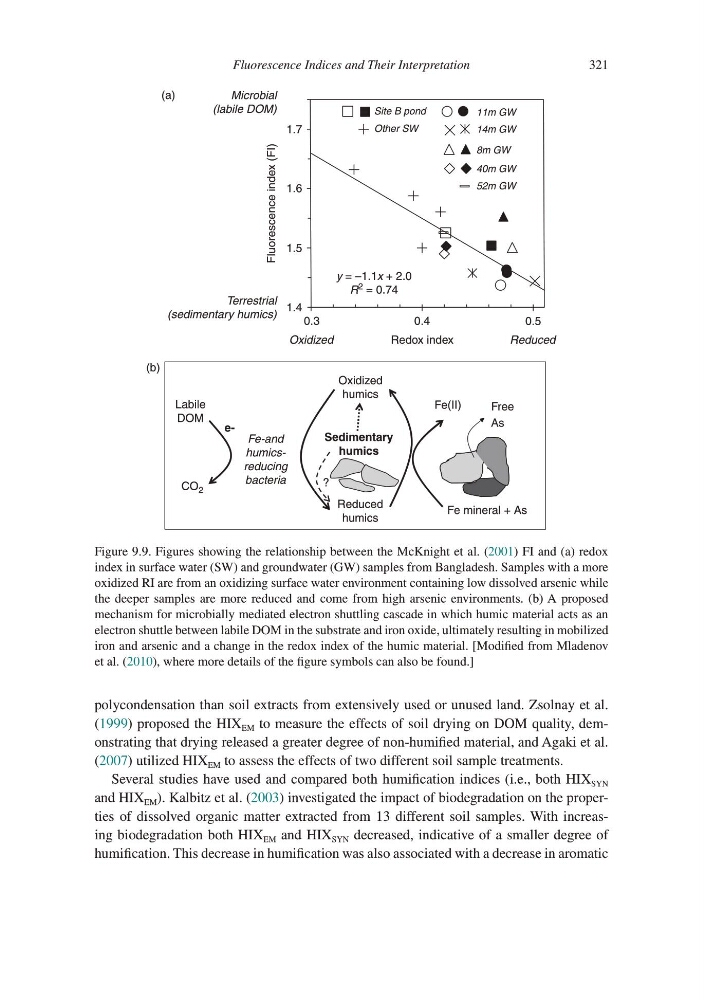
Figure 9.9. Figures showing the relationship between the McKnight et al. (2001) FI and (a) redox
index in surface water (SW) and groundwater (GW) samples from Bangladesh. Samples with a more
oxidized RI are from an oxidizing surface water environment containing low dissolved arsenic while
the deeper samples are more reduced and come from high arsenic environments. (b) A proposed
mechanism for microbially mediated electron shuttling cascade in which humic material acts as an
electron shuttle between labile DOM in the substrate and iron oxide, ultimately resulting in mobilized
iron and arsenic and a change in the redox index of the humic material. [Modified from Mladenov
et al. (2010), where more details of the figure symbols can also be found.]
321
polycondensation than soil extracts from extensively used or unused land. Zsolnay et al.
(1999) proposed the HIX EM to measure the effects of soil drying on DOM quality, demonstrating that drying released a greater degree of non-humified material, and Agaki et al.
(2007) utilized HIX EM to assess the effects of two different soil sample treatments.
Several studies have used and compared both humification indices (i.e., both HIX SYN
and HIX EM ). Kalbitz et al. (2003) investigated the impact of biodegradation on the properties of dissolved organic matter extracted from 13 different soil samples. With increasing biodegradation both HIX EM and HIX SYN decreased, indicative of a smaller degree of
humification. This decrease in humification was also associated with a decrease in aromatic
Reduced
humics
?
eFe-and
humicsreducing
bacteria
Oxidized
humics
0.3
1.4
1.5
1.6
Fluorescence index (FI)
1.7
Microbial
(labile DOM)
Site B pond
Other SW
Terrestrial
(sedimentary humics)
0.4
11m GW
14m GW
8m GW
40m GW
52m GW
0.5
y = –1.1x + 2.0
R
2 = 0.74
Redox index
Oxidized
Reduced
Sedimentary
humics
Fe(II)
Free
As
Fe mineral + As
CO 2
Labile
DOM
(b)
(a)
Figure 9.9. Figures showing the relationship between the McKnight et al. (2001) FI and (a) redox
index in surface water (SW) and groundwater (GW) samples from Bangladesh. Samples with a more
oxidized RI are from an oxidizing surface water environment containing low dissolved arsenic while
the deeper samples are more reduced and come from high arsenic environments. (b) A proposed
mechanism for microbially mediated electron shuttling cascade in which humic material acts as an
electron shuttle between labile DOM in the substrate and iron oxide, ultimately resulting in mobilized
iron and arsenic and a change in the redox index of the humic material. [Modified from Mladenov
et al. (2010), where more details of the figure symbols can also be found.]