

The Principles of Fluorescence
15
representing the values of +½ or –½. For a specified electronic state the total spin quantum
number (s) is given by the vector addition (angular momentum) of the individual spin quantum numbers. Therefore the spin multiplicity of an electronic state is defined as 2s + 1.
If a molecule has two electrons in its highest occupied molecular orbital in the ground
state then these have opposing spins of +½ or –½. Hence s = 0 and the multiplicity (2s + 1)
of this specific state is 1; this is referred to as a singlet state (Figure 1.4a). In an excited
state, the electrons will either remain opposing (Figure 1.4b) where s = 0 or else adopt
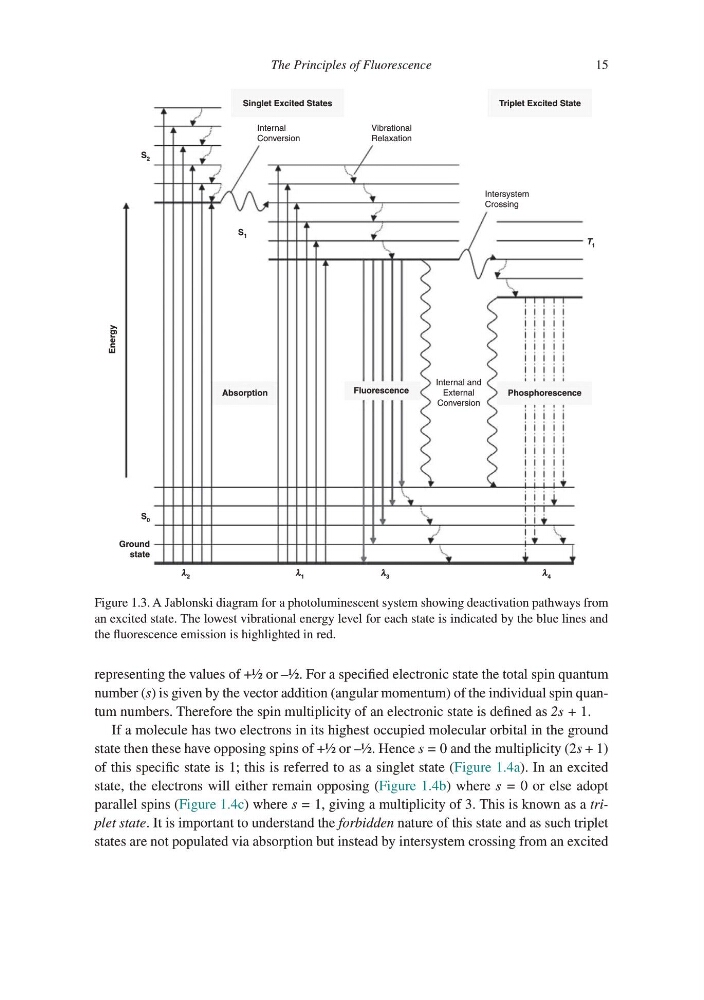
parallel spins (Figure 1.4c) where s = 1, giving a multiplicity of 3. This is known as a triplet state. It is important to understand the forbidden nature of this state and as such triplet
states are not populated via absorption but instead by intersystem crossing from an excited
Internal
Conversion
Internal and
External
Conversion
Vibrational
Relaxation
Intersystem
Crossing
Absorption
Ground
state
Fluorescence
Phosphorescence
S 1
S 0
λ 2
λ 1
λ 3
λ 4
T 1
S 2
Energy
Singlet Excited States
Triplet Excited State
Figure 1.3. A Jablonski diagram for a photoluminescent system showing deactivation pathways from
an excited state. The lowest vibrational energy level for each state is indicated by the blue lines and
the fluorescence emission is highlighted in red.
15
representing the values of +½ or –½. For a specified electronic state the total spin quantum
number (s) is given by the vector addition (angular momentum) of the individual spin quantum numbers. Therefore the spin multiplicity of an electronic state is defined as 2s + 1.
If a molecule has two electrons in its highest occupied molecular orbital in the ground
state then these have opposing spins of +½ or –½. Hence s = 0 and the multiplicity (2s + 1)
of this specific state is 1; this is referred to as a singlet state (Figure 1.4a). In an excited
state, the electrons will either remain opposing (Figure 1.4b) where s = 0 or else adopt
parallel spins (Figure 1.4c) where s = 1, giving a multiplicity of 3. This is known as a triplet state. It is important to understand the forbidden nature of this state and as such triplet
states are not populated via absorption but instead by intersystem crossing from an excited
Internal
Conversion
Internal and
External
Conversion
Vibrational
Relaxation
Intersystem
Crossing
Absorption
Ground
state
Fluorescence
Phosphorescence
S 1
S 0
λ 2
λ 1
λ 3
λ 4
T 1
S 2
Energy
Singlet Excited States
Triplet Excited State
Figure 1.3. A Jablonski diagram for a photoluminescent system showing deactivation pathways from
an excited state. The lowest vibrational energy level for each state is indicated by the blue lines and
the fluorescence emission is highlighted in red.