

Biological Origins
293
8.4 Future Research
Recent studies have put forward the hypothesis that photochemical and bacterial degradation act in a complementary way through formation of substrates available to the other
process (Amado et al., 2007; Vähätalo and Wetzel, 2008). This hypothesis appears to be
reflected in shifts in the FDOM pool during combined and/or subsequent photo and biochemical degradation of DOM, as summarized earlier, suggesting that FDOM is a good
proxy for processes influencing the wider (non-fluorescent + fluorescent) DOM pool.
However, one major limitation to using FDOM as a proxy to understand changes to the
DOM pool is the lack of a quantitative relationship between FDOM components/fractions
and DOM concentration. FDOM is a sensitive tracer that has provided new insight on how
rapidly some fractions of the DOM pool respond to coupled photo-biochemical processes
in the environment, often without detectable changes in the DOM pool measured on a
carbon basis (e.g., Nieto-Cid et al., 2006). These findings may suggest that although in
some systems FDOM may be a small fraction of the total DOM pool, some fractions of
the DOM pool may be more dynamic than previously assessed based solely on spatial and/
or temporal variation in DOC concentrations. Although challenging, it would be a major
breakthrough if we could link FDOM components with carbon concentrations.
Although much work is needed to develop a quantitative approach to FDOM as a proxy
for DOM processing in the environment, this chapter highlights some of the advances in
the qualitative understanding of photochemical and microbial sources and sinks of FDOM.
However, much more work is needed to unambiguously decipher the FDOM signature
such that we can discern the relative importance of each process acting on the DOM pool
Sunlight + microbial
processing
FDOM
FDOM
(a)
(b)
Landscape & hydrologic controls
stream
lake
stream
lake
stream
biodegradation
photodegradation
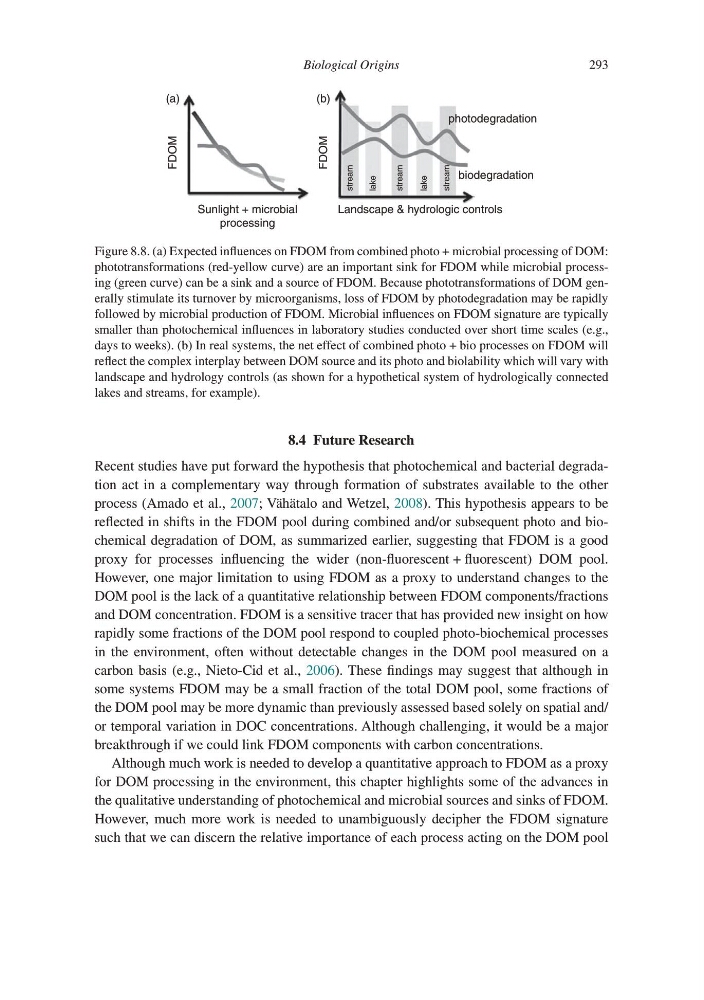
Figure 8.8. (a) Expected influences on FDOM from combined photo + microbial processing of DOM:
phototransformations (red-yellow curve) are an important sink for FDOM while microbial processing (green curve) can be a sink and a source of FDOM. Because phototransformations of DOM generally stimulate its turnover by microorganisms, loss of FDOM by photodegradation may be rapidly
followed by microbial production of FDOM. Microbial influences on FDOM signature are typically
smaller than photochemical influences in laboratory studies conducted over short time scales (e.g.,
days to weeks). (b) In real systems, the net effect of combined photo + bio processes on FDOM will
reflect the complex interplay between DOM source and its photo and biolability which will vary with
landscape and hydrology controls (as shown for a hypothetical system of hydrologically connected
lakes and streams, for example).
293
8.4 Future Research
Recent studies have put forward the hypothesis that photochemical and bacterial degradation act in a complementary way through formation of substrates available to the other
process (Amado et al., 2007; Vähätalo and Wetzel, 2008). This hypothesis appears to be
reflected in shifts in the FDOM pool during combined and/or subsequent photo and biochemical degradation of DOM, as summarized earlier, suggesting that FDOM is a good
proxy for processes influencing the wider (non-fluorescent + fluorescent) DOM pool.
However, one major limitation to using FDOM as a proxy to understand changes to the
DOM pool is the lack of a quantitative relationship between FDOM components/fractions
and DOM concentration. FDOM is a sensitive tracer that has provided new insight on how
rapidly some fractions of the DOM pool respond to coupled photo-biochemical processes
in the environment, often without detectable changes in the DOM pool measured on a
carbon basis (e.g., Nieto-Cid et al., 2006). These findings may suggest that although in
some systems FDOM may be a small fraction of the total DOM pool, some fractions of
the DOM pool may be more dynamic than previously assessed based solely on spatial and/
or temporal variation in DOC concentrations. Although challenging, it would be a major
breakthrough if we could link FDOM components with carbon concentrations.
Although much work is needed to develop a quantitative approach to FDOM as a proxy
for DOM processing in the environment, this chapter highlights some of the advances in
the qualitative understanding of photochemical and microbial sources and sinks of FDOM.
However, much more work is needed to unambiguously decipher the FDOM signature
such that we can discern the relative importance of each process acting on the DOM pool
Sunlight + microbial
processing
FDOM
FDOM
(a)
(b)
Landscape & hydrologic controls
stream
lake
stream
lake
stream
biodegradation
photodegradation
Figure 8.8. (a) Expected influences on FDOM from combined photo + microbial processing of DOM:
phototransformations (red-yellow curve) are an important sink for FDOM while microbial processing (green curve) can be a sink and a source of FDOM. Because phototransformations of DOM generally stimulate its turnover by microorganisms, loss of FDOM by photodegradation may be rapidly
followed by microbial production of FDOM. Microbial influences on FDOM signature are typically
smaller than photochemical influences in laboratory studies conducted over short time scales (e.g.,
days to weeks). (b) In real systems, the net effect of combined photo + bio processes on FDOM will
reflect the complex interplay between DOM source and its photo and biolability which will vary with
landscape and hydrology controls (as shown for a hypothetical system of hydrologically connected
lakes and streams, for example).