

Stedmon and Cory
286
(Jørgensen et al., 2011) and to also apply for CDOM absorption (Nelson et al., 2010).
Earlier experimental work also supports these findings. Rochelle-Newall and Fisher (2002)
and Stedmon and Markager (2005b) have shown how humic-like fluorescence is not evidently produced by phytoplankton directly, but by microbial activity on otherwise colorless DOM. In contrast, amino acid-like fluorescence appeared to be produced during the
300
800
600
400
200
300
350
400
Emission Wavelength (nm)
0
(a)
(b)
HO
OH
HYDROXYANTHRANILIC ACID
SKATOLE
INDOLE
TRYPTOPHAN
TYROSINE
NORADRENALINE
ADRENALIN
CATECHOL
DOPAMINE
O
NH 2
CH 3
N
H
200
100
300
N
H
350
400
HN
OH
OH
OH
OH H
N
OH
OH
OH
(R)
(R)
HO
HO
HO
HO
NH 2
NH 2
OH
H 2 N
H
O
OH
O
HN 2
Emission Wavelength (nm)
Fluorescence (10
–3
Raman units/nm)
Fluorescence (10
–3
Raman units/nm)
0
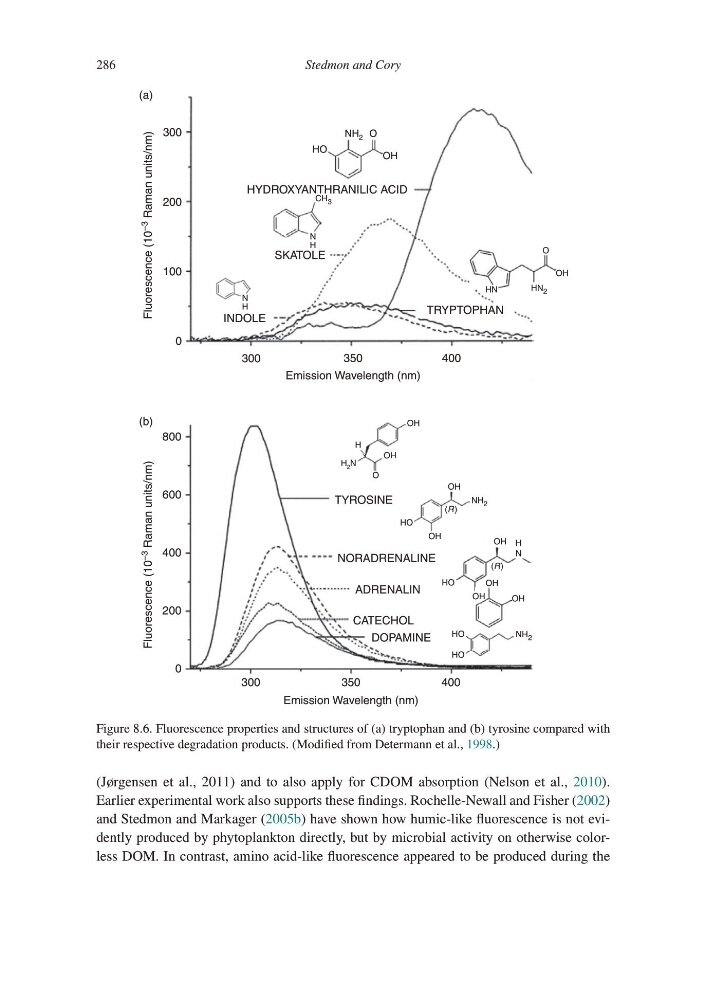
Figure 8.6. Fluorescence properties and structures of (a) tryptophan and (b) tyrosine compared with
their respective degradation products. (Modified from Determann et al., 1998.)
286
(Jørgensen et al., 2011) and to also apply for CDOM absorption (Nelson et al., 2010).
Earlier experimental work also supports these findings. Rochelle-Newall and Fisher (2002)
and Stedmon and Markager (2005b) have shown how humic-like fluorescence is not evidently produced by phytoplankton directly, but by microbial activity on otherwise colorless DOM. In contrast, amino acid-like fluorescence appeared to be produced during the
300
800
600
400
200
300
350
400
Emission Wavelength (nm)
0
(a)
(b)
HO
OH
HYDROXYANTHRANILIC ACID
SKATOLE
INDOLE
TRYPTOPHAN
TYROSINE
NORADRENALINE
ADRENALIN
CATECHOL
DOPAMINE
O
NH 2
CH 3
N
H
200
100
300
N
H
350
400
HN
OH
OH
OH
OH H
N
OH
OH
OH
(R)
(R)
HO
HO
HO
HO
NH 2
NH 2
OH
H 2 N
H
O
OH
O
HN 2
Emission Wavelength (nm)
Fluorescence (10
–3
Raman units/nm)
Fluorescence (10
–3
Raman units/nm)
0
Figure 8.6. Fluorescence properties and structures of (a) tryptophan and (b) tyrosine compared with
their respective degradation products. (Modified from Determann et al., 1998.)