

Biological Origins
281
Stedmon and Markager, 2005a). During colder temperatures the fluorescence signals were
comparable but during the summer months the fluorescence at 412 nm was much greater.
In contrast, more anthropogenically influenced catchments, such as those dominated
by agriculture, the mineral content and drainage time of the soils are notably higher.
Subsequently the FDOM leached from these types of catchments differs from natural
catchments. Seasonal changes in FDOM characteristics are less apparent and leaching of
FDOM is largely driven by rapid drainage of precipitation. A recent study by Fellman et al.
(2009a) has also shown that changes in the characteristics of FDOM exported from soils
comparable to those seen across season in natural catchments can also occur over very
short time periods, such as during a storm event. These compositional changes again reflect
2
3
4
Polyaromatic Hydrocarbons Rings
5
6
7
1.0
1 .2
1.4
Polyaromatic Hydrocarbons (C/H)
1.6
1 .8
2.0
460
400
380
Fluorescence Maximum (nm)
Fluorescence Maximum (nm)
340
320
360
420
440
550
400
300
350
450
500
y = 214.2x + 66.4
R
2 = 0.6773
(b)
(a)
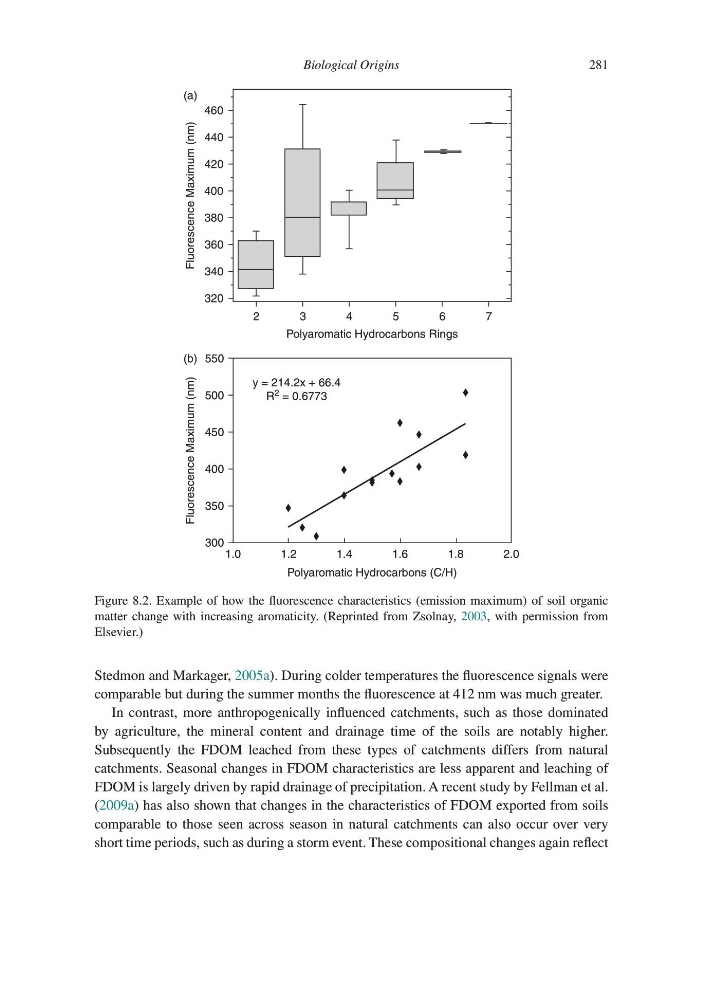
Figure 8.2. Example of how the fluorescence characteristics (emission maximum) of soil organic
matter change with increasing aromaticity. (Reprinted from Zsolnay, 2003, with permission from
Elsevier.)
281
Stedmon and Markager, 2005a). During colder temperatures the fluorescence signals were
comparable but during the summer months the fluorescence at 412 nm was much greater.
In contrast, more anthropogenically influenced catchments, such as those dominated
by agriculture, the mineral content and drainage time of the soils are notably higher.
Subsequently the FDOM leached from these types of catchments differs from natural
catchments. Seasonal changes in FDOM characteristics are less apparent and leaching of
FDOM is largely driven by rapid drainage of precipitation. A recent study by Fellman et al.
(2009a) has also shown that changes in the characteristics of FDOM exported from soils
comparable to those seen across season in natural catchments can also occur over very
short time periods, such as during a storm event. These compositional changes again reflect
2
3
4
Polyaromatic Hydrocarbons Rings
5
6
7
1.0
1 .2
1.4
Polyaromatic Hydrocarbons (C/H)
1.6
1 .8
2.0
460
400
380
Fluorescence Maximum (nm)
Fluorescence Maximum (nm)
340
320
360
420
440
550
400
300
350
450
500
y = 214.2x + 66.4
R
2 = 0.6773
(b)
(a)
Figure 8.2. Example of how the fluorescence characteristics (emission maximum) of soil organic
matter change with increasing aromaticity. (Reprinted from Zsolnay, 2003, with permission from
Elsevier.)