

Conmy, Del Castillo, Downing, and Chen
214
found that the products were only marginally effective against algal growth (McLean et al.,
1997). The same study reported that these coatings could ultimately serve as substrate for
microfauna because it increased the surface roughness of optical windows, therefore it is
best not apply them at all. Common anti-biofouling strategies used today include the use of
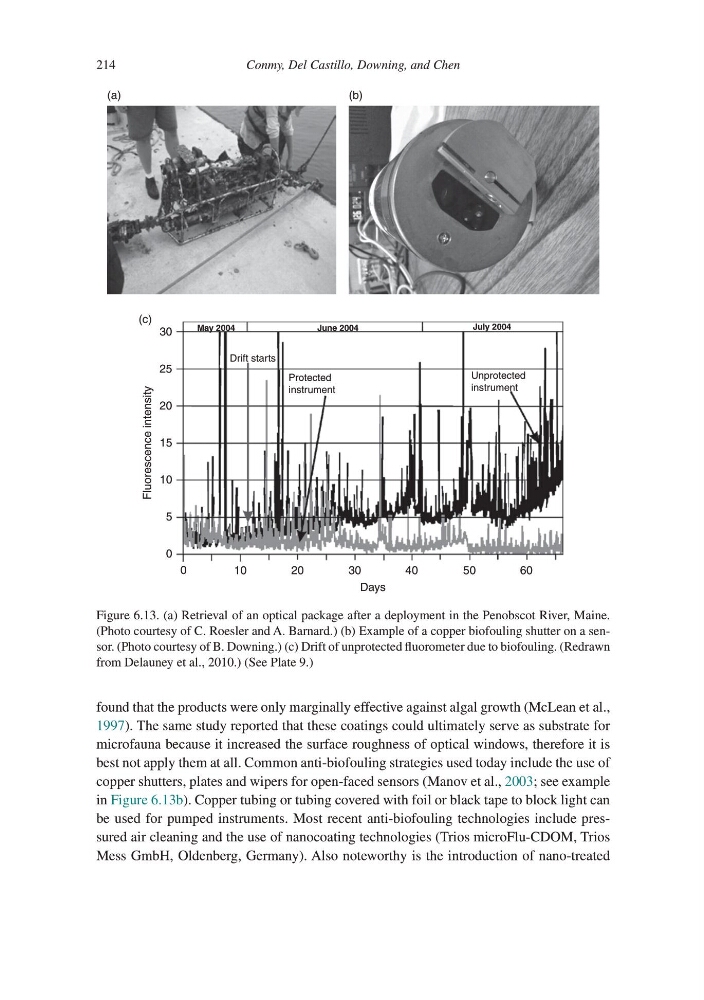
copper shutters, plates and wipers for open-faced sensors (Manov et al., 2003; see example
in Figure 6.13b). Copper tubing or tubing covered with foil or black tape to block light can
be used for pumped instruments. Most recent anti-biofouling technologies include pressured air cleaning and the use of nanocoating technologies (Trios microFlu-CDOM, Trios
Mess GmbH, Oldenberg, Germany). Also noteworthy is the introduction of nano-treated
0
0
5
10
15
Fluorescence intensity
20
25
Drift starts
June 2004
July 2004
May 2004
Protected
instrument
Unprotected
instrument
30
(a)
(b)
(c)
10
20
30
Days
40
50
60
Figure 6.13. (a) Retrieval of an optical package after a deployment in the Penobscot River, Maine.
(Photo courtesy of C. Roesler and A. Barnard.) (b) Example of a copper biofouling shutter on a sensor. (Photo courtesy of B. Downing.) (c) Drift of unprotected fluorometer due to biofouling. (Redrawn
from Delauney et al., 2010.) (See Plate 9.)
214
found that the products were only marginally effective against algal growth (McLean et al.,
1997). The same study reported that these coatings could ultimately serve as substrate for
microfauna because it increased the surface roughness of optical windows, therefore it is
best not apply them at all. Common anti-biofouling strategies used today include the use of
copper shutters, plates and wipers for open-faced sensors (Manov et al., 2003; see example
in Figure 6.13b). Copper tubing or tubing covered with foil or black tape to block light can
be used for pumped instruments. Most recent anti-biofouling technologies include pressured air cleaning and the use of nanocoating technologies (Trios microFlu-CDOM, Trios
Mess GmbH, Oldenberg, Germany). Also noteworthy is the introduction of nano-treated
0
0
5
10
15
Fluorescence intensity
20
25
Drift starts
June 2004
July 2004
May 2004
Protected
instrument
Unprotected
instrument
30
(a)
(b)
(c)
10
20
30
Days
40
50
60
Figure 6.13. (a) Retrieval of an optical package after a deployment in the Penobscot River, Maine.
(Photo courtesy of C. Roesler and A. Barnard.) (b) Example of a copper biofouling shutter on a sensor. (Photo courtesy of B. Downing.) (c) Drift of unprotected fluorometer due to biofouling. (Redrawn
from Delauney et al., 2010.) (See Plate 9.)