

Optical Spectroscopy Instrumentation Design
165
to be considered. The spectral bandpass ultimately defines the resolution of the instrument and for a given slit width, W, this is given by: (5.9)
R R W
λ = D
(5.9)
The resolution of the monochromator is closely related to the spectral dispersion. The
•
dispersion governs how far apart two wavelengths are, while the resolution specifies
whether the separation can be distinguished. The Rayleigh criterion states that two
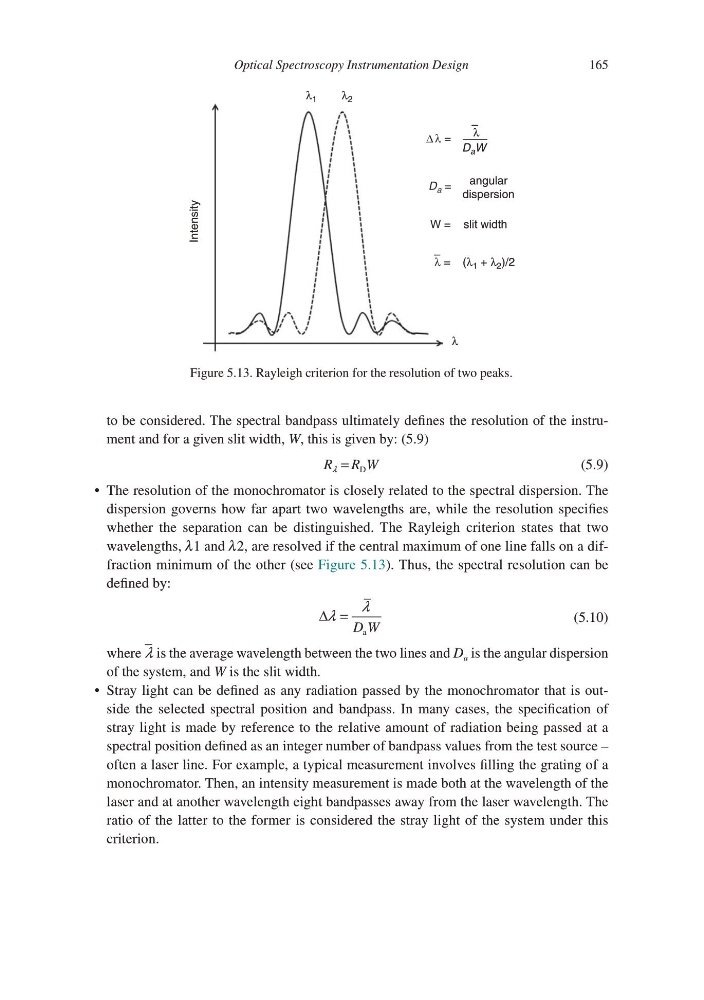
wavelengths, λ1 and λ2, are resolved if the central maximum of one line falls on a diffraction minimum of the other (see Figure 5.13). Thus, the spectral resolution can be
defined by:
∆λ
λ
= D W
a
(5.10)
where λ is the average wavelength between the two lines and D a is the angular dispersion
of the system, and W is the slit width.
Stray light can be defined as any radiation passed by the monochromator that is out•
side the selected spectral position and bandpass. In many cases, the specification of
stray light is made by reference to the relative amount of radiation being passed at a
spectral position defined as an integer number of bandpass values from the test source –
often a laser line. For example, a typical measurement involves filling the grating of a
monochromator. Then, an intensity measurement is made both at the wavelength of the
laser and at another wavelength eight bandpasses away from the laser wavelength. The
ratio of the latter to the former is considered the stray light of the system under this
criterion.
W = slit width
angular
dispersion
D a =
λ = (λ 1 + λ 2 )/2
–
λ
Intensity
λ 1
λ 2
∆ λ = D a W
λ
–
Figure 5.13. Rayleigh criterion for the resolution of two peaks.
165
to be considered. The spectral bandpass ultimately defines the resolution of the instrument and for a given slit width, W, this is given by: (5.9)
R R W
λ = D
(5.9)
The resolution of the monochromator is closely related to the spectral dispersion. The
•
dispersion governs how far apart two wavelengths are, while the resolution specifies
whether the separation can be distinguished. The Rayleigh criterion states that two
wavelengths, λ1 and λ2, are resolved if the central maximum of one line falls on a diffraction minimum of the other (see Figure 5.13). Thus, the spectral resolution can be
defined by:
∆λ
λ
= D W
a
(5.10)
where λ is the average wavelength between the two lines and D a is the angular dispersion
of the system, and W is the slit width.
Stray light can be defined as any radiation passed by the monochromator that is out•
side the selected spectral position and bandpass. In many cases, the specification of
stray light is made by reference to the relative amount of radiation being passed at a
spectral position defined as an integer number of bandpass values from the test source –
often a laser line. For example, a typical measurement involves filling the grating of a
monochromator. Then, an intensity measurement is made both at the wavelength of the
laser and at another wavelength eight bandpasses away from the laser wavelength. The
ratio of the latter to the former is considered the stray light of the system under this
criterion.
W = slit width
angular
dispersion
D a =
λ = (λ 1 + λ 2 )/2
–
λ
Intensity
λ 1
λ 2
∆ λ = D a W
λ
–
Figure 5.13. Rayleigh criterion for the resolution of two peaks.