

Optical Spectroscopy Instrumentation Design
151
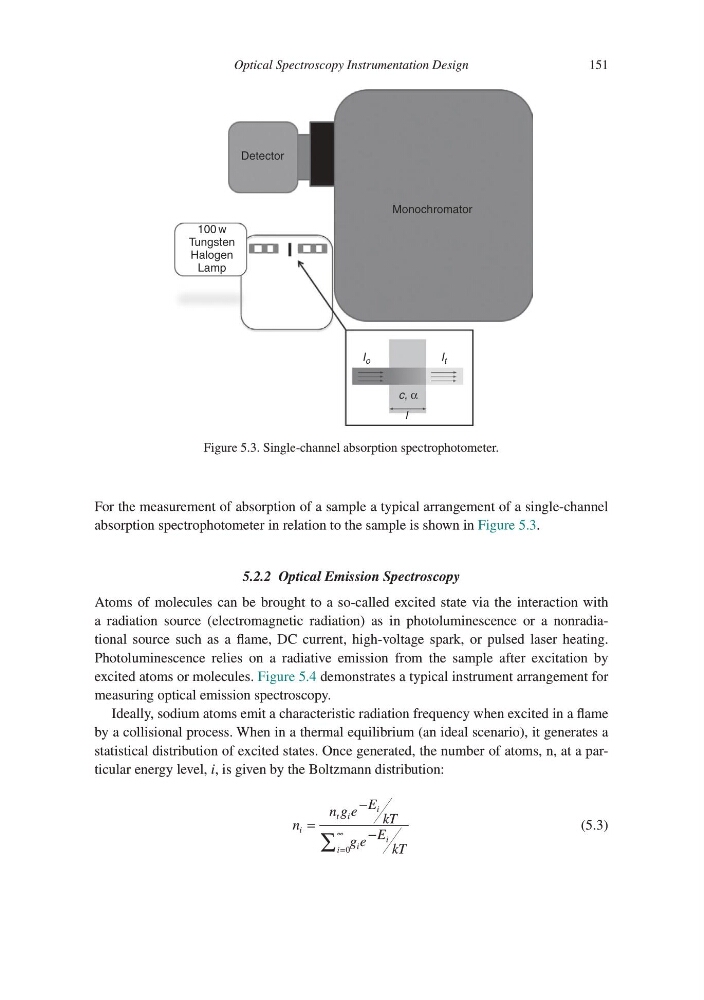
For the measurement of absorption of a sample a typical arrangement of a single-channel
absorption spectrophotometer in relation to the sample is shown in Figure 5.3.
5.2.2 Optical Emission Spectroscopy
Atoms of molecules can be brought to a so-called excited state via the interaction with
a radiation source (electromagnetic radiation) as in photoluminescence or a nonradiational source such as a flame, DC current, high-voltage spark, or pulsed laser heating.
Photoluminescence relies on a radiative emission from the sample after excitation by
excited atoms or molecules. Figure 5.4 demonstrates a typical instrument arrangement for
measuring optical emission spectroscopy.
Ideally, sodium atoms emit a characteristic radiation frequency when excited in a flame
by a collisional process. When in a thermal equilibrium (an ideal scenario), it generates a
statistical distribution of excited states. Once generated, the number of atoms, n, at a particular energy level, i, is given by the Boltzmann distribution:
n
n g e E
kT
g e E
kT
i
t i
i
i
i
i
=
−
−
=
∞
∑ 0
(5.3)
I o
I t
l
100 w
Tungsten
Halogen
Lamp
Detector
Monochromator
c, α
Figure 5.3. Single-channel absorption spectrophotometer.
151
For the measurement of absorption of a sample a typical arrangement of a single-channel
absorption spectrophotometer in relation to the sample is shown in Figure 5.3.
5.2.2 Optical Emission Spectroscopy
Atoms of molecules can be brought to a so-called excited state via the interaction with
a radiation source (electromagnetic radiation) as in photoluminescence or a nonradiational source such as a flame, DC current, high-voltage spark, or pulsed laser heating.
Photoluminescence relies on a radiative emission from the sample after excitation by
excited atoms or molecules. Figure 5.4 demonstrates a typical instrument arrangement for
measuring optical emission spectroscopy.
Ideally, sodium atoms emit a characteristic radiation frequency when excited in a flame
by a collisional process. When in a thermal equilibrium (an ideal scenario), it generates a
statistical distribution of excited states. Once generated, the number of atoms, n, at a particular energy level, i, is given by the Boltzmann distribution:
n
n g e E
kT
g e E
kT
i
t i
i
i
i
i
=
−
−
=
∞
∑ 0
(5.3)
I o
I t
l
100 w
Tungsten
Halogen
Lamp
Detector
Monochromator
c, α
Figure 5.3. Single-channel absorption spectrophotometer.