

Sampling Design for Organic Matter Fluorescence Analysis
127
sampling design to trace the specific source of any contamination observed in the field
blank if required. Individual equipment, filter, and sampler blanks can be used to test for
contamination from equipment, filters, or sampling devices (e.g., pumps, Niskin bottles)
and to assess the equipment, filter and sampler cleaning protocols. Ambient blanks that are
exposed to atmospheric outfall or other relevant conditions (e.g., inside a fume hood) can
be used to examine if the sample exposure was the source of any contamination. As such,
blanks are both important in observing any potential contamination and also discovering
any contamination so that it may be eliminated and are fundamental to successful sampling
design.
Replicate samples are collected at the same time or as close to one another as possible
via identical equipment and procedures. Replicate samples are also important for quality control as they allow for identification and also quantification of any variability in the
overall sampling, or parts thereof if broken down into individual sections (e.g., filtration
Wavelength (nm)
200 210 220 230 240 250 260 270 280 290 300 310 320 330 340 350
Absorption coefficient (m –1
)
0
100
200
300
400
500
600
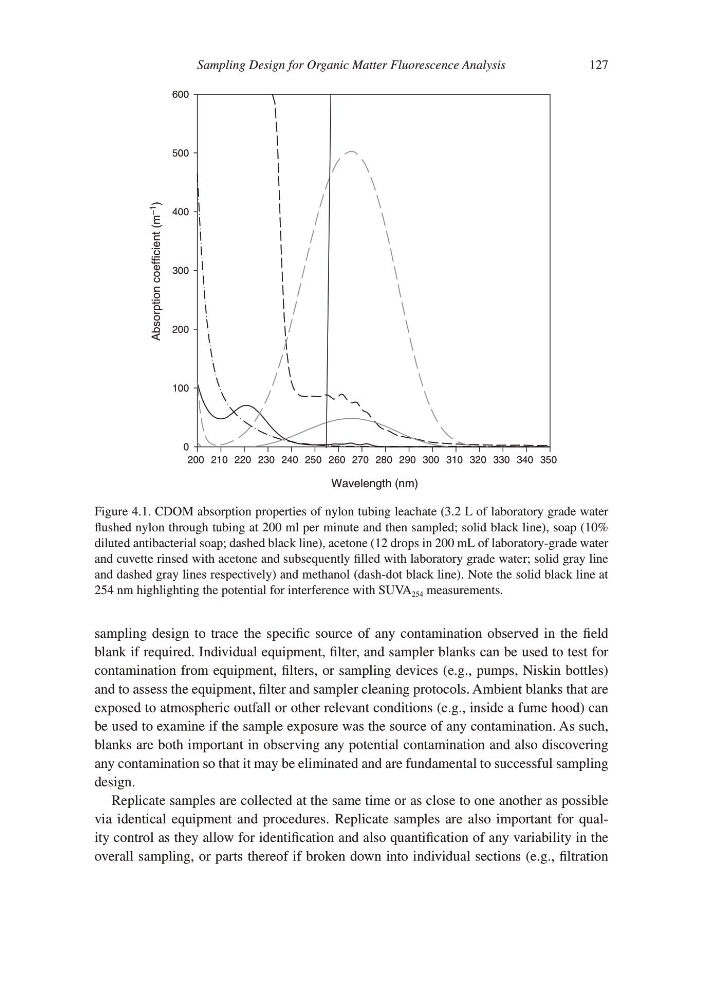
Figure 4.1. CDOM absorption properties of nylon tubing leachate (3.2 L of laboratory grade water
flushed nylon through tubing at 200 ml per minute and then sampled; solid black line), soap (10%
diluted antibacterial soap; dashed black line), acetone (12 drops in 200 mL of laboratory-grade water
and cuvette rinsed with acetone and subsequently filled with laboratory grade water; solid gray line
and dashed gray lines respectively) and methanol (dash-dot black line). Note the solid black line at
254 nm highlighting the potential for interference with SUVA 254 measurements.
127
sampling design to trace the specific source of any contamination observed in the field
blank if required. Individual equipment, filter, and sampler blanks can be used to test for
contamination from equipment, filters, or sampling devices (e.g., pumps, Niskin bottles)
and to assess the equipment, filter and sampler cleaning protocols. Ambient blanks that are
exposed to atmospheric outfall or other relevant conditions (e.g., inside a fume hood) can
be used to examine if the sample exposure was the source of any contamination. As such,
blanks are both important in observing any potential contamination and also discovering
any contamination so that it may be eliminated and are fundamental to successful sampling
design.
Replicate samples are collected at the same time or as close to one another as possible
via identical equipment and procedures. Replicate samples are also important for quality control as they allow for identification and also quantification of any variability in the
overall sampling, or parts thereof if broken down into individual sections (e.g., filtration
Wavelength (nm)
200 210 220 230 240 250 260 270 280 290 300 310 320 330 340 350
Absorption coefficient (m –1
)
0
100
200
300
400
500
600
Figure 4.1. CDOM absorption properties of nylon tubing leachate (3.2 L of laboratory grade water
flushed nylon through tubing at 200 ml per minute and then sampled; solid black line), soap (10%
diluted antibacterial soap; dashed black line), acetone (12 drops in 200 mL of laboratory-grade water
and cuvette rinsed with acetone and subsequently filled with laboratory grade water; solid gray line
and dashed gray lines respectively) and methanol (dash-dot black line). Note the solid black line at
254 nm highlighting the potential for interference with SUVA 254 measurements.