

CHAPTER 4
PHASE DIAGRAMS AND MIXTURES
75
μ A = μ
0
A + RT ln X A and μ B = μ
0
B + RT ln X B
(4.6)
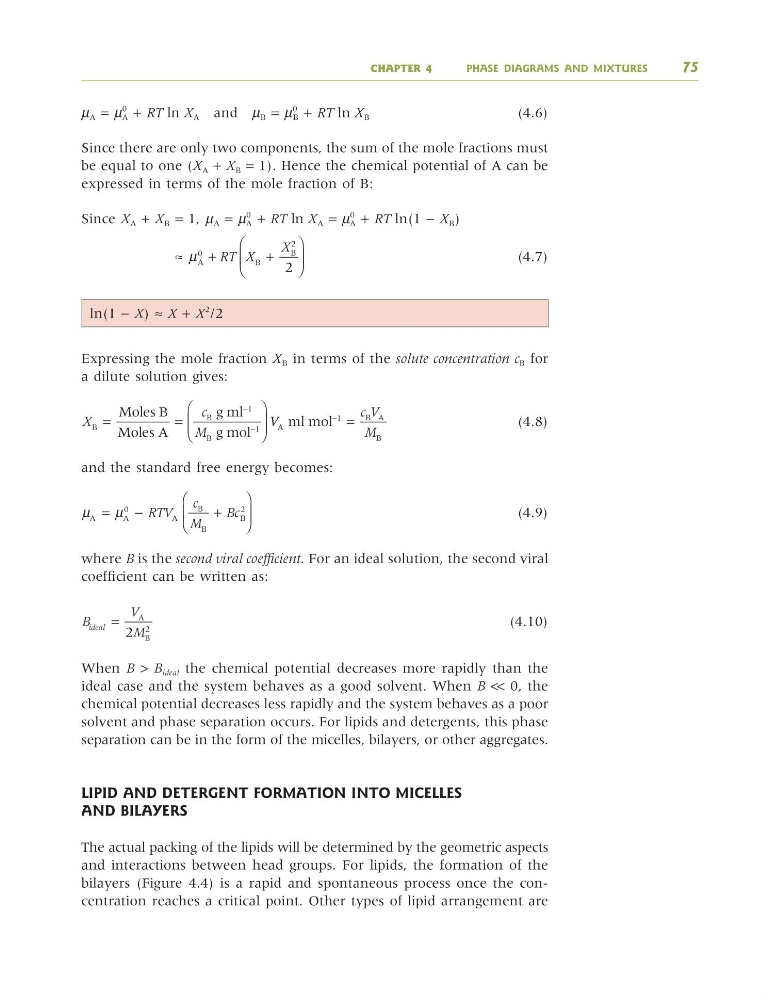
Since there are only two components, the sum of the mole fractions must
be equal to one (X A + X B = 1). Hence the chemical potential of A can be
expressed in terms of the mole fraction of B:
Since X A + X B = 1, μ A = μ
0
A + RT ln X A = μ
0
A + RT ln(1 − X B )
≈
(4.7)
ln(1 − X) ≈ X + X
2
/2
Expressing the mole fraction X B in terms of the solute concentration c B for
a dilute solution gives:
(4.8)
and the standard free energy becomes:
(4.9)
where B is the second 9iral coefficient. For an ideal solution, the second viral
coefficient can be written as:
(4.10)
When B > B ideal the chemical potential decreases more rapidly than the
ideal case and the system behaves as a good solvent. When B << 0, the
chemical potential decreases less rapidly and the system behaves as a poor
solvent and phase separation occurs. For lipids and detergents, this phase
separation can be in the form of the micelles, bilayers, or other aggregates.
LIPID AND DETERGENT FORMATION INTO MICELLES
AND BILAYERS
The actual packing of the lipids will be determined by the geometric aspects
and interactions between head groups. For lipids, the formation of the
bilayers (Figure 4.4) is a rapid and spontaneous process once the concentration reaches a critical point. Other types of lipid arrangement are
B
V
M
ideal =
A
B
2
2
μ
μ
A
A
A
B
B
B
=
−
+
⎛
⎝
⎜ ⎜
⎞
⎠
⎟ ⎟
0
2
RTV
c
M
Bc
X
c
M
B
B
B
Moles B
Moles A
g ml
g mol
=
=
⎛
⎝
⎜ ⎜
⎞
⎠
⎟ ⎟
−
−
1
1
V V
c V
M
A
B A
B
ml mol
−
=
1
μ A
B
B
0
2
2
+
+
⎛
⎝
⎜ ⎜
⎞
⎠
⎟ ⎟
RT X
X
9781405124362_4_004.qxd 4/29/08 9:08 Page 75
PHASE DIAGRAMS AND MIXTURES
75
μ A = μ
0
A + RT ln X A and μ B = μ
0
B + RT ln X B
(4.6)
Since there are only two components, the sum of the mole fractions must
be equal to one (X A + X B = 1). Hence the chemical potential of A can be
expressed in terms of the mole fraction of B:
Since X A + X B = 1, μ A = μ
0
A + RT ln X A = μ
0
A + RT ln(1 − X B )
≈
(4.7)
ln(1 − X) ≈ X + X
2
/2
Expressing the mole fraction X B in terms of the solute concentration c B for
a dilute solution gives:
(4.8)
and the standard free energy becomes:
(4.9)
where B is the second 9iral coefficient. For an ideal solution, the second viral
coefficient can be written as:
(4.10)
When B > B ideal the chemical potential decreases more rapidly than the
ideal case and the system behaves as a good solvent. When B << 0, the
chemical potential decreases less rapidly and the system behaves as a poor
solvent and phase separation occurs. For lipids and detergents, this phase
separation can be in the form of the micelles, bilayers, or other aggregates.
LIPID AND DETERGENT FORMATION INTO MICELLES
AND BILAYERS
The actual packing of the lipids will be determined by the geometric aspects
and interactions between head groups. For lipids, the formation of the
bilayers (Figure 4.4) is a rapid and spontaneous process once the concentration reaches a critical point. Other types of lipid arrangement are
B
V
M
ideal =
A
B
2
2
μ
μ
A
A
A
B
B
B
=
−
+
⎛
⎝
⎜ ⎜
⎞
⎠
⎟ ⎟
0
2
RTV
c
M
Bc
X
c
M
B
B
B
Moles B
Moles A
g ml
g mol
=
=
⎛
⎝
⎜ ⎜
⎞
⎠
⎟ ⎟
−
−
1
1
V V
c V
M
A
B A
B
ml mol
−
=
1
μ A
B
B
0
2
2
+
+
⎛
⎝
⎜ ⎜
⎞
⎠
⎟ ⎟
RT X
X
9781405124362_4_004.qxd 4/29/08 9:08 Page 75