

Electric motors draw a current when the motor is turning the transmission (which turns the wheels). With regenerative braking, the electric motor
turns backwards when the car is slowing down, generating a current that
regenerates the battery. Regenerative braking allows hybrid cars to convert what would normally be simple heat loss into electrical energy that
is stored until it is needed to power the car.
CHAPTER 3
SECOND LAW OF THERMODYNAMICS
63
Derivation box 3.1
Entropy as a state function
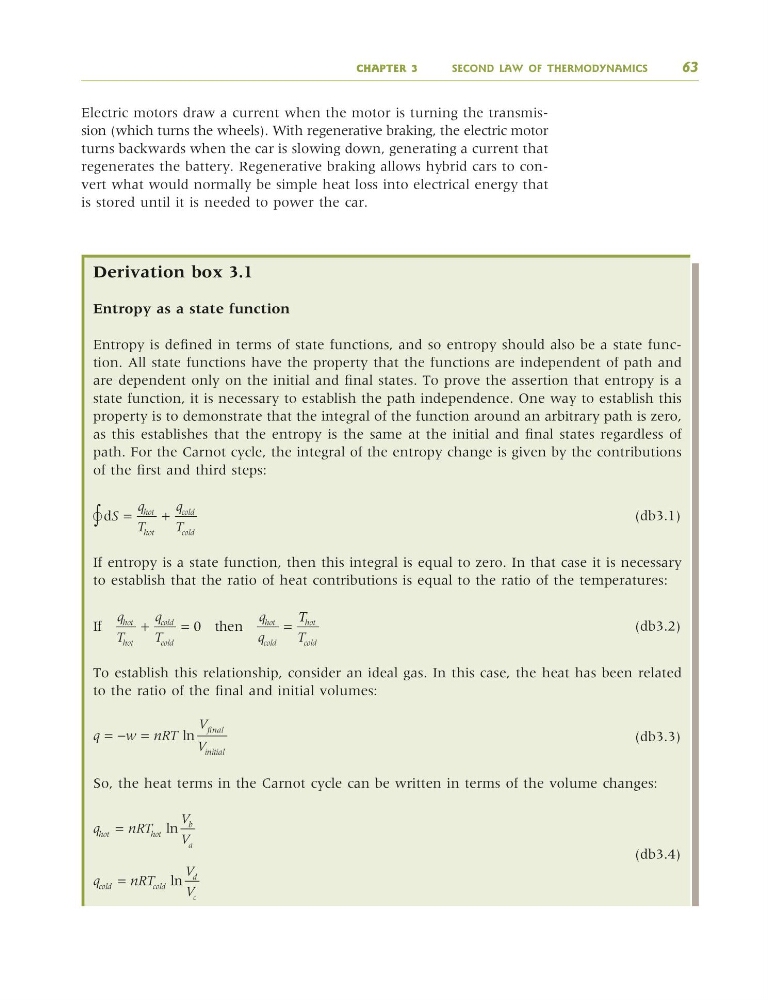
Entropy is defined in terms of state functions, and so entropy should also be a state function. All state functions have the property that the functions are independent of path and
are dependent only on the initial and final states. To prove the assertion that entropy is a
state function, it is necessary to establish the path independence. One way to establish this
property is to demonstrate that the integral of the function around an arbitrary path is zero,
as this establishes that the entropy is the same at the initial and final states regardless of
path. For the Carnot cycle, the integral of the entropy change is given by the contributions
of the first and third steps:
(db3.1)
If entropy is a state function, then this integral is equal to zero. In that case it is necessary
to establish that the ratio of heat contributions is equal to the ratio of the temperatures:
(db3.2)
To establish this relationship, consider an ideal gas. In this case, the heat has been related
to the ratio of the final and initial volumes:
(db3.3)
So, the heat terms in the Carnot cycle can be written in terms of the volume changes:
(db3.4)
q
w nRT
V
V
nal
initial
ln
= − =
3
If
then
q
T
q
T
q
q
hot
hot
cold
cold
hot
cold
+
=
=
0
T T
T
hot
cold
dS
q
T
q
T
hot
hot
cold
cold
=
+
∫
x
q
nRT
V
V
cold
cold
d
c
ln
=
q
nRT
V
V
hot
hot
b
a
ln
=
9781405124362_4_003.qxd 4/30/08 19:05 Page 63
turns backwards when the car is slowing down, generating a current that
regenerates the battery. Regenerative braking allows hybrid cars to convert what would normally be simple heat loss into electrical energy that
is stored until it is needed to power the car.
CHAPTER 3
SECOND LAW OF THERMODYNAMICS
63
Derivation box 3.1
Entropy as a state function
Entropy is defined in terms of state functions, and so entropy should also be a state function. All state functions have the property that the functions are independent of path and
are dependent only on the initial and final states. To prove the assertion that entropy is a
state function, it is necessary to establish the path independence. One way to establish this
property is to demonstrate that the integral of the function around an arbitrary path is zero,
as this establishes that the entropy is the same at the initial and final states regardless of
path. For the Carnot cycle, the integral of the entropy change is given by the contributions
of the first and third steps:
(db3.1)
If entropy is a state function, then this integral is equal to zero. In that case it is necessary
to establish that the ratio of heat contributions is equal to the ratio of the temperatures:
(db3.2)
To establish this relationship, consider an ideal gas. In this case, the heat has been related
to the ratio of the final and initial volumes:
(db3.3)
So, the heat terms in the Carnot cycle can be written in terms of the volume changes:
(db3.4)
q
w nRT
V
V
nal
initial
ln
= − =
3
If
then
q
T
q
T
q
q
hot
hot
cold
cold
hot
cold
+
=
=
0
T T
T
hot
cold
dS
q
T
q
T
hot
hot
cold
cold
=
+
∫
x
q
nRT
V
V
cold
cold
d
c
ln
=
q
nRT
V
V
hot
hot
b
a
ln
=
9781405124362_4_003.qxd 4/30/08 19:05 Page 63