

As an example, consider how the Gibbs energy can be calculated
from the equilibrium constant for the reaction catalyzed by the enzyme
phosphoglucomutase:
glucose 1 − phosphate ↔ glucose 6 − phosphate
Biochemical analysis of the reaction at 25°C and pH equal to 7 shows
that the final equilibrium mixture will contain 1 mM glucose 1-phosphate
for every 19 mM glucose 6-phosphate. The equilibrium constant is given
by the ratio of the relative concentrations:
(3.21)
Using eqn 3.20, the change in the Gibbs energy can be calculated:
ΔG = −RT ln K = −(8.315 J/(mol K))(298 K)(ln 19)
= −7,296 J mol
−1
(3.22)
Thus, the reaction proceeds spontaneously, producing a large decrease in
the Gibbs energy, as expected for a large positive value for the equilibrium
constant.
RESEARCH DIRECTION: DRUG DESIGN II
In Chapter 2, calorimetry was described as a technique that could accurately
measure the heat change in response to drug binding. The binding affinity
can now be related to the Gibbs energy according to eqn 3.20 and consequently also related to the changes in enthalpy and entropy associated
with the binding:
K = e
−ΔG/kT
= e
−(ΔH−TΔS)/kT
(3.23)
K
[
]
[
=
Glucose 6 – phosphate
Glucose1 – phosphate] ]
=
=
19
1
19
mM
mM
56
PART I
THERMODYNAMICS AND KINETICS
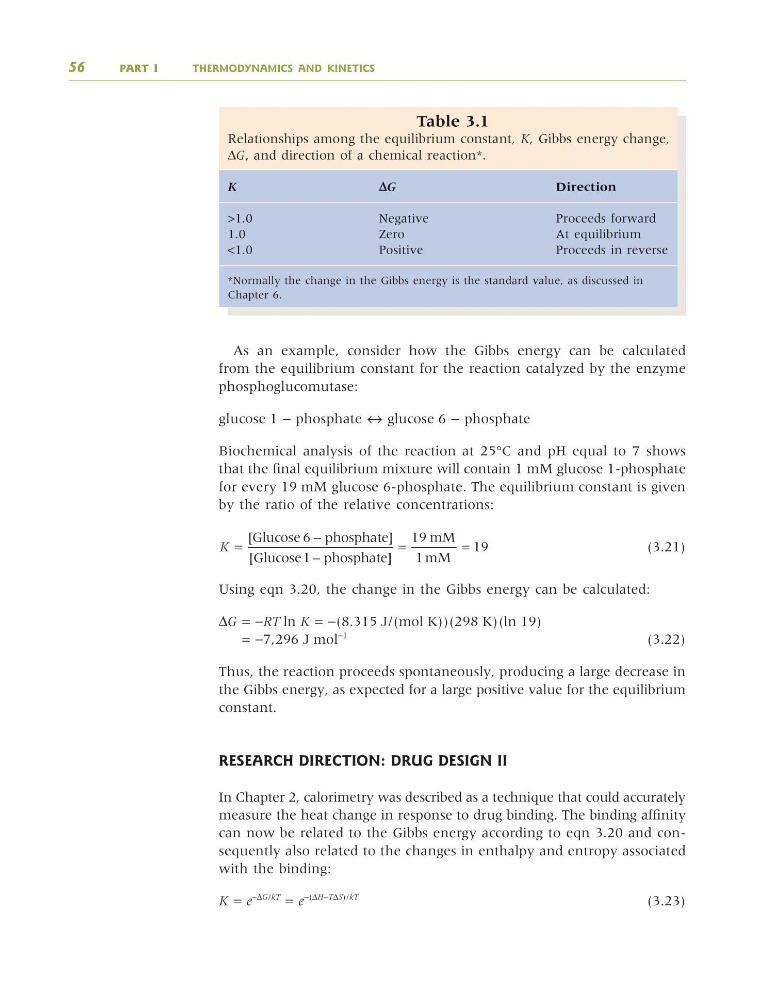
Table 3.1
Relationships among the equilibrium constant, K, Gibbs energy change,
ΔG, and direction of a chemical reaction*.
K
Δ ΔG
Direction
>1.0
Negative
Proceeds forward
1.0
Zero
At equilibrium
<1.0
Positive
Proceeds in reverse
*Normally the change in the Gibbs energy is the standard value, as discussed in
Chapter 6.
9781405124362_4_003.qxd 4/29/08 10:40 Page 56
from the equilibrium constant for the reaction catalyzed by the enzyme
phosphoglucomutase:
glucose 1 − phosphate ↔ glucose 6 − phosphate
Biochemical analysis of the reaction at 25°C and pH equal to 7 shows
that the final equilibrium mixture will contain 1 mM glucose 1-phosphate
for every 19 mM glucose 6-phosphate. The equilibrium constant is given
by the ratio of the relative concentrations:
(3.21)
Using eqn 3.20, the change in the Gibbs energy can be calculated:
ΔG = −RT ln K = −(8.315 J/(mol K))(298 K)(ln 19)
= −7,296 J mol
−1
(3.22)
Thus, the reaction proceeds spontaneously, producing a large decrease in
the Gibbs energy, as expected for a large positive value for the equilibrium
constant.
RESEARCH DIRECTION: DRUG DESIGN II
In Chapter 2, calorimetry was described as a technique that could accurately
measure the heat change in response to drug binding. The binding affinity
can now be related to the Gibbs energy according to eqn 3.20 and consequently also related to the changes in enthalpy and entropy associated
with the binding:
K = e
−ΔG/kT
= e
−(ΔH−TΔS)/kT
(3.23)
K
[
]
[
=
Glucose 6 – phosphate
Glucose1 – phosphate] ]
=
=
19
1
19
mM
mM
56
PART I
THERMODYNAMICS AND KINETICS
Table 3.1
Relationships among the equilibrium constant, K, Gibbs energy change,
ΔG, and direction of a chemical reaction*.
K
Δ ΔG
Direction
>1.0
Negative
Proceeds forward
1.0
Zero
At equilibrium
<1.0
Positive
Proceeds in reverse
*Normally the change in the Gibbs energy is the standard value, as discussed in
Chapter 6.
9781405124362_4_003.qxd 4/29/08 10:40 Page 56