

CHAPTER 2
FIRST LAW OF THERMODYNAMICS
35
where the subscript denotes that the process occurs for fixed y. Conversely, if the boy moves
along the y direction only by an amount Δy, the change in altitude would be:
(db2.2)
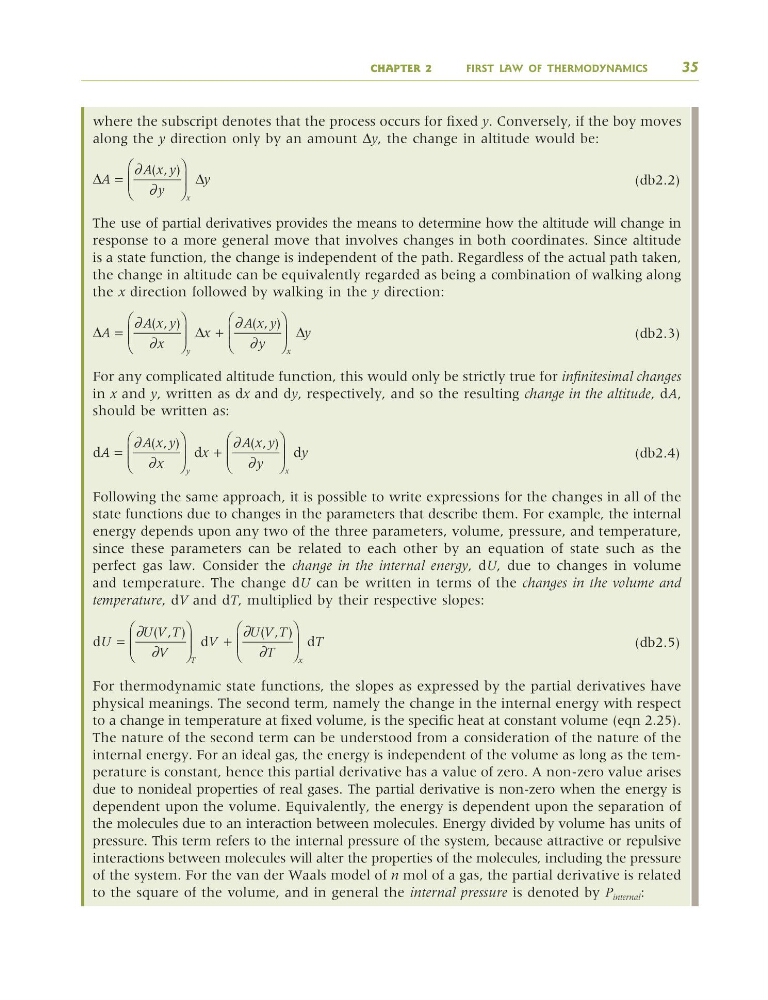
The use of partial derivatives provides the means to determine how the altitude will change in
response to a more general move that involves changes in both coordinates. Since altitude
is a state function, the change is independent of the path. Regardless of the actual path taken,
the change in altitude can be equivalently regarded as being a combination of walking along
the x direction followed by walking in the y direction:
(db2.3)
For any complicated altitude function, this would only be strictly true for infinitesimal changes
in x and y, written as dx and dy, respectively, and so the resulting change in the altitude, dA,
should be written as:
(db2.4)
Following the same approach, it is possible to write expressions for the changes in all of the
state functions due to changes in the parameters that describe them. For example, the internal
energy depends upon any two of the three parameters, volume, pressure, and temperature,
since these parameters can be related to each other by an equation of state such as the
perfect gas law. Consider the change in the internal energy, dU, due to changes in volume
and temperature. The change dU can be written in terms of the changes in the volume and
temperature, dV and dT, multiplied by their respective slopes:
(db2.5)
For thermodynamic state functions, the slopes as expressed by the partial derivatives have
physical meanings. The second term, namely the change in the internal energy with respect
to a change in temperature at fixed volume, is the specific heat at constant volume (eqn 2.25).
The nature of the second term can be understood from a consideration of the nature of the
internal energy. For an ideal gas, the energy is independent of the volume as long as the temperature is constant, hence this partial derivative has a value of zero. A non-zero value arises
due to nonideal properties of real gases. The partial derivative is non-zero when the energy is
dependent upon the volume. Equivalently, the energy is dependent upon the separation of
the molecules due to an interaction between molecules. Energy divided by volume has units of
pressure. This term refers to the internal pressure of the system, because attractive or repulsive
interactions between molecules will alter the properties of the molecules, including the pressure
of the system. For the van der Waals model of n mol of a gas, the partial derivative is related
to the square of the volume, and in general the internal pressure is denoted by P internal :
d
d
U
U V T
V
V
U V T
T
T
( , )
( , )
=
⎛
⎝
⎜ ⎜
⎞
⎠
⎟ ⎟
+
⎛
⎝
⎜ ⎜
⎞
⎠
∂
∂
∂
∂
⎟ ⎟ ⎟
x
T
d
d
d
A
A x y
x
x
A x y
y
y
( , )
( , )
=
⎛
⎝
⎜ ⎜
⎞
⎠
⎟ ⎟
+
⎛
⎝
⎜ ⎜
⎞
⎠
∂
∂
∂
∂
⎟ ⎟ ⎟
x
y
d
Δ
Δ
A
A x y
x
x
A x y
y
y
( , )
( , )
=
⎛
⎝
⎜ ⎜
⎞
⎠
⎟ ⎟
+
⎛
⎝
⎜ ⎜
⎞
⎠
∂
∂
∂
∂
⎟ ⎟ ⎟
x
y
Δ
Δ
Δ
A
A x y
y
y
x
( , )
=
⎛
⎝
⎜ ⎜
⎞
⎠
⎟ ⎟
∂
∂
9781405124362_4_002.qxd 4/30/08 19:28 Page 35
FIRST LAW OF THERMODYNAMICS
35
where the subscript denotes that the process occurs for fixed y. Conversely, if the boy moves
along the y direction only by an amount Δy, the change in altitude would be:
(db2.2)
The use of partial derivatives provides the means to determine how the altitude will change in
response to a more general move that involves changes in both coordinates. Since altitude
is a state function, the change is independent of the path. Regardless of the actual path taken,
the change in altitude can be equivalently regarded as being a combination of walking along
the x direction followed by walking in the y direction:
(db2.3)
For any complicated altitude function, this would only be strictly true for infinitesimal changes
in x and y, written as dx and dy, respectively, and so the resulting change in the altitude, dA,
should be written as:
(db2.4)
Following the same approach, it is possible to write expressions for the changes in all of the
state functions due to changes in the parameters that describe them. For example, the internal
energy depends upon any two of the three parameters, volume, pressure, and temperature,
since these parameters can be related to each other by an equation of state such as the
perfect gas law. Consider the change in the internal energy, dU, due to changes in volume
and temperature. The change dU can be written in terms of the changes in the volume and
temperature, dV and dT, multiplied by their respective slopes:
(db2.5)
For thermodynamic state functions, the slopes as expressed by the partial derivatives have
physical meanings. The second term, namely the change in the internal energy with respect
to a change in temperature at fixed volume, is the specific heat at constant volume (eqn 2.25).
The nature of the second term can be understood from a consideration of the nature of the
internal energy. For an ideal gas, the energy is independent of the volume as long as the temperature is constant, hence this partial derivative has a value of zero. A non-zero value arises
due to nonideal properties of real gases. The partial derivative is non-zero when the energy is
dependent upon the volume. Equivalently, the energy is dependent upon the separation of
the molecules due to an interaction between molecules. Energy divided by volume has units of
pressure. This term refers to the internal pressure of the system, because attractive or repulsive
interactions between molecules will alter the properties of the molecules, including the pressure
of the system. For the van der Waals model of n mol of a gas, the partial derivative is related
to the square of the volume, and in general the internal pressure is denoted by P internal :
d
d
U
U V T
V
V
U V T
T
T
( , )
( , )
=
⎛
⎝
⎜ ⎜
⎞
⎠
⎟ ⎟
+
⎛
⎝
⎜ ⎜
⎞
⎠
∂
∂
∂
∂
⎟ ⎟ ⎟
x
T
d
d
d
A
A x y
x
x
A x y
y
y
( , )
( , )
=
⎛
⎝
⎜ ⎜
⎞
⎠
⎟ ⎟
+
⎛
⎝
⎜ ⎜
⎞
⎠
∂
∂
∂
∂
⎟ ⎟ ⎟
x
y
d
Δ
Δ
A
A x y
x
x
A x y
y
y
( , )
( , )
=
⎛
⎝
⎜ ⎜
⎞
⎠
⎟ ⎟
+
⎛
⎝
⎜ ⎜
⎞
⎠
∂
∂
∂
∂
⎟ ⎟ ⎟
x
y
Δ
Δ
Δ
A
A x y
y
y
x
( , )
=
⎛
⎝
⎜ ⎜
⎞
⎠
⎟ ⎟
∂
∂
9781405124362_4_002.qxd 4/30/08 19:28 Page 35