

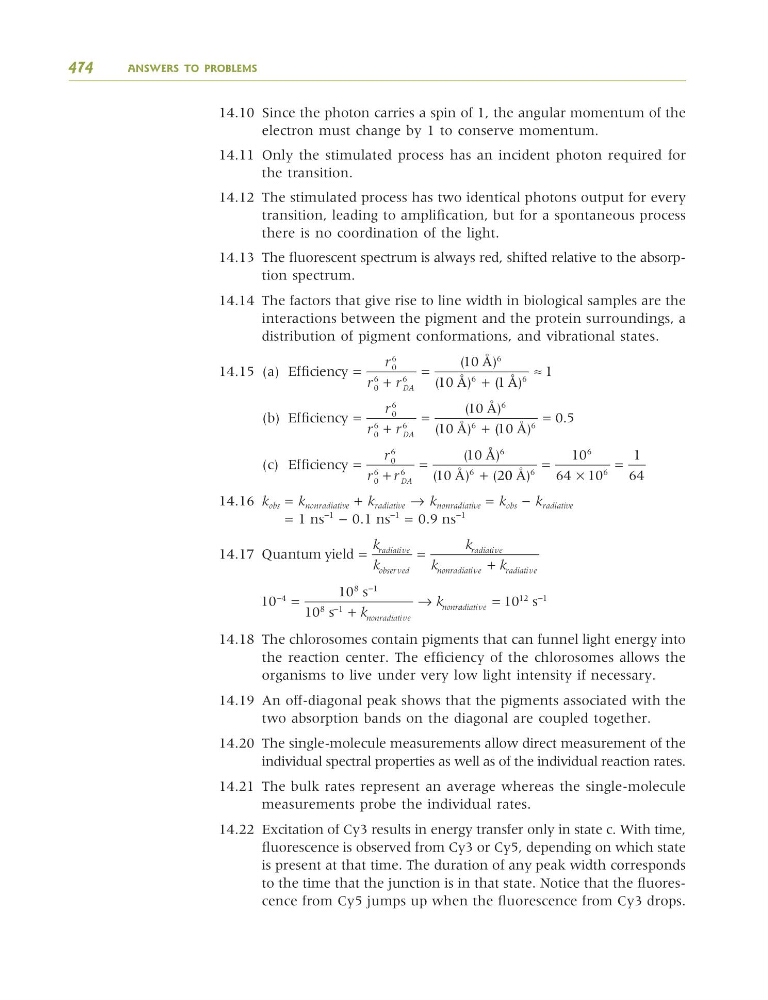
14.10 Since the photon carries a spin of 1, the angular momentum of the
electron must change by 1 to conserve momentum.
14.11 Only the stimulated process has an incident photon required for
the transition.
14.12 The stimulated process has two identical photons output for every
transition, leading to amplification, but for a spontaneous process
there is no coordination of the light.
14.13 The fluorescent spectrum is always red, shifted relative to the absorption spectrum.
14.14 The factors that give rise to line width in biological samples are the
interactions between the pigment and the protein surroundings, a
distribution of pigment conformations, and vibrational states.
14.15 (a)
(b)
(c)
14.16 k obs = k nonradiati9e + k radiati9e → k nonradiati9e = k obs − k radiati9e
= 1 ns
−1
− 0.1 ns
−1
= 0.9 ns
−1
14.17
14.18 The chlorosomes contain pigments that can funnel light energy into
the reaction center. The efficiency of the chlorosomes allows the
organisms to live under very low light intensity if necessary.
14.19 An off-diagonal peak shows that the pigments associated with the
two absorption bands on the diagonal are coupled together.
14.20 The single-molecule measurements allow direct measurement of the
individual spectral properties as well as of the individual reaction rates.
14.21 The bulk rates represent an average whereas the single-molecule
measurements probe the individual rates.
14.22 Excitation of Cy3 results in energy transfer only in state c. With time,
fluorescence is observed from Cy3 or Cy5, depending on which state
is present at that time. The duration of any peak width corresponds
to the time that the junction is in that state. Notice that the fluorescence from Cy5 jumps up when the fluorescence from Cy3 drops.
10
10
10
4
8
1
8
1
−
−
−
=
+
→
s
s
k
k
nonradiati e
nonr
9
a adiati e
9 =
−
10
12
1
s
Quantum yield =
=
k
k
k
radiati e
obser ed
radia
9
9
t ti e
nonradiati e
radiati e
k
k
9
9
9
+
Ef ciency
Å
Å
1
(
)
(
)
(
=
+
=
+
r
r r DA
0
6
0
6
6
6
6
10
10
20 0
10
64 10
1
64
6
6
6
Å)
=
×
=
Ef ciency
Å
Å
1
(
)
(
)
=
+
=
+
r
r
r DA
0
6
0
6
6
6
6
10
10
( (
)
.
10
0 5
6
Å
=
Ef ciency
Å
Å
1
(
)
(
)
=
+
=
+
r
r
r DA
0
6
0
6
6
6
6
10
10
( ( )
1
1
6
Å
≈
474
ANSWERS TO PROBLEMS
9781405124362_5_end.qxd 4/29/08 9:17 Page 474
electron must change by 1 to conserve momentum.
14.11 Only the stimulated process has an incident photon required for
the transition.
14.12 The stimulated process has two identical photons output for every
transition, leading to amplification, but for a spontaneous process
there is no coordination of the light.
14.13 The fluorescent spectrum is always red, shifted relative to the absorption spectrum.
14.14 The factors that give rise to line width in biological samples are the
interactions between the pigment and the protein surroundings, a
distribution of pigment conformations, and vibrational states.
14.15 (a)
(b)
(c)
14.16 k obs = k nonradiati9e + k radiati9e → k nonradiati9e = k obs − k radiati9e
= 1 ns
−1
− 0.1 ns
−1
= 0.9 ns
−1
14.17
14.18 The chlorosomes contain pigments that can funnel light energy into
the reaction center. The efficiency of the chlorosomes allows the
organisms to live under very low light intensity if necessary.
14.19 An off-diagonal peak shows that the pigments associated with the
two absorption bands on the diagonal are coupled together.
14.20 The single-molecule measurements allow direct measurement of the
individual spectral properties as well as of the individual reaction rates.
14.21 The bulk rates represent an average whereas the single-molecule
measurements probe the individual rates.
14.22 Excitation of Cy3 results in energy transfer only in state c. With time,
fluorescence is observed from Cy3 or Cy5, depending on which state
is present at that time. The duration of any peak width corresponds
to the time that the junction is in that state. Notice that the fluorescence from Cy5 jumps up when the fluorescence from Cy3 drops.
10
10
10
4
8
1
8
1
−
−
−
=
+
→
s
s
k
k
nonradiati e
nonr
9
a adiati e
9 =
−
10
12
1
s
Quantum yield =
=
k
k
k
radiati e
obser ed
radia
9
9
t ti e
nonradiati e
radiati e
k
k
9
9
9
+
Ef ciency
Å
Å
1
(
)
(
)
(
=
+
=
+
r
r r DA
0
6
0
6
6
6
6
10
10
20 0
10
64 10
1
64
6
6
6
Å)
=
×
=
Ef ciency
Å
Å
1
(
)
(
)
=
+
=
+
r
r
r DA
0
6
0
6
6
6
6
10
10
( (
)
.
10
0 5
6
Å
=
Ef ciency
Å
Å
1
(
)
(
)
=
+
=
+
r
r
r DA
0
6
0
6
6
6
6
10
10
( ( )
1
1
6
Å
≈
474
ANSWERS TO PROBLEMS
9781405124362_5_end.qxd 4/29/08 9:17 Page 474