

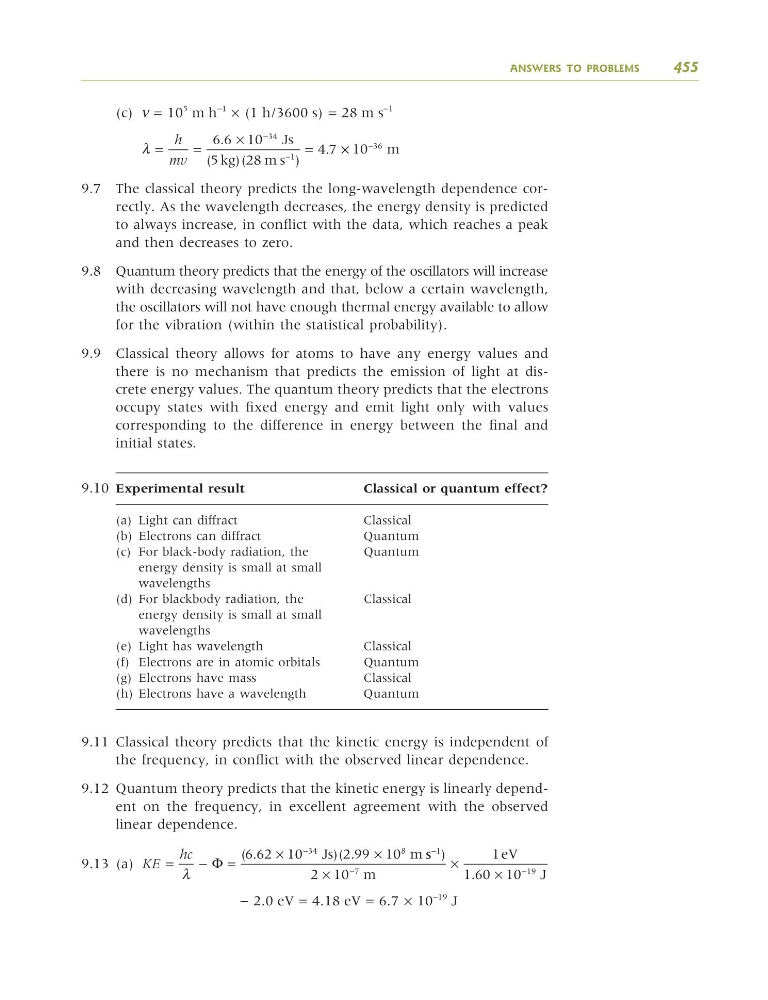
(c) ν = 10
5 m h
−1
× (1 h/3600 s) = 28 m s
−1
9.7 The classical theory predicts the long-wavelength dependence correctly. As the wavelength decreases, the energy density is predicted
to always increase, in conflict with the data, which reaches a peak
and then decreases to zero.
9.8 Quantum theory predicts that the energy of the oscillators will increase
with decreasing wavelength and that, below a certain wavelength,
the oscillators will not have enough thermal energy available to allow
for the vibration (within the statistical probability).
9.9 Classical theory allows for atoms to have any energy values and
there is no mechanism that predicts the emission of light at discrete energy values. The quantum theory predicts that the electrons
occupy states with fixed energy and emit light only with values
corresponding to the difference in energy between the final and
initial states.
9.10 Experimental result
Classical or quantum effect?
(a) Light can diffract
Classical
(b) Electrons can diffract
Quantum
(c) For black-body radiation, the
Quantum
energy density is small at small
wavelengths
(d) For blackbody radiation, the
Classical
energy density is small at small
wavelengths
(e) Light has wavelength
Classical
(f) Electrons are in atomic orbitals
Quantum
(g) Electrons have mass
Classical
(h) Electrons have a wavelength
Quantum
9.11 Classical theory predicts that the kinetic energy is independent of
the frequency, in conflict with the observed linear dependence.
9.12 Quantum theory predicts that the kinetic energy is linearly dependent on the frequency, in excellent agreement with the observed
linear dependence.
9.13 (a)
− 2.0 eV = 4.18 eV = 6.7 × 10
−19 J
KE
hc
( .
)( .
=
− =
×
×
−
λ
Φ
6 62 10
2 99 10
34
8
Js
m s s
m
eV
J
−
−
−
×
×
×
1
7
1 9
2 10
1
1 60 10
)
.
λ
.
(
)(
)
.
=
=
×
=
−
−
h
m9
6 6 10
5
28
4 7
34
1
Js
kg
m s
× ×
−
10
36 m
ANSWERS TO PROBLEMS
455
9781405124362_5_end.qxd 4/29/08 9:17 Page 455
5 m h
−1
× (1 h/3600 s) = 28 m s
−1
9.7 The classical theory predicts the long-wavelength dependence correctly. As the wavelength decreases, the energy density is predicted
to always increase, in conflict with the data, which reaches a peak
and then decreases to zero.
9.8 Quantum theory predicts that the energy of the oscillators will increase
with decreasing wavelength and that, below a certain wavelength,
the oscillators will not have enough thermal energy available to allow
for the vibration (within the statistical probability).
9.9 Classical theory allows for atoms to have any energy values and
there is no mechanism that predicts the emission of light at discrete energy values. The quantum theory predicts that the electrons
occupy states with fixed energy and emit light only with values
corresponding to the difference in energy between the final and
initial states.
9.10 Experimental result
Classical or quantum effect?
(a) Light can diffract
Classical
(b) Electrons can diffract
Quantum
(c) For black-body radiation, the
Quantum
energy density is small at small
wavelengths
(d) For blackbody radiation, the
Classical
energy density is small at small
wavelengths
(e) Light has wavelength
Classical
(f) Electrons are in atomic orbitals
Quantum
(g) Electrons have mass
Classical
(h) Electrons have a wavelength
Quantum
9.11 Classical theory predicts that the kinetic energy is independent of
the frequency, in conflict with the observed linear dependence.
9.12 Quantum theory predicts that the kinetic energy is linearly dependent on the frequency, in excellent agreement with the observed
linear dependence.
9.13 (a)
− 2.0 eV = 4.18 eV = 6.7 × 10
−19 J
KE
hc
( .
)( .
=
− =
×
×
−
λ
Φ
6 62 10
2 99 10
34
8
Js
m s s
m
eV
J
−
−
−
×
×
×
1
7
1 9
2 10
1
1 60 10
)
.
λ
.
(
)(
)
.
=
=
×
=
−
−
h
m9
6 6 10
5
28
4 7
34
1
Js
kg
m s
× ×
−
10
36 m
ANSWERS TO PROBLEMS
455
9781405124362_5_end.qxd 4/29/08 9:17 Page 455