

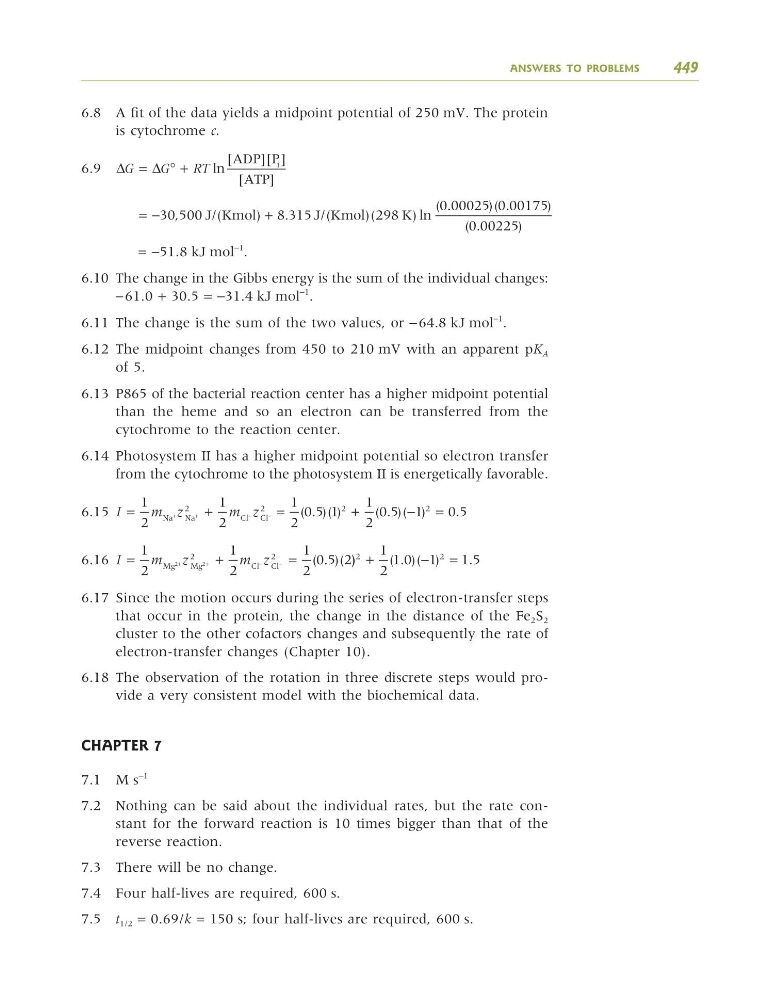
6.8 A fit of the data yields a midpoint potential of 250 mV. The protein
is cytochrome c.
6.9
= −51.8 kJ mol
−1
.
6.10 The change in the Gibbs energy is the sum of the individual changes:
− 61.0 + 30.5 = −31.4 kJ mol
−1
.
6.11 The change is the sum of the two values, or −64.8 kJ mol
−1
.
6.12 The midpoint changes from 450 to 210 mV with an apparent pK A
of 5.
6.13 P865 of the bacterial reaction center has a higher midpoint potential
than the heme and so an electron can be transferred from the
cytochrome to the reaction center.
6.14 Photosystem II has a higher midpoint potential so electron transfer
from the cytochrome to the photosystem II is energetically favorable.
6.15
6.16
6.17 Since the motion occurs during the series of electron-transfer steps
that occur in the protein, the change in the distance of the Fe 2 S 2
cluster to the other cofactors changes and subsequently the rate of
electron-transfer changes (Chapter 10).
6.18 The observation of the rotation in three discrete steps would provide a very consistent model with the biochemical data.
CHAPTER 7
7.1 M s
−1
7.2 Nothing can be said about the individual rates, but the rate constant for the forward reaction is 10 times bigger than that of the
reverse reaction.
7.3 There will be no change.
7.4 Four half-lives are required, 600 s.
7.5 t 1/2 = 0.69/k = 150 s; four half-lives are required, 600 s.
I
m z
m z
( . )(
=
+
=
+
+
−
−
1
2
1
2
1
2
0 5 2
2
2
2
2
Mg
Mg
Cl Cl
) )
( . )( )
.
2
2
1
2
1 0 1
1 5
+
− =
I
m z
m z
( . )( )
=
+
=
+
+
−
−
1
2
1
2
1
2
0 5 1
2
2
2
Na Na
Cl Cl
+ +
− =
( . )( )
.
1
2
0 5 1
0 5
2
= −
+
,
(
30 500
0
J/(Kmol) 8.315 J/(Kmol)(298 K) ln
. .
)( .
)
( .
)
00025 0 00175
0 00225
Δ
Δ
G
G
RTln
[
][ ]
[
]
=
° +
ADP P
ATP
i
ANSWERS TO PROBLEMS
449
9781405124362_5_end.qxd 4/29/08 9:17 Page 449
is cytochrome c.
6.9
= −51.8 kJ mol
−1
.
6.10 The change in the Gibbs energy is the sum of the individual changes:
− 61.0 + 30.5 = −31.4 kJ mol
−1
.
6.11 The change is the sum of the two values, or −64.8 kJ mol
−1
.
6.12 The midpoint changes from 450 to 210 mV with an apparent pK A
of 5.
6.13 P865 of the bacterial reaction center has a higher midpoint potential
than the heme and so an electron can be transferred from the
cytochrome to the reaction center.
6.14 Photosystem II has a higher midpoint potential so electron transfer
from the cytochrome to the photosystem II is energetically favorable.
6.15
6.16
6.17 Since the motion occurs during the series of electron-transfer steps
that occur in the protein, the change in the distance of the Fe 2 S 2
cluster to the other cofactors changes and subsequently the rate of
electron-transfer changes (Chapter 10).
6.18 The observation of the rotation in three discrete steps would provide a very consistent model with the biochemical data.
CHAPTER 7
7.1 M s
−1
7.2 Nothing can be said about the individual rates, but the rate constant for the forward reaction is 10 times bigger than that of the
reverse reaction.
7.3 There will be no change.
7.4 Four half-lives are required, 600 s.
7.5 t 1/2 = 0.69/k = 150 s; four half-lives are required, 600 s.
I
m z
m z
( . )(
=
+
=
+
+
−
−
1
2
1
2
1
2
0 5 2
2
2
2
2
Mg
Mg
Cl Cl
) )
( . )( )
.
2
2
1
2
1 0 1
1 5
+
− =
I
m z
m z
( . )( )
=
+
=
+
+
−
−
1
2
1
2
1
2
0 5 1
2
2
2
Na Na
Cl Cl
+ +
− =
( . )( )
.
1
2
0 5 1
0 5
2
= −
+
,
(
30 500
0
J/(Kmol) 8.315 J/(Kmol)(298 K) ln
. .
)( .
)
( .
)
00025 0 00175
0 00225
Δ
Δ
G
G
RTln
[
][ ]
[
]
=
° +
ADP P
ATP
i
ANSWERS TO PROBLEMS
449
9781405124362_5_end.qxd 4/29/08 9:17 Page 449