

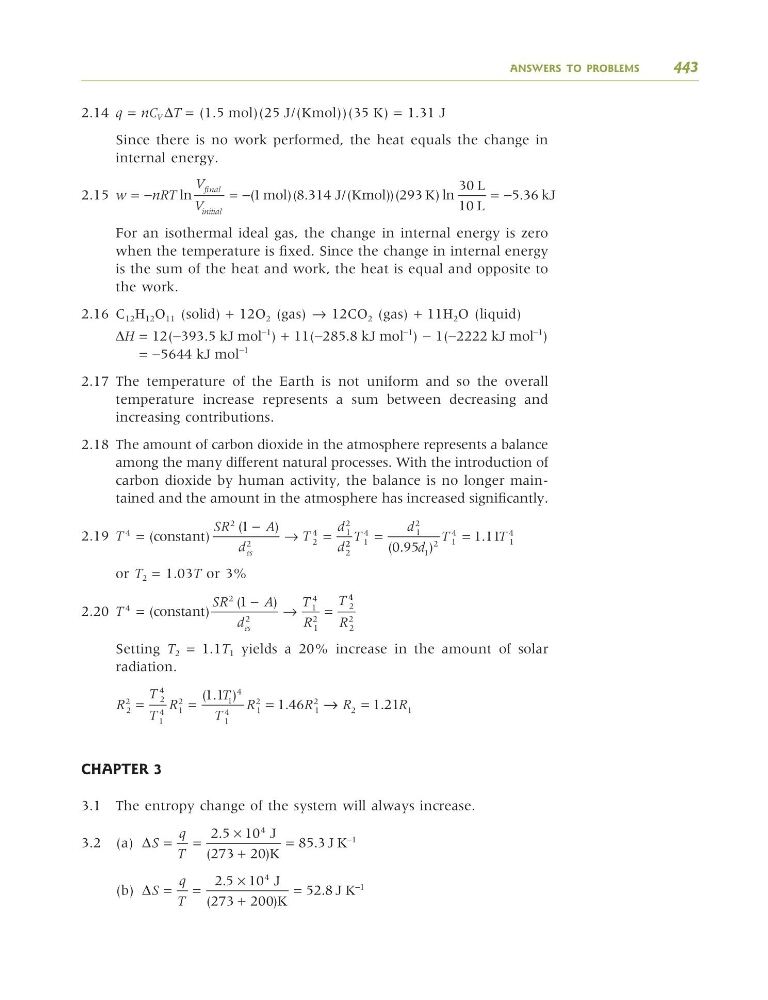
2.14 q = nC V ΔT = (1.5 mol)(25 J/(Kmol))(35 K) = 1.31 J
Since there is no work performed, the heat equals the change in
internal energy.
2.15
For an isothermal ideal gas, the change in internal energy is zero
when the temperature is fixed. Since the change in internal energy
is the sum of the heat and work, the heat is equal and opposite to
the work.
2.16 C 12 H 12 O 11 (solid) + 12O 2 (gas) → 12CO 2 (gas) + 11H 2 O (liquid)
ΔH = 12(−393.5 kJ mol
−1
) + 11(−285.8 kJ mol
−1
) − 1(−2222 kJ mol
−1
)
= −5644 kJ mol
−1
2.17 The temperature of the Earth is not uniform and so the overall
temperature increase represents a sum between decreasing and
increasing contributions.
2.18 The amount of carbon dioxide in the atmosphere represents a balance
among the many different natural processes. With the introduction of
carbon dioxide by human activity, the balance is no longer maintained and the amount in the atmosphere has increased significantly.
2.19
or T 2 = 1.03T or 3%
2.20
Setting T 2 = 1.1T 1 yields a 20% increase in the amount of solar
radiation.
CHAPTER 3
3.1 The entropy change of the system will always increase.
3.2 (a)
(b) ΔS
q
T
.
(
)
.
= =
×
+
=
−
2 5 10
273 200
52 8
4
1
J
K
J K
ΔS
q
T
.
(
)
.
= =
×
+
=
−
2 5 10
273 20
85 3
4
1
J
K
J K
R
T
T
R
T
T
R
R
2
2
2
4
1
4
1
2
1
4
1
4
1
2
1
2
1 1
1 46
( . )
.
=
=
=
→
→
= .
R
R
2
1
1 21
T
SR
A
d
T
R
T
es
4
2
2
1
4
1
2
2
1
(
)
(
)
=
−
→
=
constant
4 4
2
2
R
T
SR
A
d
T
d
d
es
4
2
2
2
4
1
2
2
1
(
)
(
)
=
−
→
=
constant
2 2
1
4
1
2
1
2
1
4
1
4
0 95
1 11
T
d
d
T
T
( .
)
.
=
=
w
nRT
V
V
nal
initial
ln
(
)( .
= −
= −
3
1
8 314
mol
J/(Km mol)
K
L
L
kJ
)(
) ln
.
293
30
10
5 36
= −
ANSWERS TO PROBLEMS
443
9781405124362_5_end.qxd 4/29/08 9:17 Page 443
Since there is no work performed, the heat equals the change in
internal energy.
2.15
For an isothermal ideal gas, the change in internal energy is zero
when the temperature is fixed. Since the change in internal energy
is the sum of the heat and work, the heat is equal and opposite to
the work.
2.16 C 12 H 12 O 11 (solid) + 12O 2 (gas) → 12CO 2 (gas) + 11H 2 O (liquid)
ΔH = 12(−393.5 kJ mol
−1
) + 11(−285.8 kJ mol
−1
) − 1(−2222 kJ mol
−1
)
= −5644 kJ mol
−1
2.17 The temperature of the Earth is not uniform and so the overall
temperature increase represents a sum between decreasing and
increasing contributions.
2.18 The amount of carbon dioxide in the atmosphere represents a balance
among the many different natural processes. With the introduction of
carbon dioxide by human activity, the balance is no longer maintained and the amount in the atmosphere has increased significantly.
2.19
or T 2 = 1.03T or 3%
2.20
Setting T 2 = 1.1T 1 yields a 20% increase in the amount of solar
radiation.
CHAPTER 3
3.1 The entropy change of the system will always increase.
3.2 (a)
(b) ΔS
q
T
.
(
)
.
= =
×
+
=
−
2 5 10
273 200
52 8
4
1
J
K
J K
ΔS
q
T
.
(
)
.
= =
×
+
=
−
2 5 10
273 20
85 3
4
1
J
K
J K
R
T
T
R
T
T
R
R
2
2
2
4
1
4
1
2
1
4
1
4
1
2
1
2
1 1
1 46
( . )
.
=
=
=
→
→
= .
R
R
2
1
1 21
T
SR
A
d
T
R
T
es
4
2
2
1
4
1
2
2
1
(
)
(
)
=
−
→
=
constant
4 4
2
2
R
T
SR
A
d
T
d
d
es
4
2
2
2
4
1
2
2
1
(
)
(
)
=
−
→
=
constant
2 2
1
4
1
2
1
2
1
4
1
4
0 95
1 11
T
d
d
T
T
( .
)
.
=
=
w
nRT
V
V
nal
initial
ln
(
)( .
= −
= −
3
1
8 314
mol
J/(Km mol)
K
L
L
kJ
)(
) ln
.
293
30
10
5 36
= −
ANSWERS TO PROBLEMS
443
9781405124362_5_end.qxd 4/29/08 9:17 Page 443