

• Closed systems: a system is described as closed when energy can be
exchanged between the system and surroundings but not matter. An
example of this is a cup of hot water that is sealed but not insulated.
The water vapor cannot escape but heat can still leave the cup.
• Isolated systems: a system can be considered to be isolated when neither matter nor energy can leave the system for the surroundings. An
example of this is a cup of hot water that is not only sealed to prevent
water vapor from escaping but is also insulated, so preventing heat from
leaving the cup.
In considering energy flow, two terms must be
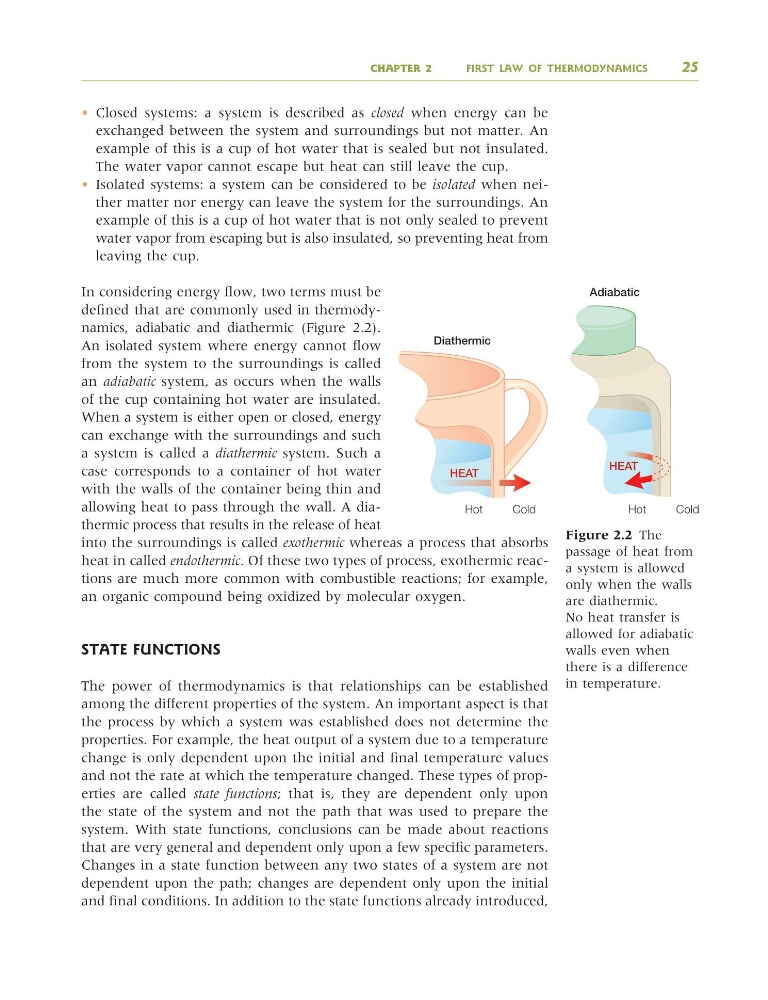
defined that are commonly used in thermodynamics, adiabatic and diathermic (Figure 2.2).
An isolated system where energy cannot flow
from the system to the surroundings is called
an adiabatic system, as occurs when the walls
of the cup containing hot water are insulated.
When a system is either open or closed, energy
can exchange with the surroundings and such
a system is called a diathermic system. Such a
case corresponds to a container of hot water
with the walls of the container being thin and
allowing heat to pass through the wall. A diathermic process that results in the release of heat
into the surroundings is called exothermic whereas a process that absorbs
heat in called endothermic. Of these two types of process, exothermic reactions are much more common with combustible reactions; for example,
an organic compound being oxidized by molecular oxygen.
STATE FUNCTIONS
The power of thermodynamics is that relationships can be established
among the different properties of the system. An important aspect is that
the process by which a system was established does not determine the
properties. For example, the heat output of a system due to a temperature
change is only dependent upon the initial and final temperature values
and not the rate at which the temperature changed. These types of properties are called state functions; that is, they are dependent only upon
the state of the system and not the path that was used to prepare the
system. With state functions, conclusions can be made about reactions
that are very general and dependent only upon a few specific parameters.
Changes in a state function between any two states of a system are not
dependent upon the path; changes are dependent only upon the initial
and final conditions. In addition to the state functions already introduced,
CHAPTER 2
FIRST LAW OF THERMODYNAMICS
25
HEAT
Adiabatic
Cold
Hot
Cold
HEAT
Diathermic
Hot
Cold
Figure 2.2 The
passage of heat from
a system is allowed
only when the walls
are diathermic.
No heat transfer is
allowed for adiabatic
walls even when
there is a difference
in temperature.
9781405124362_4_002.qxd 4/29/08 14:06 Page 25
exchanged between the system and surroundings but not matter. An
example of this is a cup of hot water that is sealed but not insulated.
The water vapor cannot escape but heat can still leave the cup.
• Isolated systems: a system can be considered to be isolated when neither matter nor energy can leave the system for the surroundings. An
example of this is a cup of hot water that is not only sealed to prevent
water vapor from escaping but is also insulated, so preventing heat from
leaving the cup.
In considering energy flow, two terms must be
defined that are commonly used in thermodynamics, adiabatic and diathermic (Figure 2.2).
An isolated system where energy cannot flow
from the system to the surroundings is called
an adiabatic system, as occurs when the walls
of the cup containing hot water are insulated.
When a system is either open or closed, energy
can exchange with the surroundings and such
a system is called a diathermic system. Such a
case corresponds to a container of hot water
with the walls of the container being thin and
allowing heat to pass through the wall. A diathermic process that results in the release of heat
into the surroundings is called exothermic whereas a process that absorbs
heat in called endothermic. Of these two types of process, exothermic reactions are much more common with combustible reactions; for example,
an organic compound being oxidized by molecular oxygen.
STATE FUNCTIONS
The power of thermodynamics is that relationships can be established
among the different properties of the system. An important aspect is that
the process by which a system was established does not determine the
properties. For example, the heat output of a system due to a temperature
change is only dependent upon the initial and final temperature values
and not the rate at which the temperature changed. These types of properties are called state functions; that is, they are dependent only upon
the state of the system and not the path that was used to prepare the
system. With state functions, conclusions can be made about reactions
that are very general and dependent only upon a few specific parameters.
Changes in a state function between any two states of a system are not
dependent upon the path; changes are dependent only upon the initial
and final conditions. In addition to the state functions already introduced,
CHAPTER 2
FIRST LAW OF THERMODYNAMICS
25
HEAT
Adiabatic
Cold
Hot
Cold
HEAT
Diathermic
Hot
Cold
Figure 2.2 The
passage of heat from
a system is allowed
only when the walls
are diathermic.
No heat transfer is
allowed for adiabatic
walls even when
there is a difference
in temperature.
9781405124362_4_002.qxd 4/29/08 14:06 Page 25