

Whereas these structures provide insight into the molecular mechanism
of transport, many questions remain. For example, how are the movements
of the substrate and ions physically coupled? A
hint is provided by the structure of a Na
+
/Cl
−
-
dependent neurotransmitter transporter. In the
structure one of the two sodium atoms bound in
the transporter comes into contact with a bound
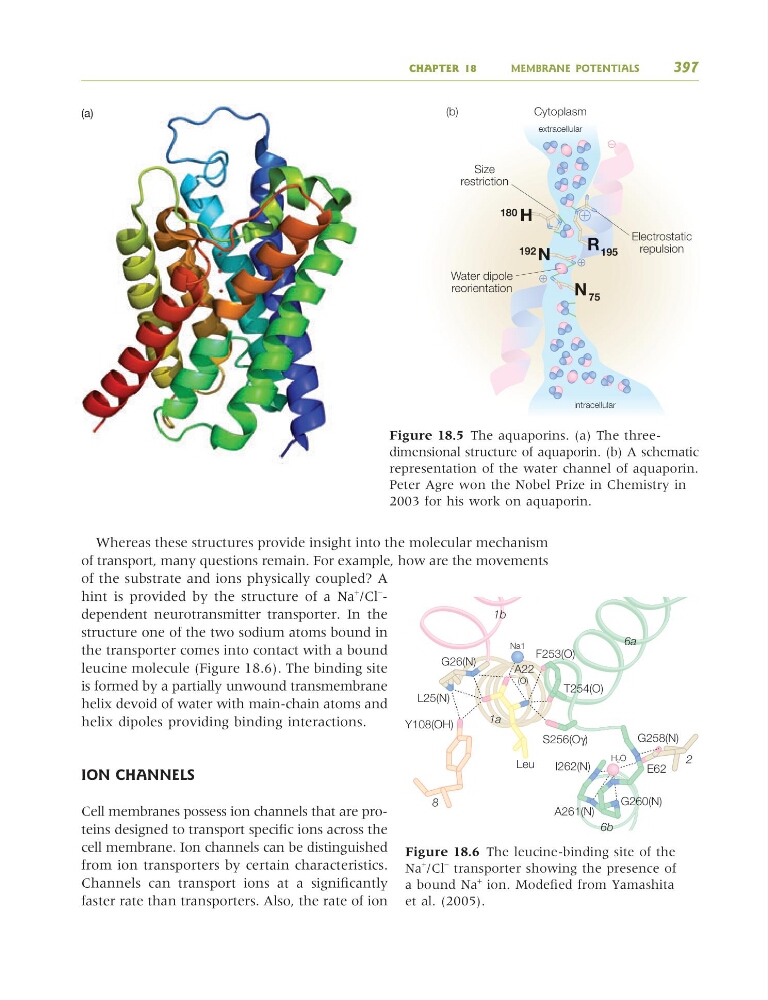
leucine molecule (Figure 18.6). The binding site
is formed by a partially unwound transmembrane
helix devoid of water with main-chain atoms and
helix dipoles providing binding interactions.
ION CHANNELS
Cell membranes possess ion channels that are proteins designed to transport specific ions across the
cell membrane. Ion channels can be distinguished
from ion transporters by certain characteristics.
Channels can transport ions at a significantly
faster rate than transporters. Also, the rate of ion
CHAPTER 18
MEMBRANE POTENTIALS
397
R 195
192
180
75
N
N
H
Water dipole
reorientation
Electrostatic
repulsion
Size
restriction
intracellular
extracellular
Cytoplasm
(b)
Figure 18.5 The aquaporins. (a) The threedimensional structure of aquaporin. (b) A schematic
representation of the water channel of aquaporin.
Peter Agre won the Nobel Prize in Chemistry in
2003 for his work on aquaporin.
Na1
A22
(O)
G26(N)
F253(O)
G258(N)
I262(N)
G260(N)
A261(N)
E62
H2O
T254(O)
S256(Oγ)
Leu
L25(N)
Y108(OH)
1b
6a
6b
2
1a
8
Figure 18.6 The leucine-binding site of the
Na
+
/Cl
− transporter showing the presence of
a bound Na
+ ion. Modefied from Yamashita
et al. (2005).
(a)
9781405124362_4_018.qxd 4/29/08 10:47 Page 397
of transport, many questions remain. For example, how are the movements
of the substrate and ions physically coupled? A
hint is provided by the structure of a Na
+
/Cl
−
-
dependent neurotransmitter transporter. In the
structure one of the two sodium atoms bound in
the transporter comes into contact with a bound
leucine molecule (Figure 18.6). The binding site
is formed by a partially unwound transmembrane
helix devoid of water with main-chain atoms and
helix dipoles providing binding interactions.
ION CHANNELS
Cell membranes possess ion channels that are proteins designed to transport specific ions across the
cell membrane. Ion channels can be distinguished
from ion transporters by certain characteristics.
Channels can transport ions at a significantly
faster rate than transporters. Also, the rate of ion
CHAPTER 18
MEMBRANE POTENTIALS
397
R 195
192
180
75
N
N
H
Water dipole
reorientation
Electrostatic
repulsion
Size
restriction
intracellular
extracellular
Cytoplasm
(b)
Figure 18.5 The aquaporins. (a) The threedimensional structure of aquaporin. (b) A schematic
representation of the water channel of aquaporin.
Peter Agre won the Nobel Prize in Chemistry in
2003 for his work on aquaporin.
Na1
A22
(O)
G26(N)
F253(O)
G258(N)
I262(N)
G260(N)
A261(N)
E62
H2O
T254(O)
S256(Oγ)
Leu
L25(N)
Y108(OH)
1b
6a
6b
2
1a
8
Figure 18.6 The leucine-binding site of the
Na
+
/Cl
− transporter showing the presence of
a bound Na
+ ion. Modefied from Yamashita
et al. (2005).
(a)
9781405124362_4_018.qxd 4/29/08 10:47 Page 397