

in the mammalian central nervous system is the amino acid glutamate.
Glutamate transporters transport three Na
+ ions and one proton across
the membrane while glutamate and one K
+ ion
are transferred in the opposite direction. The
glutamate-transporter family has properties that
are distinct from those of the major facilitator
superfamily, in particular only eight transmembrane helices. The fold of homolog of a glutamate
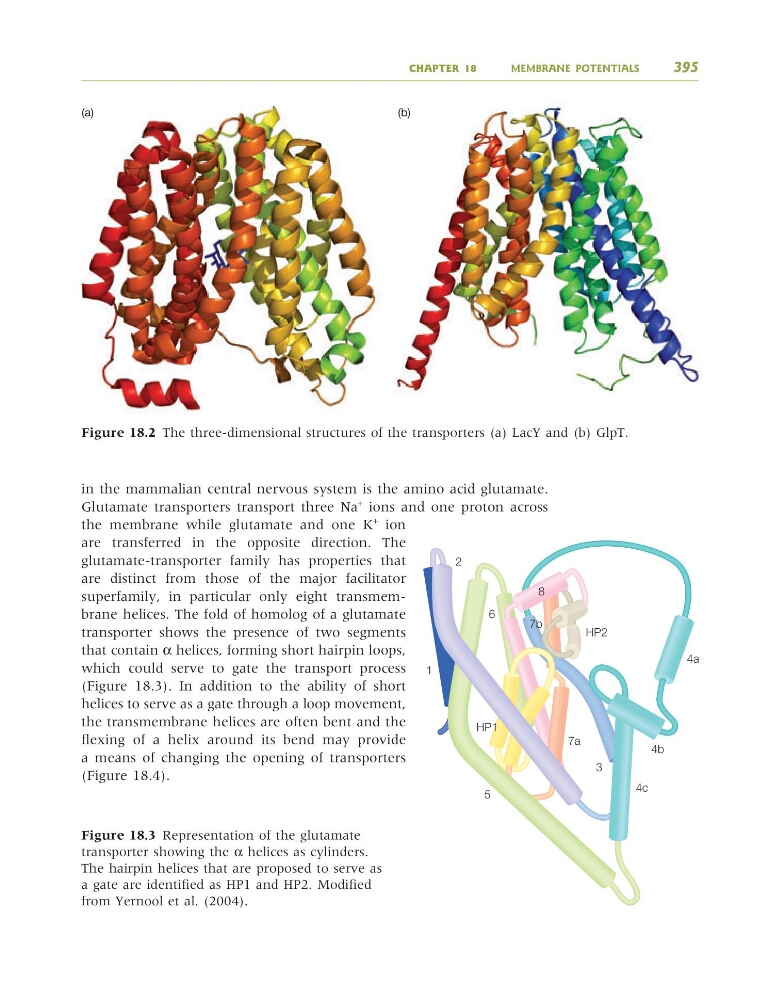
transporter shows the presence of two segments
that contain α helices, forming short hairpin loops,
which could serve to gate the transport process
(Figure 18.3). In addition to the ability of short
helices to serve as a gate through a loop movement,
the transmembrane helices are often bent and the
flexing of a helix around its bend may provide
a means of changing the opening of transporters
(Figure 18.4).
CHAPTER 18
MEMBRANE POTENTIALS
395
Figure 18.2 The three-dimensional structures of the transporters (a) LacY and (b) GlpT.
1
2
6
5
7a
3
4c
4b
4a
7b
8
HP2
HP1
Figure 18.3 Representation of the glutamate
transporter showing the α helices as cylinders.
The hairpin helices that are proposed to serve as
a gate are identified as HP1 and HP2. Modified
from Yernool et al. (2004).
(a)
(b)
9781405124362_4_018.qxd 4/29/08 10:47 Page 395
Glutamate transporters transport three Na
+ ions and one proton across
the membrane while glutamate and one K
+ ion
are transferred in the opposite direction. The
glutamate-transporter family has properties that
are distinct from those of the major facilitator
superfamily, in particular only eight transmembrane helices. The fold of homolog of a glutamate
transporter shows the presence of two segments
that contain α helices, forming short hairpin loops,
which could serve to gate the transport process
(Figure 18.3). In addition to the ability of short
helices to serve as a gate through a loop movement,
the transmembrane helices are often bent and the
flexing of a helix around its bend may provide
a means of changing the opening of transporters
(Figure 18.4).
CHAPTER 18
MEMBRANE POTENTIALS
395
Figure 18.2 The three-dimensional structures of the transporters (a) LacY and (b) GlpT.
1
2
6
5
7a
3
4c
4b
4a
7b
8
HP2
HP1
Figure 18.3 Representation of the glutamate
transporter showing the α helices as cylinders.
The hairpin helices that are proposed to serve as
a gate are identified as HP1 and HP2. Modified
from Yernool et al. (2004).
(a)
(b)
9781405124362_4_018.qxd 4/29/08 10:47 Page 395