

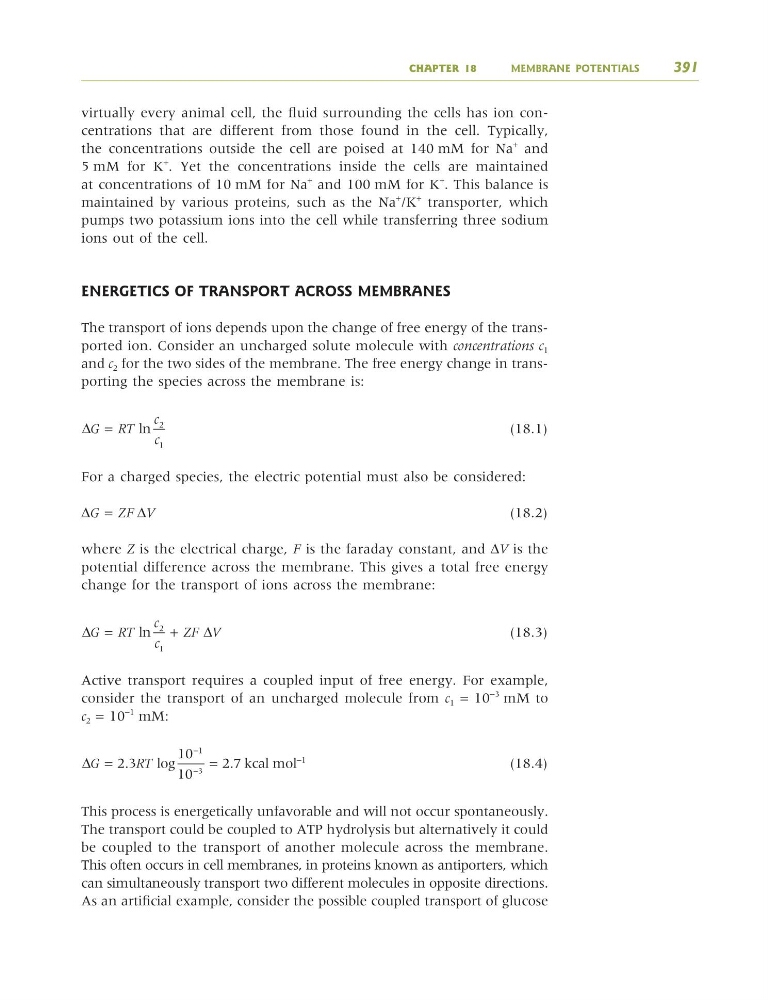
virtually every animal cell, the fluid surrounding the cells has ion concentrations that are different from those found in the cell. Typically,
the concentrations outside the cell are poised at 140 mM for Na
+ and
5 mM for K
+
. Yet the concentrations inside the cells are maintained
at concentrations of 10 mM for Na
+ and 100 mM for K
+
. This balance is
maintained by various proteins, such as the Na
+
/K
+ transporter, which
pumps two potassium ions into the cell while transferring three sodium
ions out of the cell.
ENERGETICS OF TRANSPORT ACROSS MEMBRANES
The transport of ions depends upon the change of free energy of the transported ion. Consider an uncharged solute molecule with concentrations c 1
and c 2 for the two sides of the membrane. The free energy change in transporting the species across the membrane is:
(18.1)
For a charged species, the electric potential must also be considered:
ΔG = ZF ΔV
(18.2)
where Z is the electrical charge, F is the faraday constant, and ΔV is the
potential difference across the membrane. This gives a total free energy
change for the transport of ions across the membrane:
(18.3)
Active transport requires a coupled input of free energy. For example,
consider the transport of an uncharged molecule from c 1 = 10
−3 mM to
c 2 = 10
−1 mM:
(18.4)
This process is energetically unfavorable and will not occur spontaneously.
The transport could be coupled to ATP hydrolysis but alternatively it could
be coupled to the transport of another molecule across the membrane.
This often occurs in cell membranes, in proteins known as antiporters, which
can simultaneously transport two different molecules in opposite directions.
As an artificial example, consider the possible coupled transport of glucose
ΔG
RT
.
log
.
=
=
−
−
−
2 3
10
10
2 7
1
3
1
kcal mol
Δ
Δ
G RT
c
c
ZF V
ln
=
+
2
1
ΔG RT
c
c
ln
=
2
1
CHAPTER 18
MEMBRANE POTENTIALS
391
9781405124362_4_018.qxd 4/29/08 10:46 Page 391
the concentrations outside the cell are poised at 140 mM for Na
+ and
5 mM for K
+
. Yet the concentrations inside the cells are maintained
at concentrations of 10 mM for Na
+ and 100 mM for K
+
. This balance is
maintained by various proteins, such as the Na
+
/K
+ transporter, which
pumps two potassium ions into the cell while transferring three sodium
ions out of the cell.
ENERGETICS OF TRANSPORT ACROSS MEMBRANES
The transport of ions depends upon the change of free energy of the transported ion. Consider an uncharged solute molecule with concentrations c 1
and c 2 for the two sides of the membrane. The free energy change in transporting the species across the membrane is:
(18.1)
For a charged species, the electric potential must also be considered:
ΔG = ZF ΔV
(18.2)
where Z is the electrical charge, F is the faraday constant, and ΔV is the
potential difference across the membrane. This gives a total free energy
change for the transport of ions across the membrane:
(18.3)
Active transport requires a coupled input of free energy. For example,
consider the transport of an uncharged molecule from c 1 = 10
−3 mM to
c 2 = 10
−1 mM:
(18.4)
This process is energetically unfavorable and will not occur spontaneously.
The transport could be coupled to ATP hydrolysis but alternatively it could
be coupled to the transport of another molecule across the membrane.
This often occurs in cell membranes, in proteins known as antiporters, which
can simultaneously transport two different molecules in opposite directions.
As an artificial example, consider the possible coupled transport of glucose
ΔG
RT
.
log
.
=
=
−
−
−
2 3
10
10
2 7
1
3
1
kcal mol
Δ
Δ
G RT
c
c
ZF V
ln
=
+
2
1
ΔG RT
c
c
ln
=
2
1
CHAPTER 18
MEMBRANE POTENTIALS
391
9781405124362_4_018.qxd 4/29/08 10:46 Page 391